World Wildlife Day 2026
World Wildlife Day 2026
Key Takeaways
· India actively supports in-situ conservation through MPCDAs, ex-situ cultivation and resource augmentation under Central Sector Scheme on Conservation, Development and Sustainable Management of Medicinal Plants of NMPB Ministry of Ayush.
Introduction
Every year on 3 March, the world observes World Wildlife Day, proclaimed by the United Nations to celebrate wild fauna and flora and to raise awareness about their importance to people and the planet. The day marks the adoption of the Convention on International Trade in Endangered Species of Wild Fauna and Flora (CITES), reinforcing global commitment to ensuring that trade in wildlife does not threaten species survival. The day underscores that wildlife is not merely part of nature’s beauty, but a critical pillar of food security, healthcare, livelihoods, climate resilience, and sustainable development. At a time when biodiversity faces mounting pressure from habitat destruction, overexploitation, illegal trade, and climate change, World Wildlife Day serves as a global call to conserve and sustainably use biological resources for present and future generations.
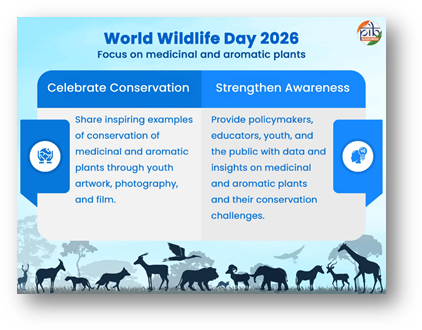
The theme for World Wildlife Day 2026 – “Medicinal and Aromatic Plants: Conserving Health, Heritage and Livelihoods” – highlights the importance of plants used for medicine, their role in preserving cultural traditions, and the income they provide to local communities. Across the world, 70–95% of people in developing countries depend on traditional medicine for basic healthcare, much of it derived from plant-based resources. Medicinal and aromatic plants form the foundation of traditional systems of medicine and also contribute significantly to modern pharmaceuticals. Beyond their health applications, these plants strengthen ecosystems by supporting pollinators, improving soil health, and enhancing biodiversity. Their conservation is therefore a global priority, especially for biodiversity-rich countries like India.
India’s Rich Biodiversity of Medicinal and Aromatic Plants
For India, the 2026 theme carries particular significance. India is one of the 17 mega biodiversity-rich countries in the world and has 7% of the world’s bio-diversity. It has 15 agro-climatic regions, 45,000 different plant species out of which 15,000 are medicinal plants. Of these, about 8,000 species are used in Indian systems of medicine and folk medicines. Nearly 70% of India’s medicinal and aromatic plants (MAPs) are found in the tropical forests of the Western and Eastern Ghats, the Himalayas, and the Aravalli range.
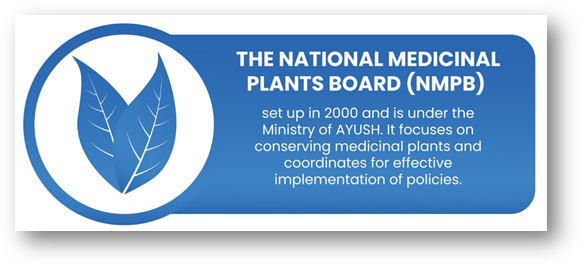
The Botanical Survey of India has identified over 5,250 plant species and documented over 9,567 folk claims for various ailments. India has been taking strong steps to protect this rich heritage. The National Medicinal Plants Board (NMPB) runs a dedicated scheme for the conservation and sustainable management of medicinal plants. It supports Conservation, IEC activities, farmer training, research & Development and marketing. These efforts reflect India’s strong and unwavering commitment to protecting its rich
medicinal plant heritage.
Conservation Mechanisms
India has adopted a strong and multi-layered approach to conserve its rich medicinal and aromatic plant heritage.
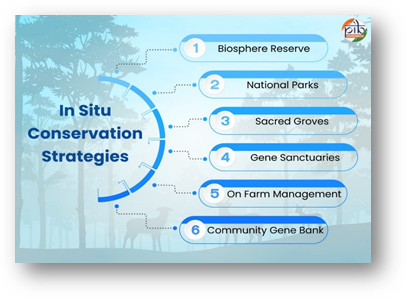
In situ conservation means protecting plants and animals in their natural habitats. It is carried out through national parks, biosphere reserves and gene sanctuaries. One important example of such conservation for medicinal plants is the Medicinal Plants Conservation Area initiative (MPCA). MPCA is a designated site aimed at protecting medicinal plant species in their natural habitats. Presently, 115 MPCA sites in India represent models to implement indigenous health traditions along with biological and cultural diversity using in-situ conservation techniques.
Ex-Situ Conservation
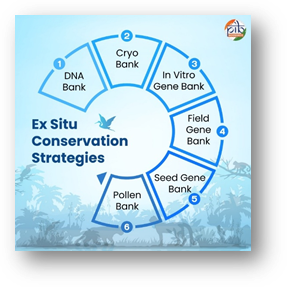
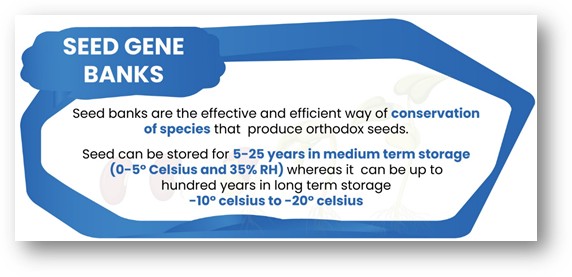
Ex situ conservation means protecting plant genetic resources outside their natural habitats under controlled conditions to ensure long-term preservation and possible reintroduction into the wild. In India, this includes the conservation of 9,361 medicinal and aromatic plant (MAP) accessions at the National Seed Gene Bank, National Bureau of Plant Genetic Resources (NBPGR), New Delhi. These ex-situ methods are used for species with poor seed formation or vegetative propagation. Together, they help secure medicinal plant diversity for future use.
Key Government Schemes and Initiatives
The Government has launched several key schemes and initiatives to promote the conservation, cultivation, and sustainable use of medicinal plants across the country.
National Ayush Mission (NAM)
In the past Ministry of Ayush had implemented Medicinal Plant Component under the National Ayush Mission (NAM) a flagship scheme of the Ministry of AYUSH through States and Union Territories to promote the cultivation of medicinal plants integrated with farming systems to support crop diversification and enhance farmer incomes from the financial year 2015-16 to 2020-21.
Currently, Ministry of Agriculture and Farmers Welfare under its Mission for Integrated Development of Horticulture (MIDH) – A Centrally Sponsored Scheme is promoting the holistic growth of the horticulture sector including medicinal plants. All States and UTs are covered under MIDH.
Aushadhi Vanaspati Mitra Program (AVMP)
NMPB Ministry of Ayush recognizes and rewards individuals, communities, and institutions for their outstanding contribution to medicinal plant conservation, cultivation, and marketing. It encourages more people to actively participate in protecting medicinal plants.
Central Sector Scheme for Conservation, Development and Sustainable Management of Medicinal Plants
The Government of India, through NMPB, runs this flagship scheme with an outlay of ₹322.41 crores for 2021-22 to 2025-26. Under this scheme, Medicinal Plants Conservation and Development Areas (MPCDAs) are set up to protect plants in their natural habitats. The conservation initiatives are also promoted by supporting plantations on degraded and rural lands. Research and quality assurance are key focus areas, supported through GACPs and Raw Drug Repositories across the country.
e-CHARAK
To provide a platform for trade of Medicinal Plants & to provide easy market access National Medicinal Plants Board (NMPB), Ministry of AYUSH has launched “e-CHARAK” mobile application as well as web portal for the promotion and marketing of medicinal plants/herbs. “e-CHARAK” is a platform to enable information exchange between various stakeholders mainly farmers involved in the medicinal plants sector across the country. The “e-CHARAK” application is available in different local languages. Fortnightly market price of 100 MPs from 25 herbal markets across India is updated regularly on e-Charak platform.
Herbal Gardens and Awareness Programs
Herbal gardens are promoted in schools, institutions, and public spaces to build awareness among students and the general public. Species-specific campaigns are also run on and print media to highlight the importance of medicinal plants in daily life.
Livelihood Support to Local Communities
The scheme provides financial and infrastructural support to Joint Forest Management Committees, Self Help Groups, Van Panchayats, and Biodiversity Management Committees. This helps local communities with value addition, drying, warehousing, and marketing of medicinal plants, directly improving their livelihoods.
Bilateral and International Cooperation
NMPB, Ministry of Ayush actively collaborates with international organisations to promote the medicinal plant sector globally. It also participates in international exhibitions and works to protect India’s traditional knowledge and ensure fair benefit-sharing under global agreements.
Integrated Component (IC)
NMPB, Ministry of Ayush, Government of India is implementing a component namely “Forward and backward linkage in supply chain of medicinal plants (Integrated Component)” under Central Sector Scheme on “Conservation, Development and Sustainable Management of Medicinal Plants” throughout the country wherein the following activities are being supported under the Integrated Component:
Medicinal Plants Business Centre (MPBC)
NMPB, Ministry of Ayush recently incorporated a new component “Medicinal Plants Business Centre (MPBC)” under the existing Central Sector Scheme of NMPB with following objectives: –
• To develop Medicinal Plants Business Centre for effectively managing Medicinal Plants produce
• To promote innovative and latest technologies in Medicinal Plants post-harvest management and marketing infrastructure.
• To promote creation of scientific storage capacity for storing farm produce, graded/primaryprocessedfarmproducetoreducepost-harvestandhandlinglosses.
• To provide infrastructure facilities for washing, sorting, grading, value addition, packaging, storage and quality testing of Medicinal Plants raw material.
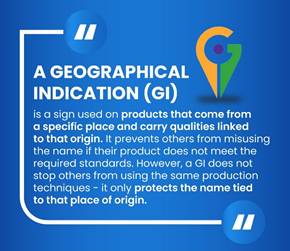
Protecting India’s Medicinal Plant Heritage Through GI Tags
Conclusion
India’s journey in protecting its medicinal and aromatic plant heritage is a story of deep roots and forward vision. From the forests of the Western Ghats to the farms of Vidarbha, from ancient Ayurvedic wisdom to modern digital platforms like e-CHARAK, the country is weaving conservation, livelihood, and healthcare into a single strong thread. With committed institutions, empowered communities, and inclusive policies, India is not just preserving its green wealth, it is turning it into a source of health, pride, and prosperity for generations to come.
References
United Nations
https://www.un.org/en/observances/world-wildlife-day
CITES
https://cites.org/sites/default/files/eng/events/wwd/2026/WWD2026_ConceptNote_EN.pdf
Press Information Bureau
https://www.pib.gov.in/PressReleasePage.aspx?PRID=2209245®=3&lang=2
https://www.pib.gov.in/PressReleasePage.aspx?PRID=2232271&v=4®=3&lang=2&v=1
Ministry of AYUSH
https://namayush.gov.in/content/operational-guidelines-medicinal-plants
https://namayush.gov.in/sites/default/files/FAQ.pdf
https://namayush.gov.in/content/operational-guidelines-medicinal-plants
National Medicinal Plants Board
Others
mission/pdf/OperationalGuideline/Operational%20Guidelines-%20Medicinal%20Plants.pdf
https://www.wipo.int/en/web/geographical-indications