Women in Science are Catalysts of “Viksit Bharat”: Dr. Jitendra Singh at National Science Day Celebration 2026
Women in Science are Catalysts of “Viksit Bharat”: Dr. Jitendra Singh at National Science Day Celebration 2026
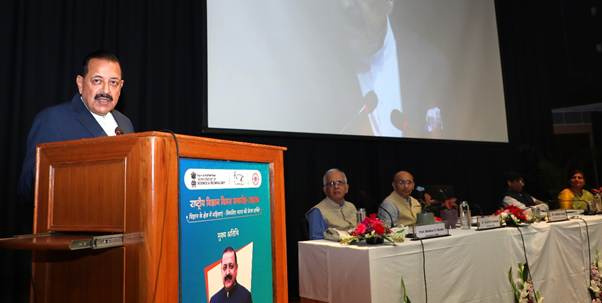
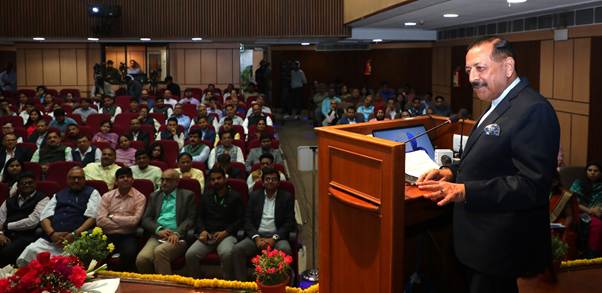
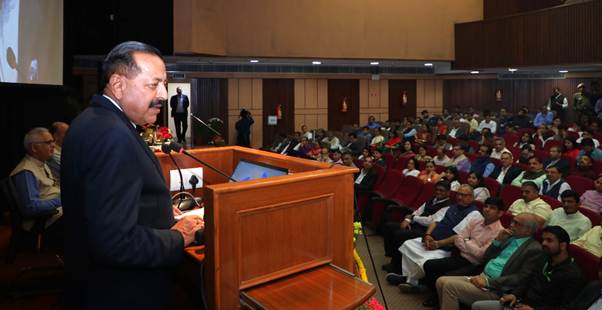
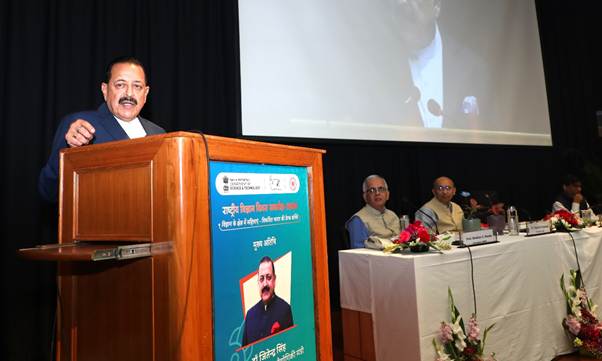
Union Minister of State (Independent Charge) for Science & Technology, Earth Sciences, MoS PMO, Personnel, Public Grievances, Pensions, Atomic Energy and Space, Dr. Jitendra Singh, today said that women in science are not merely participants but powerful “catalysts” in India’s journey towards Viksit Bharat. Addressing the National Science Day Celebration–2026 at the INSA Auditorium, New Delhi, the Minister underlined that scientific growth and national development are inseparable, and that inclusive participation especially of women is essential to sustaining India’s innovation momentum.
Speaking on the focal theme “Women in Science: Catalyzing Viksit Bharat,” Dr. Jitendra Singh emphasized that India’s scientific ecosystem must nurture talent across gender and geography. He highlighted the growing representation of women in research, leadership positions and innovation-driven sectors, noting that the transformation of India’s science landscape requires both policy support and institutional commitment.
Dr. Jitendra Singh further observed that India’s science policy framework has increasingly focused on enabling ecosystems rather than isolated achievements. He stressed that sustained institutional support, early-stage mentoring, and translational pathways are critical to ensuring that research outcomes convert into tangible societal impact. He noted that initiatives announced during the celebration reflect a continuum from student engagement to innovation clusters—designed to strengthen India’s long-term scientific capacity.
The Minister also underlined that science communication and public engagement are central to building a scientific temperament. He said that empowering young students, particularly girls, through structured exposure to laboratories and research institutions will create a multiplier effect in the years ahead. He emphasized that India’s demographic dividend must be aligned with its scientific aspirations to achieve the goals of Viksit Bharat.
During the programme, several key initiatives were launched and released. These included the Hydrogen Valley Innovation Cluster and the ANRF-Venture Centre Outreach Initiative. The Mission Innovation India Report was also released, along with the book Indigenous Architecture of Northeast India. A DST-supported technology on copper-doped nano titania coating for heritage stones was formally transferred to M/s Rebuild Technologies Services Pvt. Ltd., marking a significant step towards translating laboratory research into societal applications.
The Copper-Doped Nano Titania (Cu–TiO₂) coating technology represents an advanced scientific solution for the preservation of heritage stone monuments. The technology, developed through nano-titania and Cu-doped nano-titania coatings embedded in a Paraloid B-72 matrix, has demonstrated enhanced hydrophobicity, UV resistance and aesthetic compatibility for marble, sandstone and granite surfaces. The Cu-doped formulation retained high hydrophobic performance even after prolonged UV exposure, underscoring its durability and suitability for long-term conservation of heritage structures.
Another significant announcement was the launch of the “Engage with Science” Programme, conceptualized by the National Council for Science & Technology Communication (NCSTC), DST. The programme aims to provide immersive, one-week residential exposure to students of Classes 8 and 9 across 16 autonomous DST institutions, encouraging early interest in research and development. The initiative spans seven thematic areas including Materials Science, Biological Sciences, Astronomy, Medical Technology, Indigenous Knowledge Systems and Earth Sciences, thereby fostering scientific curiosity among young learners and nurturing future scientific ambassadors.
In his welcome address, Prof. Abhay Karandikar, Secretary, Department of Science and Technology, highlighted DST’s continued efforts to build a robust and inclusive research ecosystem. He emphasized the importance of strengthening innovation clusters, promoting translational research, and ensuring that scientific outcomes are effectively aligned with national priorities. He underscored that initiatives such as the Hydrogen Valley Innovation Cluster and the ANRF outreach efforts are designed to deepen industry-academia collaboration and accelerate research-to-market pathways.
Dr. Rajesh Gokhale, Secretary, Department of Biotechnology, stressed the need to integrate biological sciences and biotechnology innovations with national development missions. He spoke about strengthening institutional linkages, promoting interdisciplinary research, and leveraging innovation ecosystems to ensure that biotechnology solutions contribute meaningfully to healthcare, agriculture and sustainable development goals.
Further, Dr. Jitendra Singh, reiterated that India’s scientific advancement must be measured not only by global rankings but by its capacity to deliver solutions for its people. He emphasized that initiatives such as hydrogen innovation clusters, outreach programmes and technology transfers represent a shift towards mission-driven science with societal relevance. He called upon scientific institutions to maintain momentum, deepen collaboration and ensure that the spirit of National Science Day translates into year-round action.
Concluding the programme, the Minister stated that National Science Day is not merely a commemorative event but a reaffirmation of India’s scientific resolve. He emphasized that the initiatives launched reflect the Government’s commitment to empowering women scientists, strengthening indigenous innovation, preserving cultural heritage through science, and nurturing the next generation of researchers in alignment with the vision of Viksit Bharat.