Women in Indian Armed Forces – Expanding Roles and Opportunities
Women in Indian Armed Forces – Expanding Roles and Opportunities
Key Takeaways
Introduction
International Women’s Day provides an opportunity to reflect on the expanding roles and rising leadership of women across diverse spheres of life. Among these, their growing presence in the Indian Armed Forces stands out as a significant milestone. From operational duties to leadership positions, women are increasingly shaping the country’s defence landscape with professionalism and dedication. Over the past decades, their integration has emerged as one of the most significant institutional transformations in India’s defence sector. From a historically limited presence largely confined to medical and nursing roles, women’s participation has steadily expanded through progressive policy reforms, judicial support, and sustained institutional efforts aligned with national goals of gender equity and operational inclusivity.
Today, women officers are increasingly undertaking commanding, strategic, and decision-making responsibilities across the Army, Navy, and Air Force – marking a new era of inclusivity, professionalism, and strengthened operational capability in India’s defence forces.
Historical Trajectory of Women in India’s Defence Services
The role of women in India’s defence services has evolved steadily from limited support functions to increasingly diverse operational and leadership positions. Beginning with their induction into the Armed Forces Medical Services, women gradually entered other branches through short service commissions and specialised roles. Over the years, progressive policy reforms and judicial interventions have expanded their opportunities across the Army, Navy, and Air Force. This historical progression sets the foundation for understanding the transformative changes underway today.
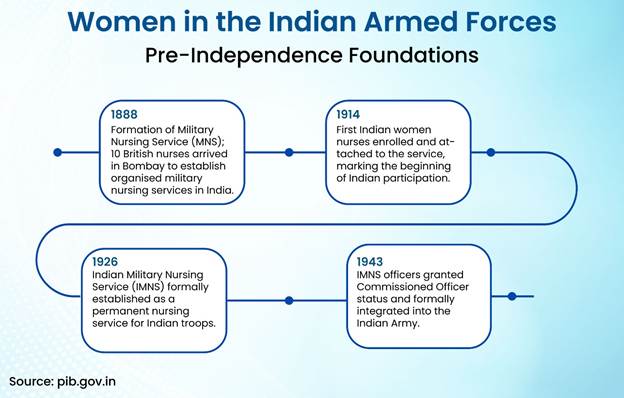
Post-independence, women’s roles in the Indian Armed Forces evolved from medical support to broader officer-level inductions and operational contributions, aligning with India’s commitment to gender equality and national security.
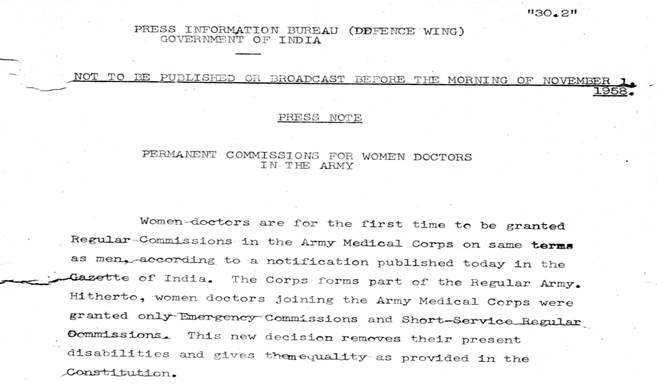
In 1958, for the first time, women doctors were granted Regular Commissions in the Army Medical Corps on same terms as men.[1]
In 1992, the Indian Armed Forces opened officer-level entry to women. The Indian Army introduced the Women Special Entry Scheme (WSES), allowing women to be commissioned in non-combat branches, while also extending eligibility to widows of service personnel killed in action as a compassionate measure.[2]
The same year witnessed parallel progress across the other services. The Indian Navy inducted women officers for the first time, while the Indian Air Force began commissioning women as Short Service Commission officers in Flying, Technical, and Non-Technical branches. Collectively, these initiatives in 1992 represented a decisive shift in India’s defence policy, laying the foundation for the gradual expansion of women’s roles across the Armed Forces.[3]
Advancing Gender Inclusion in India’s Defence Services [4]
As part of sustained measures to enhance women’s participation in the Armed Forces, significant reforms have been introduced to expand the career avenues and leadership roles among women. Women officers are now being considered for promotion to the rank of Colonel (Select Grade) and are being assigned command appointments. To prevent any adverse impact on career progression, specific waivers have been granted for officers who were unable to complete mandatory career courses during the transition phase.[5]
Building on these broader reforms, each Armed Service has undertaken focused initiatives to integrate women more deeply into leadership roles.
Indian Army
· To ensure long-term career stability, Women Officers are being granted Permanent Commission in 12 Arms and Services, in addition to the Army Medical Corps, Army Dental Corps, and Military Nursing Service.[6]
Indian Navy
· Advancing operational integration at sea, Women Officers are now deployed onboard warships in afloat appointments and are also appointed as Pilots and Naval Air Operations (NAO) officers.[7]
· Expanding entry opportunities, the Navy has opened all branches and specialisations except submarines to women for induction as officers and Agniveers, becoming the first Service to leverage the Agnipath scheme for women’s recruitment.[8]
· In the aviation domain, women officers are now eligible to join the Remotely Piloted Aircraft (RPA) stream, with the first officer joining an RPA Squadron in 2021.[9]
· Furthermore, at the Indian Naval Academy, women cadets have been made eligible for induction through the 10+2 B.Tech entry scheme from January 2024.[10]
Indian Air Force
· While IAF was the first one to induct women as pilots in 1990s in combat support role. In a landmark reform, the induction of Women Officers into combat roles – initially introduced on an experimental basis in 2015 – was formalised as a permanent scheme in 2022, thereby opening fighter and other combat streams on equal footing.[11]
· Complementing this, vacancies have been provided under the NCC Special Entry scheme for Short Service Commission (Women) in the flying branch since 2017.[12]
· Moreover, the intake of women cadets through the NDA has been institutionalised, with six vacancies (2 for Flying, 2 for Ground Duty (Tech), and 2 for Ground Duty (Non-Tech)) per course allocated for the Air Force up to 2027.[13]
· Since 02 December 2023, Agniveer Vayu Women (AgV W) have proudly joined the ranks of the Indian Air Force, reflecting the force’s steadfast commitment to empowering women and fostering an inclusive military environment.[14]
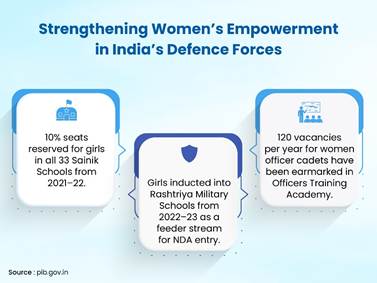
Together, these service-specific measures demonstrate a coordinated and progressive expansion of women’s participation across operational, technical, and leadership roles in India’s Armed Forces. In 2025, 17 women cadets graduated from the National Defence Academy in May and 15 more in November[15], highlighting the continued expansion of opportunities for women since their induction into the NDA in 2022. As of early 2026, a total of 158 women cadets have joined the Academy. Moreover, as of March 2025, Haryana accounts for the highest number of women cadets at the NDA with 35 cadets, followed by Uttar Pradesh with 28 and Rajasthan with 13. The Army has progressively enhanced annual intake of women cadets from 80 to 144 vacancies (80% increase) in 2024.[16]
Women Officers Breaking New Ground in the Armed Forces
Women in the Indian Armed Forces have made significant strides in leadership, operational deployments, and global representation, reflecting a sustained push toward greater gender inclusion across all three Services.
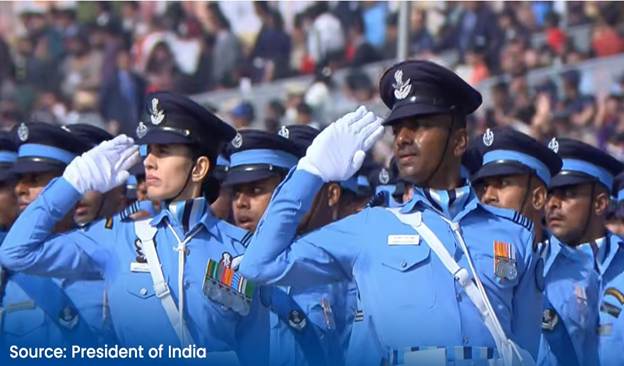
In 2025, a tri-services all-women sailing expedition saw 11 officers from the Army (Lt Col Anuja, Maj Karamjeet, Maj Tanyah, Capt Omita, Capt Dauli and Capt Prajakta), Navy (Lt Cdr Priyanka), and Air Force (Sqn Ldr Vibha, Sqn Ldr Shraddha, Sqn Ldr Aruvi and Sqn Ldr Vaishali) complete a 1,800-nautical-mile voyage to Seychelles aboard the indigenous vessel Triveni, showcasing operational competence and joint-service coordination.[17] Their growing presence was further highlighted when the Indian Air Force inducted nine women Agniveervayu into its band for the 77th Republic Day Parade, and Flight Lieutenant Akshita Dhankar unfurled the national flag alongside the President -marking a powerful symbol of women’s expanding leadership in India’s defence forces.
Women at the Helm: Leadership Roles Undertaken by Women in Uniform
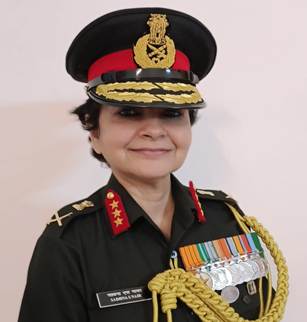
Lt Gen Sadhna Saxena Nair – The Indian Army has witnessed a steady rise in the number of women officers attaining senior leadership positions. In a significant milestone, Sadhna Saxena Nair was appointed as Director General Medical Services (Army), marking a historic achievement as she became the first woman to hold this top position in the Army’s medical wing. Her appointment reflects the growing role of women in key decision-making and strategic leadership positions within the Armed Forces.[18]
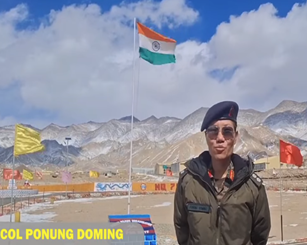
Colonel Ponung Doming – Colonel Ponung Doming from the Indian Army is the first woman officer to command the world’s highest Border Task Force located above 15,000 feet in the Northern sector with multiple firsts to her credit in over 20 years of service.[19]
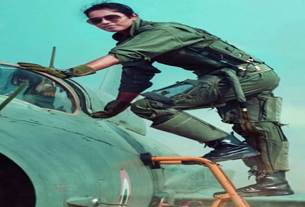
Squadron Leader Bhawana Kanth was the first day-time Indian woman fighter pilot to qualify to undertake combat missions.[20] She was the first woman fighter pilot to take part in the Republic Day Parade (2021). She also participated in the Republic Day 2024 Flypast becoming a part of the revered fighter pilot club in India.[21]
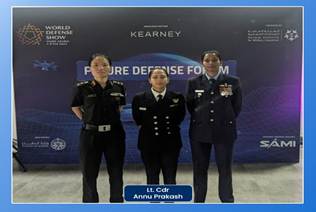
Lieutenant Commander Annu Prakash of the Indian Navy brought her expertise in maritime security and operations to the forefront. Her participation underscored the crucial role women play in safeguarding India’s vast coastline and ensuring regional stability.[22]
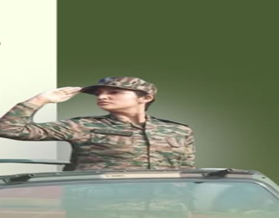
Captain Hansja Sharma – Captain Hansja Sharma made history by becoming the first woman Rudra helicopter pilot in the Indian Army. She led the 251 Army Aviation Squadron on the Republic Day 2026.[23]
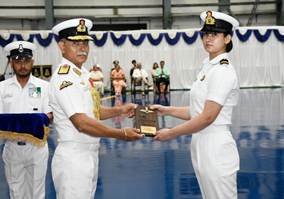
Sub Lieutenant Aastha Poonia – Sub Lieutenant Aastha Poonia made history in 2025 becoming the First Woman Pilot to be streamed into the Fighter stream of Naval Aviation, breaking gender barriers in a traditionally male-dominated field. She was awarded the prestigious Wings of Gold during the Second Basic Hawk Conversion Course graduation at INS Dega, Visakhapatnam.[24]
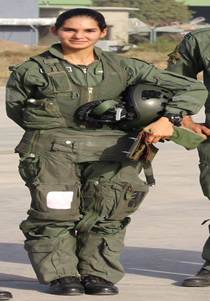
Squadron Leader Avani Chaturvedi – Avani Chaturvedi became the first woman fighter pilot of the Indian Air Force (IAF) to take part in an aerial wargame abroad. Ms Chaturvedi, a Su-30MKI pilot, was part of the IAF contingent that participated in a 16-day mega air combat exercise with the Japan Air Self-Defense Force (JASDF) at the Japanese airbase of Hyakuri.
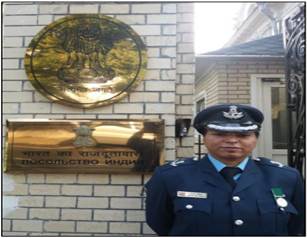
Squadron Leader Shivani Singh – Squadron Leader Shivangi Singh became India’s first woman Rafale pilot – an achievement that highlights the growing expertise and operational excellence of women in the Indian Air Force.[25]
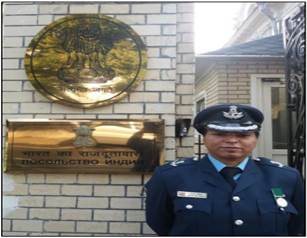
Wg Cdr Anjali Singh – Wing Commander Anjali Singh of the Indian Air Force became the first Indian woman military diplomat to be posted to an overseas mission. Her appointment as Deputy Air Attaché at the Embassy of India in Russia marked a historic milestone, highlighting the growing leadership of women in the armed forces.
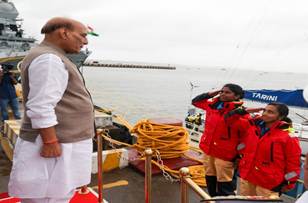
Lt Cdr Dilna K & Lt Cdr Roopa A – Lt Cdr Dilna K and Roopa A scripted history by completing a 25,600-nautical-mile global circumnavigation aboard the INSV Tarini under the Navika Sagar Parikrama II expedition. Their 238-day voyage stands as a powerful testament to Nari Shakti in the Indian Navy, showcasing courage, endurance, and the expanding leadership of women across the world’s oceans.[26]
Awards and Recognitions
UN Secretary-General’s Gender Award – 2025 (Gender Category): Major Swathi Shanthakumar, from the Indian Army, was honoured with the UN Secretary-General’s Award 2025 in the Gender Category for her work on the “Equal Partners, Lasting Peace” initiative while serving with the United Nations Mission in South Sudan (UNMISS). The recognition highlights her role in enhancing gender-responsive peacekeeping and grassroots engagement in conflict-affected regions.[27]
Army Day Awards (January 2025): At the Army Day Awards in January 2025, the NCC Girls Contingent received an Army award for the first time for marching in the Army Day Parade reflecting growing institutional recognition of women’s expanding role and participation.[28]
UN Recognition (2023, Highlighted in Ongoing Legacy): Major Radhika Sen has been named the “Military Gender Advocate of the Year 2023” by the UN Headquarters, recognizing the significant contributions of Indian women to UN peacekeeping efforts. Major Radhika Sen has been selected to be awarded with “Military Gender Advocate of the Year 2023” by the UN Headquarters, which is a testament to the positive contribution of the Indian Women in the UN peacekeeping initiatives.[29]
Global Contributions and Peacekeeping Achievements
India’s commitment to advancing gender parity in global peacekeeping is reflected in its growing deployment of women personnel across United Nations missions. As of mid-2025, more than 154 Indian women are serving in six UN peacekeeping operations, underscoring the country’s proactive role in promoting inclusive security frameworks. In alignment with the UN Gender Parity Strategy – which targets 15% women in military troop contingents and 25% women as staff officers or observers by 2028 – India has already achieved 22% representation in the staff officer and observer category, demonstrating meaningful progress toward global gender inclusion goals in peacekeeping operations.[30]
Way Forward
In 2014, the combined strength of women officers in the Indian Army, Navy, and Air Force was approximately 3,000. This number has since risen to over 11,000, reflecting not only quantitative growth but also a broader shift in institutional outlook.[31]
The future trajectory for women in the Indian Armed Forces points toward substantially larger participation, driven by ongoing reforms, Nari Shakti initiatives, and institutional commitments to gender equity. Progressive expansion in recruitment – through increased vacancies at the National Defence Academy, gradual induction of women into other ranks, and equal-opportunity policies -will enable women officers to shoulder greater responsibilities across services.
References:
Press Information Bureau
Ministry of Defence
DD News
Ministry of External Affairs
United Nations
Indian Navy
Women in Indian Armed Forces – Expanding Roles and Opportunities