Uttar Pradesh Signed Reform‑Linked MoU under Jal Jeevan Mission 2.0
Uttar Pradesh Signed Reform‑Linked MoU under Jal Jeevan Mission 2.0
In a significant step towards deepening structural reforms in rural drinking water governance, a Reform‑Linked Memorandum of Understanding (MoU) under Jal Jeevan Mission (JJM) 2.0 was signed today with the State of Uttar Pradesh, marking the State’s formal entry into the reform‑linked implementation framework of the Mission. Jal Jeevan Mission 2.0 was approved by the Union Cabinet on 10 March 2026.
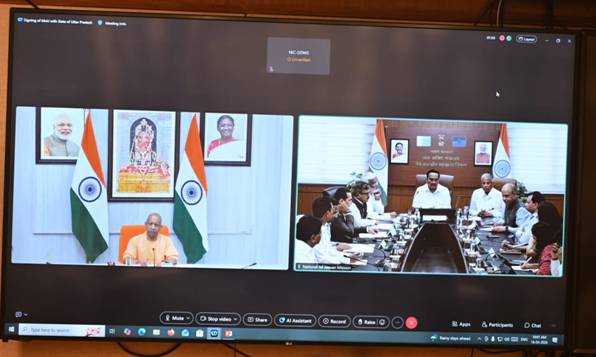
The MoU was signed in the presence of Union Minister of Jal Shakti, Shri C. R. Paatil, and Chief Minister of Uttar Pradesh, Shri Yogi Adityanath, who joined the event through video conferencing. Shri V Somanna, Minister of State, Ministry of Jal Shakti, Shri Swatantra Dev Singh, Minister of Jal Shakti, Uttar Pradesh was present in person for the MoU signing.
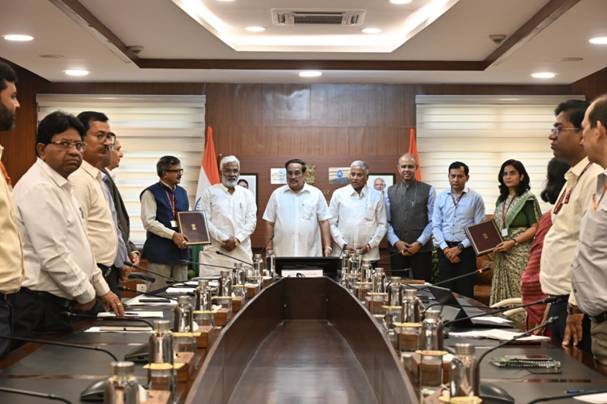
The MoU was signed and exchanged between Smt. Swati Meena Naik, Joint Secretary (Water), DDWS, Ministry of Jal Shakti, and Shri Anurag Srivastava, Additional Chief Secretary, Namami Gange and Rural Water Supply Department, Government of Uttar Pradesh.
Senior officials from the Department of Drinking Water and Sanitation (DDWS), including Shri Ashok K. K. Meena, Secretary, DDWS, Shri Kamal Kishore Soan, Additional Secretary & Mission Director, National Jal Jeevan Mission (NJJM), along with officers from DDWS and from Uttar Pradesh Dr. Raj Shekhar, Managing Director, UP Jal Nigam, and other senior officials of State Water and Sanitation Mission, Uttar Pradesh, attended the MoU signing.
Addressing the gathering, Union Minister of Jal Shakti, Shri C. R. Paatil, thanked Prime Minister Shri Narendra Modi and said that under his visionary leadership Jal Jeevan Mission 2.0 is focusing on assured service delivery, accountability and long‑term sustainability with structural reform. Signing of MoU is a part of this reform and aims to strengthen implementation on the ground. Given the vast geographical area and large beneficiary base of Uttar Pradesh, the Union Minister said that substantial financial resources have been committed under the Mission, and emphasised that effective and timely utilisation of these funds is critical for achieving universal household tap water coverage. Referring to recent Parliamentary deliberations, he reiterated that the Union Government follows a zero‑tolerance policy towards corruption, irregularities and quality lapses.
The Union Minister further stated that according to SBI Research, Jal Jeevan Mission has relieved nearly 9 crore women from the daily drudgery of fetching water, enabling them to devote more time to agriculture, livelihoods and productive activities. Citing World Health Organization (WHO) study, he said that universal access to safe drinking water through household tap connections has the potential to save nearly 5.5 crore hours every day for women and prevent close to 4 lakh deaths annually due to diarrheal diseases. Emphasising the transformative impact of these outcomes, Shri Paatil stated that Jal Jeevan Mission is not merely a scheme, but a life‑impacting mission that is bringing about fundamental improvements in health, dignity and quality of life, particularly for women and rural communities. Thus, regular and continuous drinking water supply must be ensured in every village, and public grievances should be addressed promptly.
Highlighting the call given by visionary Prime Minister importance of Jal Sanchay and Jan Bhagidari se Jal Aandolan, he stressed that alongside providing tap water connections, equal focus must be given to source sustainability, water conservation and rainwater harvesting, utilizing funds available under VB‑G RAM G. Appreciating the significant health gains achieved under the Mission, the Union Minister stated that the goal now is not only Har Ghar Jal, but to ensure quality, continuity and long‑term sustainability of rural drinking water services, and the government to work with full responsibility to establish the Mission as a successful national model.
Chief Minister of Uttar Pradesh, Shri Yogi Adityanath, said that prior to the implementation of Jal Jeevan Mission, only a limited number of villages in the State had access to piped drinking water. Referring to eastern Uttar Pradesh, he highlighted that poor water quality had led to serious health challenges such as encephalitis, resulting in high mortality over the years, and added that improved access to safe drinking water and sanitation has now brought mortality rates in these areas close to zero. The Chief Minister expressed his gratitude to the Prime Minister for his compassionate and visionary leadership in addressing the long‑standing drinking water hardships faced by rural women (mothers, sisters and daughters) and for launching Jal Jeevan Mission as a transformative initiative that has restored dignity, improved health outcomes and eased the daily drudgery of millions of households.
The Chief Minister further stated that the State Government is focused on ensuring regular and quality drinking water supply with proper operation and maintenance of assets. Further said, the lack of separate toilets and drinking water facilities was a major factor contributing to dropout of girl students, which has now been addressed through provision of separate toilets under Swachh Bharat Mission Grameen and safe water under Jal Jeevan Mission in schools and Anganwadi centres, bringing down dropout rates. In the state drinking water coverage was expanded from water‑stressed regions of Bundelkhand and the rocky Vindhya region to arsenic‑affected areas along the Ganga and fluoride‑affected areas along the Yamuna, ultimately covering previously uncovered villages and reaffirming the State’s commitment to quality, transparency and sustainable rural drinking water service delivery.
The MoU covers implementation of 11 key structural reform areas, aimed at strengthening governance, institutional capacity and long‑term sustainability of rural drinking water systems, including:
The reform‑linked MoU mandates a Gram Panchayat‑led, service‑based and community‑centered model of rural water governance. As a key condition of MoU, completed piped water supply schemes shall be formally handed over to Gram Panchayats/ VWSCs and community through “Jal Arpan” process.
The MoU also provisioned to operationalize the Decision Support System (DSS) platform developed by DDWS as a digital planning platform at District and GP levels for source sustainability, integrated with Sujalam Bharat and national water datasets.
As part of the MoU conditions, Jal Seva Aankalan to be undertake at GP level to record the responses in service delivery and reflect the outcomes to citizens through Meri Panchayat Application. The MoU also provides for observing Jal Utsav, a three‑tier annual campaign comprising Jal Mahotsav at the national level, Rajya Jal Utsav / Nadi Utsav at the State level, and Lok Jal Utsav at the Gram Panchayat level, by assimilating local cultural significance of water. As part of this initiative, National Jal Mahotsav 2026 was launched with a nationwide Jal Arpan on 8 March 2026 and will culminate on 22 March 2026 (World Water Day). The national event held on 11 March 2026 was graced by President of India Smt. Droupadi Murmu.
The extension of Jal Jeevan Mission till December 2028, with enhanced outlay, aims to restructure and reorient the programme towards assured service delivery, with a focus on functionality, water quality, sustainability and community ownership.
The reform‑linked MoU seeks to ensure that every rural household has access to drinking water supply in adequate quantity and of prescribed quality on a regular basis, through strengthened community participation (Jan Bhagidari) and bringing in structural reforms for sustainable operation and maintenance of rural water supply systems, thereby enhancing the living standards of rural communities contributing to long‑term water security aligned with the national vision of Viksit Bharat @2047.