Union Minister Shri Jyotiraditya Scindia says BharatNet is transforming India into a digitally empowered society
Union Minister Shri Jyotiraditya Scindia says BharatNet is transforming India into a digitally empowered society
BharatNet: Connecting India’s Gram Panchayats
National Broadband Mission 2.0: Targets for 2030
Call for State Cooperation on ROW
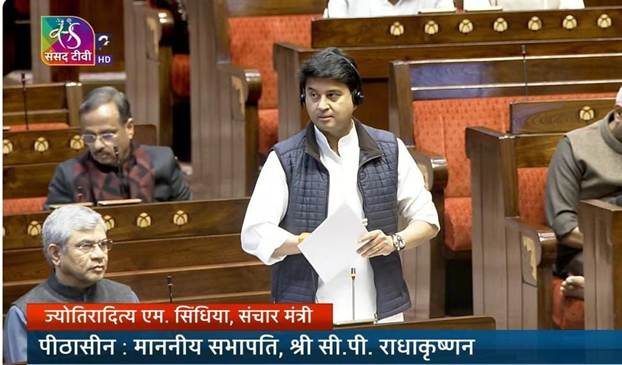
Union Minister of Communications and Development of North Eastern Region, Shri Jyotiraditya Scindia, today informed the Parliament that BharatNet, one of the world’s largest government-led connectivity programmes, is playing a transformative role in bridging the digital divide and expanding broadband access across rural India.
Replying to a question in the Rajya Sabha, the Minister said that BharatNet is an ambitious initiative of the Government of India aimed at providing internet connectivity to every citizen across the country.
“Over the last eleven years, under the leadership of Prime Minister Shri Narendra Modi, India has witnessed an unprecedented expansion in mobile and broadband connectivity, driving a historic digital transformation,” Shri Scindia stated.
The Minister highlighted that mobile subscribers have increased from 930 million in 2014 to 1.2 billion today, with mobile penetration rising from 75 per cent to 92 per cent. Internet subscribers have grown from 250 million in 2014 to over 1 billion, with penetration rising from 20 per cent to nearly 71.8 per cent.
Broadband subscribers have also increased from 61 million to over 1 billion, while the average fixed broadband speed now stands at around 61.55 Mbps, he said.
BharatNet provides connectivity by laying Optical Fibre Cable (OFC) across gram panchayats. Out of 2,56,000 gram panchayats in the country, nearly 2,14,000 have been made online under BharatNet Phases I and II, implemented at an approximate cost of ₹42,000 crore.
In Tamil Nadu, the State opted to implement the project through its special purpose vehicle, Tanfinet, instead of BSNL. Out of 12,525 gram panchayats in the State, 10869 have been connected. The remaining gram panchayats and 4,767 non-gram panchayat villages will be covered under the amended BharatNet programme, a $16.9 billion initiative and the largest government-led connectivity programme globally.
The Minister further informed the House that the National Broadband Mission (NBM) 2.0, launched on 1 April 2025, has set seven key targets for 2030:
Out of 36 States and Union Territories, 33 have implemented the Telecommunications ROW Rules, 2024. Tamil Nadu and West Bengal are among the States where compliance is pending.
The national average for ROW application processing is 30.4 days. In Tamil Nadu, the average disposal time is 85 days, nearly three times the national average,
“Cooperation from States in implementing Right of Way regulations and portals will significantly accelerate broadband expansion and ensure timely benefits to citizens,” Shri Scindia emphasised.
The Minister reiterated that continued Centre–State collaboration will be critical in achieving the 2030 broadband targets and ensuring inclusive digital growth across rural and remote regions of the country.
Regarding “National Broadband Mission in Tamil Nadu”, Union Minister Jyotiraditya Scindia gave a detailed reply in a written statement, as under:
National Broadband Mission (NBM) aims to fast-track the rapid expansion of digital communications infrastructure, bridge the digital and socio-economic divide, ensuring High-speed Broadband and Meaningful Connectivity for all across the country including the rural and remote areas.
The current status of main components of the National Broadband Mission in Tamil Nadu is as follows:
The Telecom infrastructure including Base Transceiver Stations (BTSs) and OFC have been laid in the State by private facility Providers (FPs) and under the Government funded various project/schemes to ensure high-speed broadband/internet connectivity. To address the challenges in rolling out broadband services, particularly in rural, remote, and underserved areas, the Government has undertaken several policy reforms and projects.
The details of policy reforms and Government funded projects are as follows:
आदरणीय प्रधानमंत्री श्री @narendramodi जी के नेतृत्व में भारत की अमेंडेड भारतनेट योजना विश्व की सबसे बड़ी कनेक्टिविटी की पहल है। pic.twitter.com/JDk7nUtkTj
(STARRED-RS-138-120226)
Follow DoT Handles for more: –
Insta- https://www.instagram.com/department_of_telecom?igsh=MXUxbHFjd3llZTU0YQ==
Fb – https://www.facebook.com/DoTIndia
Youtube: https://youtube.com/@departmentoftelecom?si=DALnhYkt89U5jAaa
****
MI/ARJ
- OFC connectivity with 95 per cent uptime has been achieved in 42,000 villages as of December 2025, with a target of 2.7 lakh villages by 2030.
- Broadband connectivity to anchor institutions such as schools, anganwadis and panchayat offices has reached 68.8 per cent, with a target of 90 per cent by 2030.
- The national average fixed broadband download speed stands at 61.55 Mbps, with a target of 100 Mbps by 2030.
- The average Right of Way (ROW) application disposal time has been reduced from 455 days to 30.4 days, achieving the 2030 target ahead of schedule.
- Fibre mapping across government PSUs has reached 94 per cent under PM GatiShakti, NMP Platform with a target of 100 per cent by March.
- Rural internet subscribers per 100 population stand at 47.16, with a target of 60 by 2030.
- Use of sustainable energy in mobile towers is currently 12.38 per cent, with a target of 30 per cent by 2030.