Union Minister Dr Jitendra Singh interacts with a delegation of women parliamentarians from Ethiopia; shares some of India’s globally acknowledged best practices in governance
Union Minister Dr Jitendra Singh interacts with a delegation of women parliamentarians from Ethiopia; shares some of India’s globally acknowledged best practices in governance
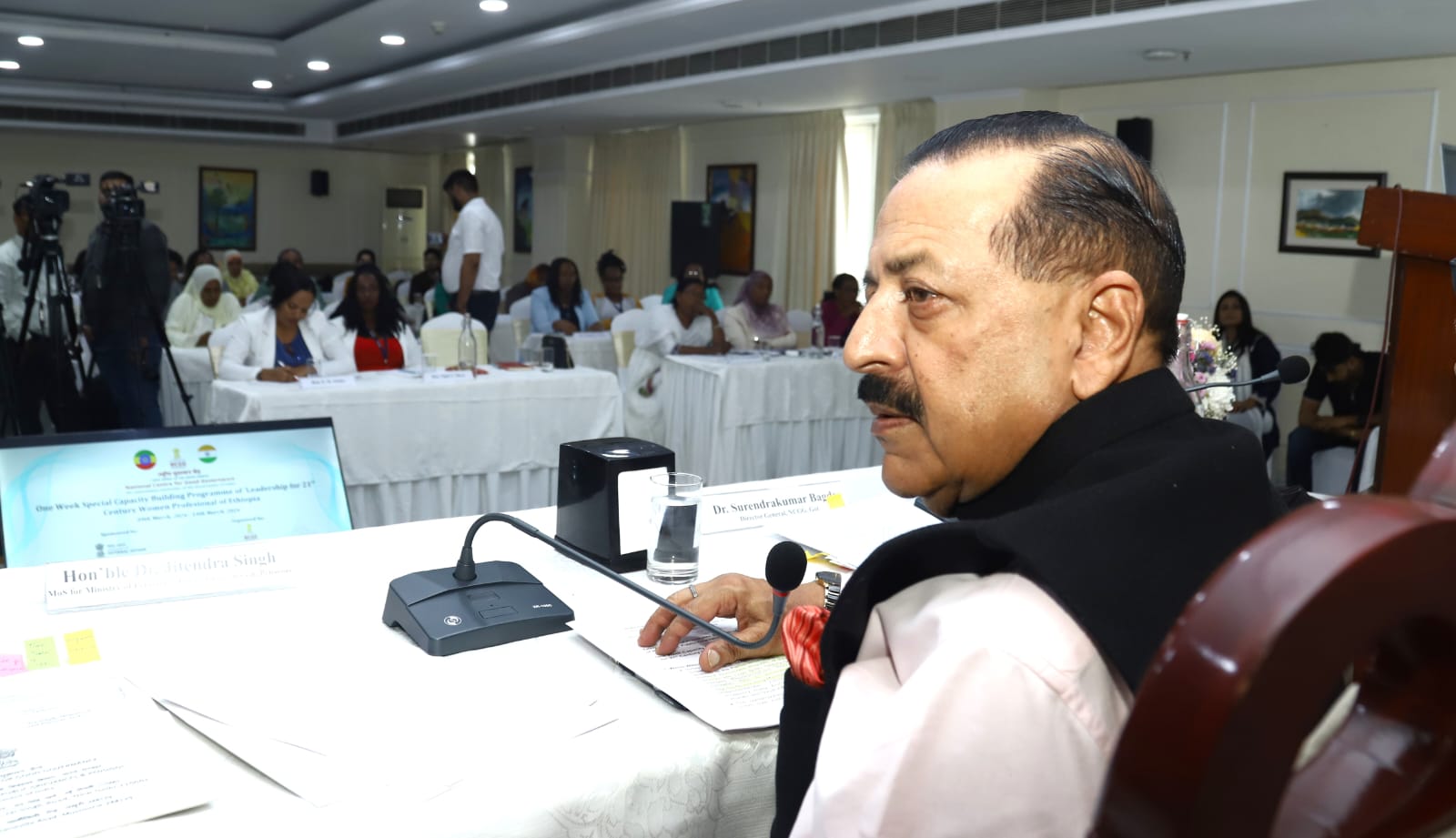
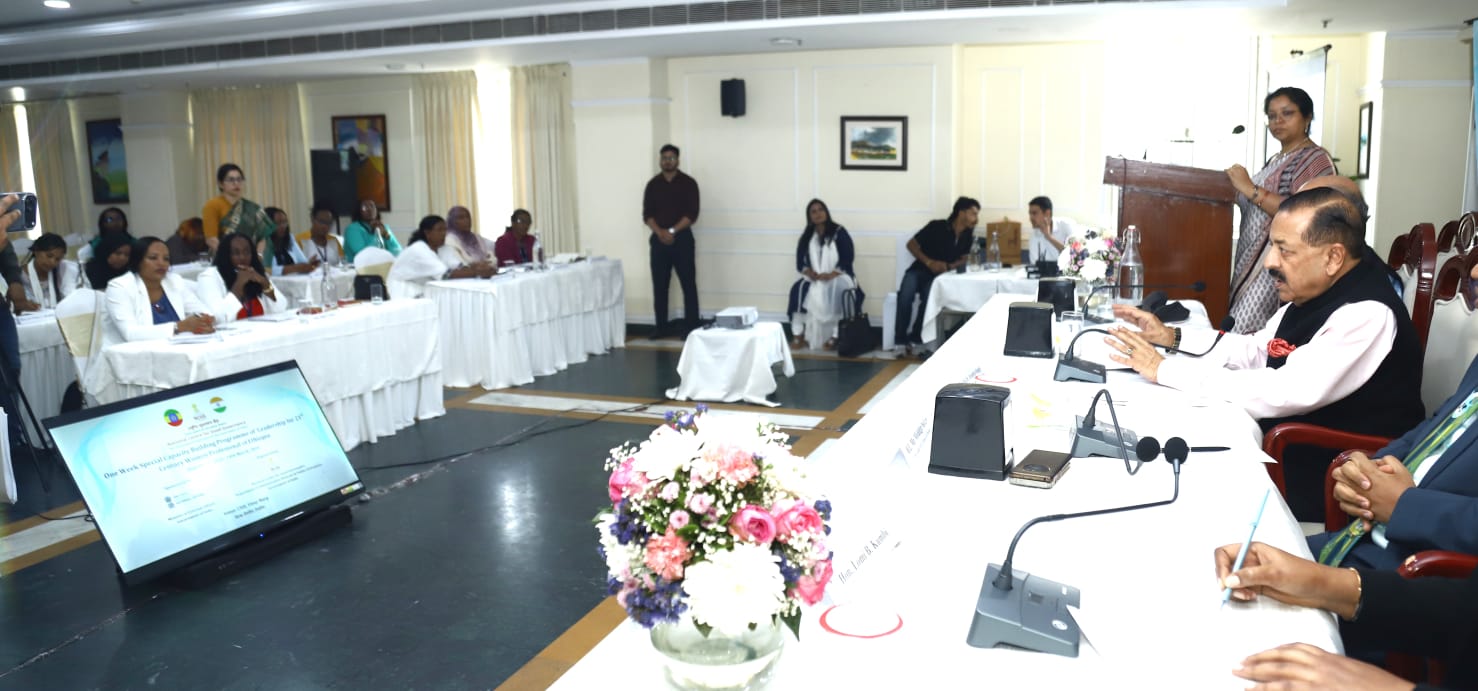
Interacting with a group of 32 women parliamentarians from Ethiopia here today, Union Minister of State (Independent Charge) for Science & Technology, Earth Sciences and MoS PMO, Personnel, Public Grievances, Pensions, Atomic Energy and Space Dr. Jitendra Singh shared some of India’s globally acknowledged best practices in governance and discussed India’s governance model based on cooperative federalism, digital administration, and women-led development, during an interaction with a visiting Parliamentary delegation from Ethiopia at the National Centre for Good Governance (NCGG) in New Delhi.
The Minister was interacting with participants of the One-Week Special Capacity Building Programme on “Leadership for 21st Century Women Professional” being organised by NCGG under the Department of Administrative Reforms and Public Grievances. The programme aims to strengthen leadership and governance capabilities of women leaders and senior officials from Ethiopia.
The Ethiopian delegation was led by Ms. Lomi Bedo Kumbi, Deputy Speaker of the House of Peoples’ Representatives, accompanied by Ms. Meseret Haile Masresha, State Minister, Mr. Worksemu Mamo Mekonnen, Member of the Standing Committee, along with Members of Parliament and senior representatives from the Ethiopian Women Federation, Prosperity Party Women Wing and Regional Women and Social Affairs Bureaus. In total, 32 senior dignitaries from Ethiopia are participating in the programme.
Referring to the long-standing partnership between India and Ethiopia, Dr. Jitendra Singh said that the two countries share strong democratic traditions and expanding cooperation in areas such as parliamentary exchanges, capacity building, trade, ICT, agriculture, and people-to-people relations.
He recalled that Prime Minister Shri Narendra Modi addressed the Joint Session of the Ethiopian Parliament in December 2025, reflecting India’s deep commitment to Africa’s development partnership. During the visit, the Prime Minister was also conferred Ethiopia’s highest civilian honour, the “Great Honour Nishan of Ethiopia”, symbolizing the mutual respect and warmth between the two nations.
Dr. Jitendra Singh explained India’s governance framework which operates through a federal structure of 28 States and 8 Union Territories, where responsibilities are distributed across the Union List, State List and Concurrent List. This system, he said, ensures coordination between the Centre and the States and is guided by the principle of cooperative federalism.
He also shared insights about the Aspirational Districts Programme, a data-driven initiative designed to accelerate development in selected districts using measurable indicators such as health, nutrition, education, water access, and infrastructure. The initiative has delivered encouraging outcomes and is now being expanded further through the Aspirational Blocks Programme.
The Minister said that technology-driven governance has significantly improved transparency and efficiency in India, with most administrative processes, grievance redressal systems and service delivery platforms functioning online. He added that several countries are now studying India’s digital governance models, including the public grievance portal and digital monitoring dashboards.
Highlighting India’s progress in women empowerment, Dr. Jitendra Singh referred to the legislation providing one-third reservation for women in Parliament, describing it as a major step toward greater representation of women in decision-making. He also noted that women are increasingly taking leadership roles across sectors including science, entrepreneurship, and governance.
He spoke about India’s expanding start-up ecosystem, which now ranks among the largest in the world with more than two lakh start-ups, a significant proportion of which are led by women entrepreneurs.
During the interaction, the Minister also shared examples of India’s governance reforms including Direct Benefit Transfer (DBT), self-help group movements, AI-based governance initiatives, geospatial policy reforms, and infrastructure monitoring through the PM Gati Shakti platform, all of which have contributed to faster decision-making and improved coordination among departments.
Dr. Jitendra Singh also spoke about India’s traditional wellness systems under the AYUSH framework, which integrates Ayurveda, Yoga, and other traditional medical systems with modern healthcare. He noted that the International Day of Yoga, observed worldwide every year on June 21 following India’s initiative at the United Nations, has helped spread awareness about holistic health practices across the globe.
Describing India as one of the world’s most diverse societies, the Minister said that despite linguistic, cultural, and regional differences, a shared sense of identity and democratic values continue to bind the country together.
Dr. Jitendra Singh said that the National Centre for Good Governance has emerged as a key platform for international cooperation in public administration. The institution has so far trained more than 6,000 civil servants from over 50 countries, contributing to global knowledge exchange in governance and administrative reforms.
He expressed confidence that such programmes will further strengthen the India-Ethiopia partnership and encourage deeper collaboration between the two countries in governance, public administration, and leadership development.
2UZT.jpeg)
5CUT.jpeg)