Trust, Diversity and Inclusion: AI in Healthcare
Trust, Diversity and Inclusion: AI in Healthcare
Artificial Intelligence is transforming the healthcare sector in various innovative ways. AI-based tools can diagnose and predict diseases, streamline clinical practices, improve hospital management, assist in drug discoveries and aid in healthcare research. However, integration of AI in healthcare is not without its obstacles and challenges. AI powered healthcare devices and tools are being developed, but their adoption is low. There is a significant lack of diverse, and representative data informing many AI-driven tools, which can reduce their accuracy and reinforce biases against certain populations. Across multiple discussions on artificial intelligence, a clear consensus has emerged: while AI has the potential to revolutionise healthcare, its development and deployment must remain patient-centered. It should expand equitable and affordable access to care, be trained on diverse and inclusive datasets, and be grounded in transparency and trust.
To encapsulate these principles, the Ministry of Health and Family Welfare released the Strategy for AI in Healthcare for India (SAHI) during the recently held India AI Impact Summit in New Delhi. SAHI sets out a national framework to guide the responsible integration of AI into India’s health system. It recognises AI as a strategic enabler of health system strengthening, while affirming that its adoption must be anchored in public interest, trust, and long-term system resilience. The various discussions held during the Summit also highlighted the importance of diversity in data, and accountable and trustworthy AI systems, along with the importance of using AI for public good.
Strategy for AI in Healthcare for India (SAHI)
SAHI works as a recommendatory national framework on the way AI can be integrated into healthcare services.
Launched as a national framework, SAHI outlines a structured roadmap for integrating AI into healthcare delivery across India. It seeks to guide policymakers, healthcare providers, and technology developers on the responsible adoption of AI, ensuring innovation is aligned with clinical needs, regulatory standards, equity considerations, and public trust.
SAHI makes inclusive development its main goal – emphasising the necessity of using this frontier technology for the purpose of public good and creating a Viksit Bharat 2047. The strategy recognises AI’s transformative role and potential in making healthcare more accessible, timely, high-quality and affordable, envisioning it both as a powerful innovative force as well as an enabler for improving public health. It seeks to establish trusted, risk-proportionate governance and robust digital and data foundations to ensure the safe, ethical, and accountable use of AI at scale. It also aims to build a future-ready health workforce and institutions, while fostering a sustainable and inclusive AI-for-health ecosystem that advances equity, quality, efficiency, and public trust.
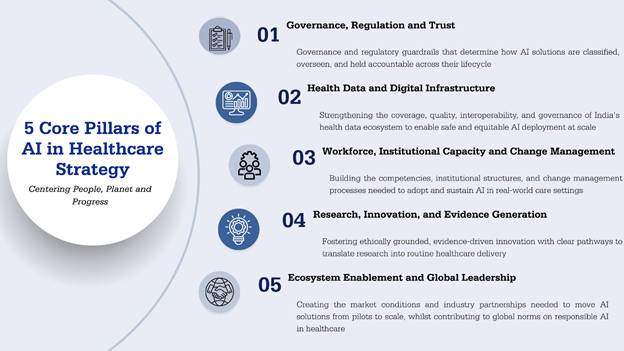
The framework’s 5 core pillars address governance and evidence generation standards; safe, ethical, robust and transparent digital and data infrastructure; and workforce readiness.
SAHI is a step ahead and builds on India’s National Strategy for Artificial Intelligence, released in 2018 after the government announced the National Program on AI, which emphasised #AIforAll. The 2018 strategy, made by India’s policy think tank NITI Aayog, aims to use AI for scalable solutions for emerging economies, for the greater good of humanity. In the healthcare sector, the strategy envisioned AI as a technology enabling universal health coverage, particularly in rural areas that suffer from poor connectivity and limited supply of healthcare professionals. AI is seen as a democratising tool to enable communities to access healthcare services through AI-driven tools such as AI driven diagnostics, personalised treatment, early identification of potential pandemics, and imaging diagnostics, among others.
BODH (Benchmarking Open Data Platform for Health AI)
BODH, also launched during the Summit, provides a structured mechanism for testing and validating Health AI solutions before deployment at scale. It will play a critical role in ensuring that AI tools used by clinicians are safe, reliable, and validated against real-world parameters before deployment. Trust, safety, and accountability must remain central to India’s health AI journey. It was developed by the Indian Institute of Technology Kanpur in collaboration with the National Health Authority.
India’s AI-Related Healthcare Policies
India has been progressing towards the goal of using AI for public good set by the 2018 strategy. In the same year, the NITI Aayog released the National Health Stack: Strategy and Approach. The health-stack strategy set a policy framework for the establishment of a unifying digital public infrastructure with national health electronic registries, a coverage and claims platform, a health records framework for patients to access their own health data and enable medical research, and other digital components such as a digital health ID, health data dictionaries, and payment gateways. This architecture is enabling many AI integrations.
The National Health Stack aims to deploy a powerful technology arsenal, from big data analytics and machine learning all the way to AI — with the goal of completely redesigning the flow of people, money, and information, bringing down the costs of health protection, converging disparate systems to ensure a cashless and seamlessly integrated experience for the poorest beneficiaries, and promoting wellness across the population.
Building on this foundation, the National Digital Health Blueprint (NDHB, 2019) identified AI, machine learning, IoT, and big data as emerging technologies that a national initiative of this scale must leverage at the earliest and called for tapping India’s growing start-up innovation ecosystem to develop AI-driven solutions for the health sector.
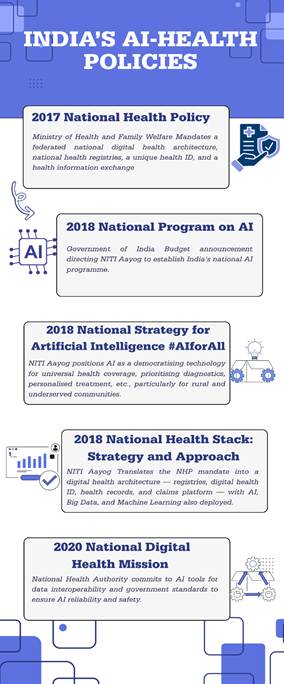
The National Digital Health Mission Strategy Overview (2020) further translated this vision into an implementation roadmap. It recognised that AI, IoT, blockchain, and cloud computing offered additional opportunities for a more holistic digital health ecosystem — one that could increase equitable access, improve health outcomes, and reduce costs. It envisaged that modern AI techniques would help health providers extract relevant information from existing health record formats and transition to interoperable data standards — while committing the government to laying down guidelines and standards to ensure the reliability of AI systems.
This policy trajectory culminated in the launch of the Ayushman Bharat Digital Mission (ABDM) by the Ministry of Health and Family Welfare – the operational realisation of the broader digital health vision. With over 860 million ABDM created for citizens, ABDM represents India’s first large-scale healthcare digital public infrastructure.
It encompasses longitudinal health records, national registries of healthcare providers, facilities, and citizens, and a consent-based data exchange architecture. This infrastructure creates a strong foundation for AI integration, several applications of which are already underway. In parallel, the Ministry has deployed AI-enabled tools for disease surveillance and early detection, including AI-supported chest X-ray interpretation systems for tuberculosis screening.
Impact of AI in Healthcare
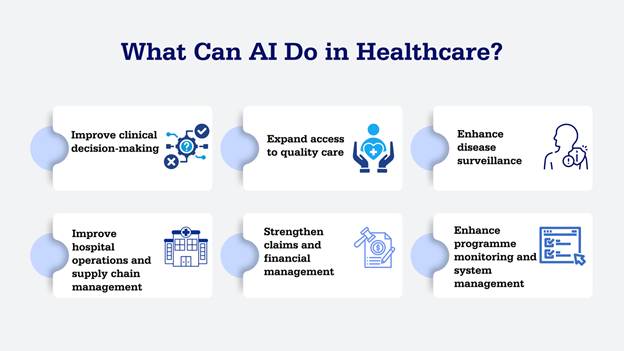
During the AI Summit, the Government of India, in collaboration with the World Health Organisation (WHO) published the India AI Impact Summit 2026 Compendium on the Real-World Impact of AI in Health and a compendium on the Real-World Impact of AI in Accessibility. The use cases span from AI in computer vision, assistive tools for disabled people, clinical decision support, predictive analysis to ambient AI for health.
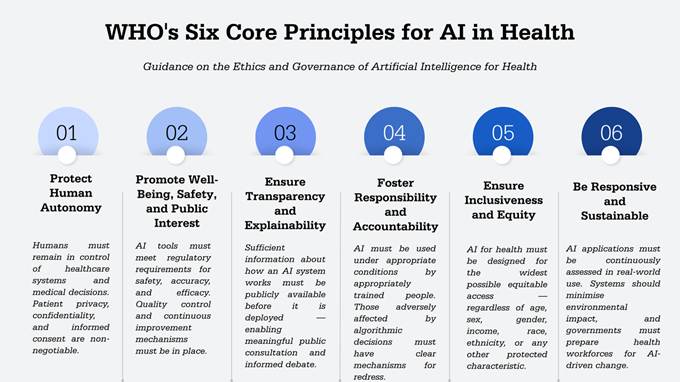
Dr. Catharina Boehm, Officer-in-Charge of the WHO South-East Asia Regional Office, leading WHO’s health initiatives across one of the world’s most populous and diverse regions, framed the compendium’s purpose plainly: to move the conversation on AI in health from promise to practice. She noted that innovation is not just confined to high-income countries — in resource-constrained settings is precisely where the most relevant ideas emerge. She emphasised that AI’s transformative potential must be accompanied by strong ethical stewardship, grounding her remarks in WHO’s six core principles for AI in health, from protecting human autonomy to advancing equity and accountability. In conclusion, she said AI will not replace health workers — it will empower them.
Dr. Mona Duggal, Director of ICMR’s National Institute of Research and Digital Health (NIRDH), echoed this, noting the compendium represented a shift away from adapting Western solutions towards building on India’s own successes. She outlined ICMR’s four priorities for AI in health —
She observed that the pursuit of AI tools had driven a valuable secondary effect: pushing institutions to take data quality far more seriously, creating a virtuous cycle – from better data to stronger evidence to more informed policy.
The casebooks compiled real stories of impactful AI tools and/systems in improving healthcare access, diagnosis speed and access, and enabling disabled people to function with ease. Some examples from the two casebooks are given below.
Bridging the Neuroradiology Divide
Neuroradiology is focused on diagnosing and treating diseases of the brain, spine, head and neck using advanced imaging like MRIs and CT scans. Over the past 15 years, radiology workload, particularly for emergency and on-call CT imaging, including head trauma and neurovascular CT, has increased by 500%.
However, in India, expertise in the field is largely concentrated in major cities of Mumbai, Delhi, Bengaluru and other tier-1 cities. In the smaller cities and towns, patients must rely on general radiologists who are often swamped with high and diverse workloads, particularly during the nighttime. Such radiologists report fatigue and burnout, leading to higher errors in interpretations for critical brain imaging cases.
Scaida BrainCT system was developed in response to this problem. It is a specialised AI decision-support module intended to assist radiologists with multi-pathology brain CT analysis. The system is based on a labelled dataset derived from about 2,000 studies and tens of thousands of annotated slices validated by radiologists.
Scaida BrainCT has been used for more than 15,000 brain CT studies across more than 30 healthcare facilities in Tier-2 and Tier-3 districts. It has helped radiologists speed up interpretations of the scans. People of all ages and both genders were assisted with this system. Since the system is assistive, a radiologist signs-off on the reports. The AI system is largely assistive and does not generate final diagnosis.
This initiative exemplifies the SAHI vision of using frontier technology to make high-quality specialised care accessible and affordable, regardless of geography.
AI-Powered Voice-First Platform for Independent Education and Living
In India, blind and visually-impaired citizens face persistent barriers in reading PDFs, textbooks, tables, diagrams, notices, images and official documents without another person helping them. SMARTON – through its mobile application, glasses and web application – helps them through an AI-powered, voice-first accessibility ecosystem. Using AI, combining computer vision, natural language processing and speech technologies, SMARTCON also enables conversational interaction too. It is also available in 50 languages including 10 Indian languages. It is empowering over 15,000 users in participating in society and accessing education.
The Future: Software, AI, and Genomics
The importance of diversity in health data was emphasised during a discussion on The Role of AI in Drug Discovery, where assistant professor of genetics of Harvard Medical School Jonathan Picker said that genomics has yet to fully transform daily medicine due to biological complexity. Lack of diverse genomics data leads to the development of healthcare models which are only representative of certain populations, failing in other areas of the world. Thus, AI can greatly help in the diversification of genomics data.
Governance Gap and “Duty of Care”
During the discussion on Catalysing Global Investment for Equitable and Responsible AI in Health, experts noted that while innovative tools are proliferating, successful implementation requires a holistic approach that integrates government policy with global institutional norms, with trust being the most important factor. To promote investments into AI for healthcare purposes, the technology must be trustworthy and useful for healthcare professionals.
To enable this, panelists highlighted two core priorities:
Conclusion
From SAHI, to the importance of diversity in health data and trust, to the need for supportive benchmarking tools such as BODH, the healthcare discussions during the India AI Impact Summit 2026 converged on a clear and urgent message: the transformative potential of AI in healthcare can only be realised if it is built on a foundation of trust, ethics, and inclusion. Closing the diagnostic gap, eliminating algorithmic bias, and ensuring equitable access require deliberate policy choices, diverse and high-quality data, and a healthcare workforce equipped to work alongside AI.
India, with its vast and diverse population, its growing digital public infrastructure, and its wealth of medical and engineering talent, is uniquely positioned to lead this charge — not merely by adopting solutions developed elsewhere, but by building its own. The vision of #AIforAll demands nothing less than an AI ecosystem that works for every patient, in every region, regardless of income, language, or geography.
References
• National Health Policy: chrome- extension://efaidnbmnnnibpcajpcglc1efindmkaj/https://www.mohfw.gov.in/sites/defa ult/files/9147562941489753121.pdf
• National Program on AI: https://www.digitalindia.gov.in/initiative/national-program-on-artificial-intelligence/
• National Strategy for Artificial Intelligence: chrome-extension://efaidnbmnnnibpcajpcglclefindmkaj/https://www.niti.gov.in/sites/default/files/2023-03/National-Strategy-for-Artificial-Intelligence.pdf
• National Health Stack: chrome-extension://efaidnbmnnnibpcajpcglclefindmkaj/https://abdm.gov.in/strapicms/uploads/NHS_Strategy_and_Approach_1_89e2dd8f87.pdf
• National Digital Health Mission: https://mohfw.gov.in/?q=en/relatedlinks-1
• WHO issues first global report on Artificial Intelligence (AI) in health and six guiding principles for its design and use: https://www.who.int/news/item/28-06-2021-who-issues-first-global-report-on-ai-in-health-and-six-guiding-principles-for-its-design-and-use
• Strategy for AI in Healthcare for India: https://abdm.gov.in/sahi/