The Office of Principal Scientific Adviser to the Government of India and the Embassy of Switzerland co-hosts GESDA-Anticipatory Leadership Lab in New Delhi.
The Office of Principal Scientific Adviser to the Government of India and the Embassy of Switzerland co-hosts GESDA-Anticipatory Leadership Lab in New Delhi.
The Office of Principal Scientific Adviser to the Government of India jointly with the Embassy of Switzerland in India and the Geneva Science and Diplomacy Anticipator (GESDA) hosted an “Anticipatory Leadership Lab” in New Delhi on 6 March 2026. Key institutional leaders from India and Switzerland including Principal Scientific Adviser to the Government of India Prof Ajay Sood, Switzerland’s State Secretary for Foreign Affairs Ambassador Alexandar Fasel, Scientific Secretary Dr Parvinder Maini, the Ambassador of Switzerland to India Maya Tissafi and the Director General of GESDA Prof. Marilyne Andersen, facilitated this event.
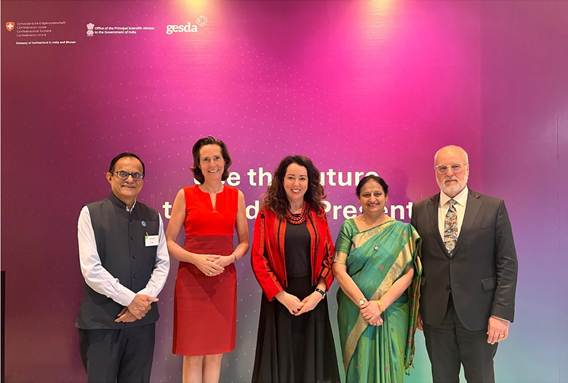
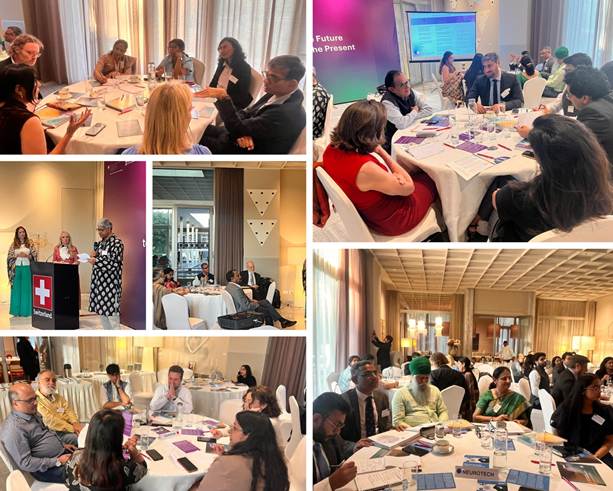
Built on GESDA’s Science Breakthrough Radar® and the anticipatory science diplomacy framework, the Lab brought together 60 leaders from academia, government, diplomatic missions, deeptech startups, business entities and civil society organisations for a structured, multistakeholder dialogue to strengthen their collective capacity to anticipate and govern emerging scientific and technological breakthroughs. The deliberations were focused on research advances in Quantum Computing, AI, Synthetic Biology and Neurotechnology, that expected to transform society and the planet over the next 5, 10 and 25 years.
Addressing the gathering, Prof Sood remarked that, “As a technology matures and disruption occurs, a governance gap becomes visible. It is then the usual governance mechanism convenes, deliberate, and responds. This conventional reactive cycle served us adequately in eras when the pace of change was measured in decades. However, it is no longer adequate. The disruptive frontiers that will define the next quarter-century – quantum computing, artificial general intelligence, synthetic biology, neurotechnology are not distant abstractions. The governance choices we make in the next five to ten years will determine the effectiveness with which these technologies serve humanity”.
Ambassador Fasel commented that “For the Swiss government, anticipating and understanding scientific breakthroughs is no longer a luxury, but a diplomatic necessity. Science and technology have become a “core currency” in international affairs, influencing prosperity, sovereignty, and security on a global scale. Switzerland has therefore made anticipatory science diplomacy a priority in our foreign policy. Our collaboration with India reflects a shared vision between two global innovation leaders, combining cutting-edge excellence with India’s unparalleled ability to scale innovation for millions.”
Professor Marilyne Andersen, Director General of GESDA, remarked that “Anticipatory science diplomacy enables us to harness fast-moving scientific breakthroughs for the benefit of humanity before they deepen global fractures and inequalities. It grounds decision-making in rigorous science, allowing to keep the conversation open and preserved from competition, pressures or quick fixes. It opens an essential window of agency so as to carefully account for all implications and involve policymakers, diplomats, scientists, innovators and citizens across geographies, socio-economic realities and cultural contexts around the table.”

During this exercise, the participants engaged in a forward-looking brainstorming discussion to examine how emerging and frontier technologies could shape India and the global landscape across short-, medium-, and long-term horizons. The deliberations focused on identifying key opportunities and risks for public policy, diplomacy, and industry, while also suggesting potential pathways for sustained engagement and cooperation. The discussion was anchored in the principle that governance frameworks for disruptive technologies must be informed by ‘science anticipation’. By systematically identifying potential technological breakthroughs and their implications at an early stage, countries can create space for collaboration and collective risk assessment before competitive dynamics, geopolitical fragmentation, or crisis-driven responses begin to dominate the global technology landscape.