Safeguarding Women at Work
Safeguarding Women at Work
Key Takeaways
Introduction
A safe workplace is not merely a legal requirement but a foundational element for ensuring that women can exercise their fundamental rights to equality, dignity, and economic empowerment. Sexual harassment of women at workplace is a serious violation of their fundamental rights guaranteed under Articles 14, 15, the right to practice any profession or occupation under Article 19(1)(g), and the right to life and dignity under Article 21 of the Indian Constitution. It creates an insecure work environment, hindering women’s participation in the workforce and adversely affecting their economic empowerment and the goal of inclusive growth.
The absence of strong safeguards in the past hindered women’s workforce entry and retention. Earlier criminal provisions under the Indian Penal Code and the Vishakha guidelines issued by Supreme Court in 1997 had provided a framework for safety and security of women at workplace. However, the Government after taking into account the need for a comprehensive framework, to holistically address every aspect of workplace related harassment of women, enacted ‘the Sexual Harassment of Women at Workplace (Prevention, Prohibition and Redressal) Act, 2013’ (SH Act) on 09th December, 2013.
It provides a clear legal framework to prevent, prohibit, and redress sexual harassment. The Act protects every woman at work, across all sectors and employment types. It promotes a culture of respect, safety and dignity of every women who are part of the workforce or visit a workplace in connection with any work, while advancing inclusive economic growth. The SHe-Box portal acts as a key digital initiative, and strengthens this framework by offering an easy, secure, and transparent way for women to file and track complaints.
Key Provisions and Obligations under the SH Act
The Sexual Harassment of Women at Workplace (Prevention, Prohibition and Redressal) Act, 2013 (SH Act) was enacted on 9th December 2013. The Act seeks to prevent sexual harassment and ensure a safe, secure and inclusive working environment for women. It applies across all sectors — public and private, organised and unorganised — and protects every woman irrespective of her age, employment status or nature of work. This also includes domestic workers.
Institutional Mechanisms
The Act establishes clear institutional mechanisms for redressal.
The Appropriate Government holds overall responsibility for monitoring implementation.
The Central Government acts as the Appropriate Government for workplaces it establishes, owns, controls or substantially or wholly finances either directly or indirectly.
State Governments perform this role for workplaces they fund either directly or indirectly, and for all other workplaces within their jurisdiction. Both levels of government maintain data on the number of cases filed and disposed of under the Act.
Complaint Process
The complaint process is time-bound to ensure prompt action.
Employer Responsibilities
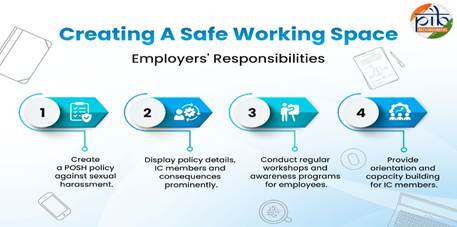
Employers have clear proactive duties under the Act. Beyond merely reacting to complaints, the law requires them to take active steps to prevent sexual harassment from occurring in the first place. This preventive approach is central to creating a respectful and secure work culture. Employers must ensure that all employees are aware of the provisions of Act and the female employees are aware of their rights and must ensure a zero-tolerance policy towards harassment. Regular engagement and training help build sensitivity and accountability across the organisation.
Monitoring and Compliance
The SH Act places strong emphasis on effective monitoring to ensure proper implementation across the country. The Appropriate Government is responsible for overseeing compliance. This includes maintaining accurate data on the number of cases filed and disposed of under the Act.
In order to support monitoring, Internal Committees (ICs) and Local Committees (LCs) prepare annual reports in the prescribed format and submit to their respective employers or District Officers. The District Officer then forwards a brief consolidated report to the State Government.
The Appropriate Government has additional powers to enforce compliance. It can request any relevant information from employers or District Officers. It can also authorise inspections of records and workplaces related to sexual harassment cases. These measures help track progress, identify gaps, and ensure the Act is implemented in both letter and spirit.
Penalties for Non-Compliance
These monitoring and enforcement measures are backed by strict penalties for anyone who fail to comply with the Act.
Role of the Ministry of Women and Child Development (MWCD)
The Ministry of Women and Child Development (MoWCD) is the nodal ministry for the SH Act. It issues advisories to Central Ministries, States, UTs and private bodies and plays a pivotal role in effective implementation.
Supreme Court Monitoring: Current Scenario
The Hon’ble Supreme Court has also monitored the progress of implementation of the SH Act in course of some cases, and issued several directions, including to State / UT authorities to ensure nationwide compliance to the Act, expedite constitution of ICs and making the information available on SHe-Box portal. In line with these judicial directions, the MoWCD regularly issues advisories to Central Ministries, State Governments, Union Territories, and private sector bodies. These advisories focus on setting up LCs in every district and ICs wherever required and organising regular workshops and awareness programmes to sensitise employees and build capacity of committee members.
The SHe-Box Portal
The MoWCD launched the Sexual Harassment electronic Box (SHe-Box) on 29th August 2024.
SHe-Box serves as a single-window, centralised digital platform. By creating a central repository — which was previously not available — the SHe-Box portal strengthens monitoring of the Act’s implementation. It helps track cases filed and disposed of nationwide. The platform promotes accountability, faster redressal, and long-term cultural change in workplaces. Ultimately, SHe-Box contributes to safer work environments and advances women’s empowerment.
It enables any woman facing sexual harassment at the workplace — irrespective of whether she works in the public or private sector, organised or unorganised sector — to register her complaint easily and securely. Once a complaint is submitted, the portal automatically forwards it to the relevant Internal Committee (IC) or Local Committee (LC) based on the details provided by the complainant.
The revamped portal includes several user-friendly and secure features:
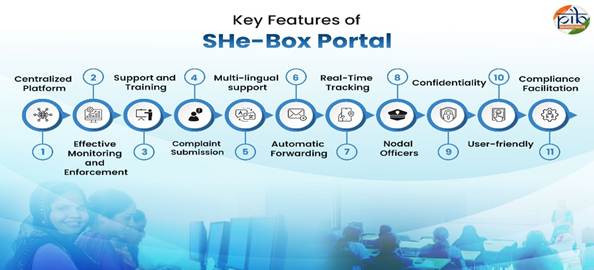
Nodal Officers appointed for monitoring the portal play a key role. They regularly update and maintain accurate information on the portal, including details of ICs and LCs, and ensure timely handling of complaints and other compliances.
The portal also supports compliance and monitoring by requiring workplaces to upload essential information:
Conclusion
The Sexual Harassment of Women at Workplace (Prevention, Prohibition and Redressal) Act, 2013 remains a landmark law. It protects women’s right to a safe and dignified workplace. The Act, together with strong institutional mechanisms, time-bound redressal, and employer duties, works to prevent harassment and ensure justice. The Ministry of Women and Child Development continues to lead implementation. It issues regular advisories, builds capacity, and promotes awareness across sectors. The revamped SHe-Box portal, launched in August 2024, marks a major step forward. It provides easy, secure, and transparent access to file and track complaints. It also creates a national database for better monitoring and accountability.
The Government remains committed to effective enforcement of the SH Act and to empowering every woman with a harassment-free work environment.
References:
Ministry of Women and Child Development: