Revolution from field to farm through Agriculture Infrastructure Fund, infrastructure worth over ₹1 lakh crore: Shri Shivraj Singh Chouhan
Revolution from field to farm through Agriculture Infrastructure Fund, infrastructure worth over ₹1 lakh crore: Shri Shivraj Singh Chouhan
Union Minister for Agriculture & Farmers’ Welfare, and Rural Development, Shri Shivraj Singh Chouhan today categorically stated in the Rajya Sabha while replying to questions raised by Members of Parliament that the government, led by Prime Minister Shri Narendra Modi, is not in power for the sake of authority, but for the comprehensive development of farmers, India’s villages and the poor. The Union Minister emphasised that a farmer is not merely an ‘annadata’ (food provider) but a ‘jeevandata’ (life giver) — “not God, but certainly no less than God”. With this conviction, policies such as the Agriculture Infrastructure Fund (AIF), Minimum Support Price (MSP), Self-Reliance in Pulses Mission, Pradhan Mantri Kisan Urja Suraksha evam Utthaan Mahabhiyan (PM-KUSUM), crop residue management and crop diversification are bringing visible change on the ground.
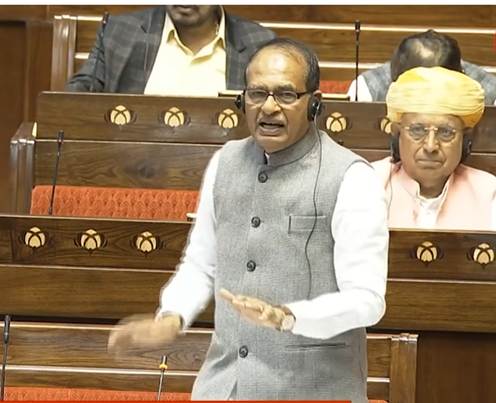
Shri Shivraj Singh Chouhan stated that workers of the Bharatiya Janata Party (BJP) do not enter politics to sit on the golden throne of power for personal enjoyment, but to engage in national reconstruction, the welfare of farmers, service of the poor and the building of a self-reliant and developed India (Viksit Bharat). Calling the farmer a life giver, the Union Minister said that although a farmer may not be God, he is certainly no less than God. However, for 50 years, Congress governments failed to seriously address the fundamental problems faced by farmers. Fruits, vegetables and food grains were continuously produced, but no adequate arrangements were created to safely store them. Prime Minister Shri Narendra Modi recognised these problems, and the difference is now visible in villages across the country.
The Union Agriculture Minister stated that Prime Minister Shri Narendra Modi took the historic decision to create agricultural infrastructure worth over ₹1 lakh crore under the Agriculture Infrastructure Fund, ensuring that farmers’ produce can be safely stored. Under this scheme, 44,243 Custom Hiring Centres, 25,854 Primary Processing Centres, 25,565 Farm Harvest Automation Units, 17,779 Warehouses, 4,201 Sorting and Grading Units, infrastructure for Smart and Precision Agriculture at 3,549 locations, and 2,827 Cold Storages have been established.
Because of these modern structures, losses of crops, fruits and vegetables have been reduced by 5 per cent to 15 per cent. Farmers are now able to store their produce safely and obtain better prices instead of being forced to sell immediately after harvest.
Shri Shivraj Chouhan made it clear that all Indians are children of Bharat Mata and there is no question of discrimination. Paying respect to the great people of Punjab, he assured that the Modi government will leave no stone unturned for Punjab’s progress and development. Under AIF, Punjab received 32,014 applications, and against an initial target of ₹7,425.98 crore, projects worth ₹11,351.54 crore were approved. With improved storage, processing and mechanisation, crop losses have reduced by 5 per cent to 15 per cent, and each project has generated direct employment for four to nine individuals, leading to the creation of lakhs of jobs.
Referring to Tamil Nadu, he said that the Self-Reliance in Pulses Mission is being implemented uniformly across the country. Good quality seeds, cluster-based production, demonstration plots, assistance up to ₹10,000 per hectare, assured procurement and support for dal mills will be available in Tamil Nadu as well. The Centre remains committed to increasing pulses production in coordination with the state government.
On the issue of MSP, Shri Shivraj Singh Chouhan directly criticised the opposition, stating that when they were in power, they rejected the Swaminathan Commission’s recommendation of MSP at 50 per cent profit over cost by filing an affidavit in court. He said the Modi government implemented MSP with 50 per cent profit over cost, and farmers have experienced the difference on the ground.
Citing pulses procurement data, he said that during 10 years of the UPA government, only 6 lakh metric tonnes of pulses were procured. In contrast, the Modi government has procured 1 crore 92 lakh metric tonnes of pulses. He announced that 100 per cent procurement of tur (pigeon pea), masoor (lentil) and urad (black gram) will be ensured. Whatever quantity farmers produce and wish to sell, the Centre will procure in full.
National Agricultural Cooperative Marketing Federation of India Ltd (NAFED) and National Cooperative Consumers’ Federation of India Ltd (NCCF) have been authorised for procurement, and state governments may also undertake procurement through their agencies. Other pulses will be procured under Pradhan Mantri Annadata Aay Sanrakshan Abhiyan (PM-AASHA). To ensure timely payments, a single-click Direct Benefit Transfer mechanism has been created to transfer money directly into farmers’ bank accounts.
Shri Shivraj Singh Chouhan noted that while India had 38 per cent of the global area under pulses cultivation, its share in production was only 28 per cent, reflecting low productivity due to old seed varieties, low seed replacement rates and adverse weather. Many farmers had shifted to other crops. Until 2016, India was the largest importer of pulses.
Through improved technology, advanced varieties, scientific research, farmer support and policy backing, a ‘Pulses Revolution’ began. As a result, in 2021–22, pulses production reached a record 27.30 million tonnes.
Under the Self-Reliance in Pulses Mission, provisions include development of improved seed varieties, higher seed replacement rates, farmer training, cluster approach, free mini-kits, demonstration plots, assistance up to ₹10,000 per hectare, transparent procurement and support up to ₹25 lakh for setting up dal mills.
Speaking about Madhya Pradesh, he said that where earlier only one crop was cultivated, now three crops — including moong — are grown. Due to irrigation and policy support, up to 20 lakh metric tonnes of moong is being produced during summer. Transparent procurement and price difference payment schemes are in operation. He expressed confidence that through this mission, India will become fully self-reliant in pulses by 2030–31.
Shri Shivraj Singh Chouhan stated clearly that pollution in Delhi-NCR is not caused solely by stubble burning and farmers. It has been scientifically established that even in winter, stubble contributes no more than 5 per cent, while a larger share comes from industrial emissions and vehicular pollution. Therefore, repeatedly blaming farmers is unjustified.
He acknowledged that stubble burning destroys beneficial insects, nutrients and organic carbon, reduces soil fertility and increases pollution. Hence, under the Crop Residue Management (CRM) scheme, farmers receive 50 per cent subsidy on stubble management machines, and Farmer Producer Organisations and institutions receive 80% subsidy for setting up Custom Hiring Centres.
So far, over 3.5 lakh machines have been distributed in Punjab, Haryana, western Uttar Pradesh and Madhya Pradesh — 1,60,296 in Punjab, 1,10,550 in Haryana and 76,135 in Uttar Pradesh. Incidents of stubble burning have declined. In Meerut, Shamli, Hapur, Muzaffarnagar, Bulandshahr, Ghaziabad, Baghpat and Gautam Buddh Nagar, 11 pellet manufacturing plants and 32.63 thousand tonnes of storage capacity have been developed to convert stubble into a resource.
Praising the Haryana model, he said the state provides ₹1,000 per acre for in-situ and ex-situ management, ₹7,000 per acre under “Mera Pani–Meri Virasat” for shifting from paddy to other crops, ₹4,000 per acre for Direct Seeded Rice (DSR), ₹1,00,000 to red zone panchayats and ₹50,000 to yellow zone panchayats for not burning stubble, and ₹500 per transport (up to ₹15,000) for supplying stubble to gaushalas.
He described paddy straw as a valuable resource. Through ex-situ management, cluster-based supply chains, bundling and transport systems are converting it into feedstock for pelleting, thermal power plants, biomass industries, bio-CNG and fuel industries.
Shri Shivraj Singh Chouhan said the government’s first goal was self-reliance in wheat and rice, which has been achieved. Today, India exports both rice and wheat and has surpassed China to become number one in rice production with 15 crore tonnes.
He acknowledged that rice consumes large quantities of water, and therefore varieties requiring less time and less water are being developed. Direct Seeded Rice (DSR) is being promoted, eliminating the need to keep fields continuously flooded.
Simultaneously, crop diversification is being promoted in Punjab, Haryana and western Uttar Pradesh. Pulses, oilseeds, coarse and nutritious grains, maize, barley, cotton and agroforestry are being encouraged. Assistance of ₹9,000 per hectare for pulses, ₹7,500 for maize and barley, ₹11,500 for hybrid maize and ₹7,500 per hectare for nutritious cereals is being provided through state governments.
He concluded by stating that assured procurement of pulses, control over cheap imports through import duty measures, efforts to ensure fair prices for farmers, along with AIF, PM-KUSUM and rural development initiatives, are collectively transforming the farmer from merely an annadata (food provider) into an urjadata (energy provider) and establishing him as the true architect of a self-reliant India (Atmanirbhar Bharat).