Pradhan Mantri Bhartiya Janaushadhi Pariyojana (PMBJP)
Pradhan Mantri Bhartiya Janaushadhi Pariyojana (PMBJP)
Key Takeaways
Introduction
In recent years, India has undertaken sustained policy measures to enhance the affordability and accessibility of healthcare. Since medicines constitute a significant share of household out-of-pocket expenditure, ensuring their availability at reasonable prices is critical to financial protection and equitable access. Branded (generic) medicines are often sold at significantly higher prices than their unbranded generic equivalents, even though they have the same therapeutic value. Addressing this disparity requires consistent policy intervention to reduce treatment costs and safeguard access to essential medicines, particularly for economically vulnerable populations.
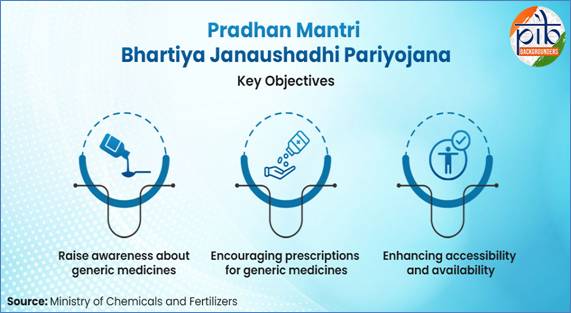
A significant initiative in this direction was the launch of the Pradhan Mantri Bhartiya Janaushadhi Pariyojana (PMBJP). The scheme seeks to provide quality-assured generic medicines at significantly lower prices through an expanding network of dedicated Jan Aushadhi Kendras (JAKs) across the country, thereby strengthening the affordability and access to generic pharmaceuticals.
Janaushadhi Saptah 2026 was launched as a nationwide outreach initiative to promote awareness of affordable, quality generic medicines, culminating in the observance of the 8th Janaushadhi Diwas on 7 March. As part of the week-long programme, health check-up camps were organised from 1 to 5 March 2026 at over 250 locations across the country by the Pharmaceuticals and Medical Devices Bureau of India (PMBI) under the Department of Pharmaceuticals, Ministry of Chemicals and Fertilisers.
Aligned with this year’s theme, “Janaushadhi Sasti Bhi, Bharosemand Bhi, Sehat Ki Baat, Bachat Ke Saath,” the initiative combines on-site diagnostic services with public engagement activities to enhance awareness about the availability of affordable, quality-assured generic medicines at JAKs.
Quality Assurance of Medicines under PMBJP
Medicines supplied under PMBJP are procured exclusively from manufacturers compliant with the World Health Organization’s Good Manufacturing Practices (WHO-GMP), thereby ensuring adherence to internationally recognised quality standards. Each batch undergoes rigorous testing at laboratories accredited by the National Accreditation Board for Testing and Calibration Laboratories (NABL). Distribution to Jan Aushadhi Kendras is undertaken only after the medicines conform to prescribed quality parameters.
Widening the Footprint of Affordable Medicines Across India
Under the scheme, over 18000 Jan Aushadhi Kendras (JAKs) are operational. The scheme’s product portfolio includes 2,110 medicines, 315 surgical items, medical consumables, and devices spanning 29 therapeutic categories, including anti-infectives, anti-diabetics, cardiovascular drugs, anti-cancer medications, and gastrointestinal treatments. On average, about 10 to 12 lakh persons visit these Kendras daily and avail quality medicines at affordable prices across the country, including in rural and remote areas.
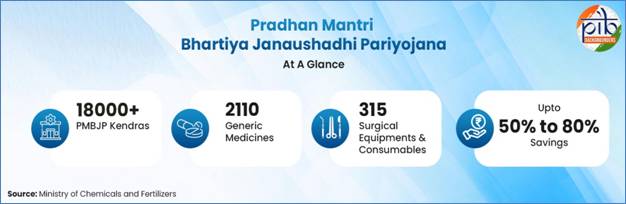
Notably, the maximum retail prices (MRPs) of medicines available under the PMBJP are generally 50-80% lower than those of comparable branded medicines, significantly reducing rural households’ healthcare expenditure. By June 2025, Jan Aushadhi medicines with an aggregate MRP value of ₹7,700 crore have been sold, generating estimated savings of approximately ₹38,000 crore for citizens relative to equivalent branded alternatives.
Franchise-Based Expansion of the Janaushadhi Kendras (JAKs)
The Government has set a target to open 25,000 JAKs under the scheme by March 2027. To achieve this target, a franchise-based model has been adopted. Online applications are invited from individual entrepreneurs, non-governmental organisations, societies, trusts, firms, and private entities through the official portal of the Pharmaceuticals and Medical Devices Bureau of India (PMBI), www.janaushadhi.gov.in. This inclusive framework supports the establishment of JAKs across urban, rural, and remote areas, including blocks and tehsils, helping to ensure wider access to affordable, quality-assured generic medicines for all.
Citizen-Centric Initiative: Janaushadhi Suvidha Sanitary Napkin
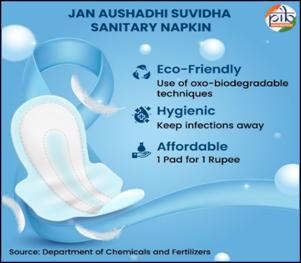 The PMBJP has introduced several citizen-centric initiatives to improve accessibility, affordability, and awareness in healthcare delivery. The Janaushadhi Suvidha Oxo-biodegradable Sanitary Napkins is one key initiative, introduced in 2019, to enhance affordable access to menstrual hygiene products for women across India. Priced at a highly subsidized rate of ₹1 per pad, the initiative aims to reduce financial barriers to safe menstrual practices. The napkins incorporate an Oxo-biodegradable additive that facilitates degradation upon exposure to oxygen after disposal, supporting environmentally responsible consumption.
Aligned with the principles of hygiene, health, and accessibility, the initiative particularly benefits economically vulnerable women. By 31 January 2026, more than 100 crore Suvidha sanitary pads have been sold under the scheme. Of these, over 22.50 crore pads were sold during FY 2025–26 alone, up to 31 January 2026. Currently, over 18,000 JAKs nationwide distribute Suvidha napkins, thereby expanding access to safe and hygienic menstrual products.
Digital-Enabled initiative: Jan Aushadhi Sugam Mobile Application
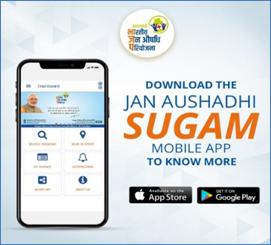 The “Jan Aushadhi Sugam” mobile application was launched in 2019 to strengthen accessibility, transparency, and user convenience. The application serves as a digital interface that enables citizens to access information on generic medicines and related services in a streamlined manner.
Key features include:
The Jan Aushadhi Sugam App is available free of charge on both Android and iOS platforms via the Google Play Store and Apple App Store. The application represents a significant digital governance intervention aimed at expanding access to affordable medicines and promoting informed adoption of quality generic drugs nationwide.
Strengthening Last-Mile Healthcare Access through Strategic JAK Expansion
The scheme not only focuses on expanding the network of Jan Aushadhi Kendras (JAKs) but also emphasizes ensuring their operational stability and long-term sustainability. In this regard, several strategic measures have been undertaken to reinforce the viability and effectiveness of JAKs:
JAKs at Railways Stations
Under the scheme, a total of 116 JAKs have been established at railway stations across the country as of 31 January 2026. This initiative seeks to enhance accessibility by ensuring the availability of quality, affordable medicines to the public, including migrant workers and low-income travelers, at the railway station. Their presence at high-footfall transit hubs enhances last-mile accessibility and promotes timely access to essential medicines at reduced prices.
Institutional and Regulatory Requirements for Establishing a PMBJK Outlet
Individuals holding a D. Pharma or B. Pharma qualification, as well as individuals/organizations employing a qualified pharmacist, are eligible to establish a JAKs. The principal eligibility criteria and procedural requirements for applying and setting up such an outlet are as follows:
Promoting Inclusive Entrepreneurship through Financial Incentives
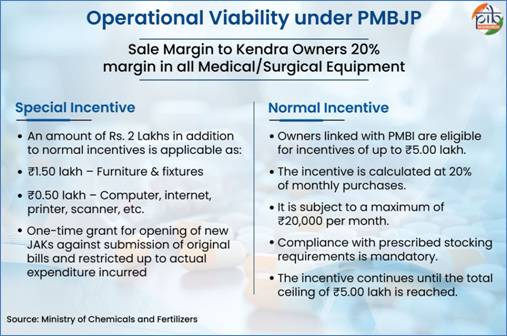
Under the PMBJK, a structured incentive approach supports the financial viability and operational sustainability for Kendra operators. Operators receive a 20% trade margin on the MRP of each drug (excluding taxes). They are also eligible for performance-linked monthly incentives up to a prescribed limit. In addition, a one-time special incentive is provided to Women, Divyangjan, SC/ST entrepreneurs, and those opening Kendras in aspirational and geographically disadvantaged regions. Therefore, the incentives encourage inclusive participation in expanding access to affordable medicines.
Special Incentives
Special incentives shall be granted for PMBJK opened by women entrepreneurs, Divyang, Scheduled Caste (SC), Scheduled Tribe (ST), and any entrepreneur opening a Jan Aushadhi Kendra in aspirational districts (backward districts) as notified by the NITI Aayog & in Himalayan, Island territories, and North-Eastern States. An amount of Rs. 2.00 lakhs in addition to normal incentives as applicable is to be given to the above-mentioned entrepreneurs as mentioned below:
This will be a one-time grant for the opening of a new PMBJK, subject to the submission of original bills and restricted to the actual expenditure incurred.
Normal Incentive
PMBJKs run by entrepreneurs, pharmacists, NGOs, and charitable organisations linked with the Pharmaceuticals and Medical Devices Bureau of India (PMBI) are eligible for incentives of up to ₹5.00 lakh. The incentive is provided at 20% of monthly purchases, subject to a maximum of ₹20,000 per month and compliance with stocking requirements. It continues until the total limit of ₹5 lakh is reached.
This benefit also applies to Kendras opened by women entrepreneurs, Divyangjan, SC/ST entrepreneurs, and those established in Aspirational Districts, Himalayan regions, Island territories, and North-Eastern States.
Supply Chain Strengthening and Logistics Management
The Pharmaceuticals and Medical Devices Bureau of India (PMBI) has undertaken a series of systemic measures to strengthen the supply chain and ensure seamless availability of medicines at JAKs.
Additionally, PMBI continuously monitors 400 fast-moving products and carries out systematic demand forecasting to maintain supply stability. The forecasting mechanism is being progressively digitised to strengthen procurement planning and improve operational efficiency through increased automation.
Conclusion
The Pradhan Mantri Bhartiya Janaushadhi Pariyojana (PMBJP) has become a key pillar in advancing affordable and equitable healthcare in India by ensuring widespread access to quality generic medicines at substantially lower prices. Through a steadily expanding network of Jan Aushadhi Kendras, robust quality assurance mechanisms, and digital tools that enhance transparency and convenience, the scheme has helped reduce households’ financial burden of medical expenses nationwide.
By promoting inclusive entrepreneurship and introducing citizen-focused initiatives such as affordable sanitary products and nationwide awareness campaigns, PMBJP goes beyond cost reduction to foster accessibility, trust, and empowerment. As the programme continues to expand its reach, it reinforces the Government’s commitment to delivering reliable, affordable healthcare for all.
References
Ministry of Chemicals and Fertilizers
https://pharma-dept.gov.in/sites/default/files/Website%20updation%202022%20PMBJP-1.pdf
https://janaushadhi.gov.in/pmbjb-scheme
https://janaushadhi.gov.in:10443/jasprodobt/Reports/2a61804b7f5e77bf.pdf
https://janaushadhi.gov.in/pdf/Guidelines_for_PMBJK_Opening.pdf
https://pharma-dept.gov.in/sites/default/files/Final%20English%202024-25%20AR%20%281%29.pdf
https://docs.google.com/document/d/1TZPY6zew0R-AeqKLHDrWQV1ZIchhj9VN/edit
https://pharma-dept.gov.in/schemes/pradhan-mantri-bhartiya-janaushadhi-pariyojana-pmbjp
https://www.pib.gov.in/PressReleasePage.aspx?PRID=2222524®=3&lang=2
https://www.pib.gov.in/PressReleaseIframePage.aspx?PRID=2067441
https://www.pib.gov.in/PressNoteDetails.aspx?NoteId=153880&ModuleId=3
https://www.pib.gov.in/PressReleasePage.aspx?PRID=2151306®=3&lang=2
Ministry of Cooperation
https://www.pib.gov.in/PressReleaseIframePage.aspx?PRID=2115196®=3&lang=2
Lok Sabha
https://sansad.in/getFile/loksabhaquestions/annex/184/AU4695_9qRCcY.pdf?source=pqals
https://sansad.in/getFile/loksabhaquestions/annex/184/AU718_3HBGam.pdf?source=pqals
https://sansad.in/getFile/loksabhaquestions/annex/185/AU1135_zwHF0O.pdf?source=pqals
https://sansad.in/getFile/annex/268/AU176_9hqb7T.pdf?source=pqars
https://sansad.in/getFile/annex/268/AU176_9hqb7T.pdf?source=pqars
https://sansad.in/getFile/annex/268/AU982_1cjye3.pdf?source=pqars
https://sansad.in/getFile/loksabhaquestions/annex/185/AU3399_rd2kkX.pdf?source=pqals https://sansad.in/getFile/loksabhaquestions/annex/185/AU1014_Bneo3x.pdf?source=pqals
https://sansad.in/getFile/annex/270/AU418_OipWQZ.pdf?source=pqars
https://www.pib.gov.in/PressReleseDetail.aspx?PRID=2234273®=20&lang=1
PIB
https://static.pib.gov.in/WriteReadData/specificdocs/documents/2025/jan/doc202516481901.pdf
https://www.pib.gov.in/PressReleasePage.aspx?PRID=2108862®=3&lang=2
https://static.pib.gov.in/WriteReadData/specificdocs/documents/2021/dec/doc2021123031.pdf
https://www.pib.gov.in/FeaturesDeatils.aspx?NoteId=157637&ModuleId=2®=3&lang=1