PM e-Vidya
PM e-Vidya
Key Takeaways
Introduction
Education and dissemination of knowledge play vital roles in shaping the intellectual and social foundations of students, preparing them to contribute meaningfully to a rapidly changing world. Recognising the need for a future-ready education system that is inclusive and responsive to diverse learner needs, the Government articulated this vision through the National Education Policy (NEP) 2020. The NEP 2020 lays out a transformative vision for India’s education system. It aims to ensure equitable access to quality education and promote holistic and multidisciplinary learning. The policy also seeks to foster critical thinking and creativity, while leveraging technology to improve teaching and learning outcomes. India has 24.8 crore school-going children[1] and 4.33 crore students enrolled in higher education (AISHE 2021-22)[2] [3], but many of them live in remote geographies where access to educational institutions remains limited, and regular classroom attendance is often constrained by socio-economic compulsions such as household responsibilities and the need to engage in livelihood activities. These challenges are further compounded by persistent shortages of trained teachers in several regions, leading to uneven learning outcomes. The COVID-19 pandemic also disrupted conventional classroom education, impacting nearly 25 crore school children and accelerated the need for innovative solutions. In this context, digital education was envisioned as a critical enabler of flexibility and inclusion; for students unable to reach classrooms, classrooms were taken to them. The Government of India launched the PM e-VIDYA initiative as a comprehensive digital education programme to ensure continuity of learning online. Built on the principle of “One Nation, One Digital Education Infrastructure,” PM e-VIDYA integrates multiple platforms—such as DIKSHA, SWAYAM, SWAYAM Prabha TV channels, radio, podcasts, and community-based digital access to deliver inclusive, accessible, and technology-enabled education to learners across the country, thereby aligning with the long-term objectives of NEP 2020.
Evolution of PM e-Vidya: Education Through Digital Platform
PM e-VIDYA was initially launched on 17 May 2020 as an emergency multi-mode digital education response amid the nationwide COVID-19 lockdown, enabling continuity of learning through television, radio, and online platforms. It was subsequently formalised and renamed under the Atmanirbhar Bharat Abhiyan on August 7, 2020, integrating existing digital assets into a unified framework.
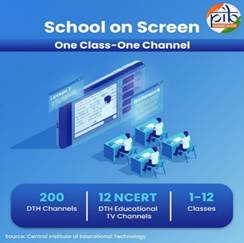
It builds upon foundational programs such as Digital India, the National Mission on Education through Information and Communication Technology (NMEICT) and SWAYAM MOOCS platform, SAMAGRA Shiksha, and NISHTHA’s teacher training and capacity-building efforts. Core operational pillars include the One Class, One TV Channel[4] under PM e-VIDYA’s SWAYAM PRABHA component, the One Nation, One Digital Platform vision embodied in DIKSHA[5] and SWAYAM MOOCS portal.
PM e-Vidya: Key Pillars
PM e-Vidya comprises six key pillars, which integrate online, on-air, and offline channels to ensure universal access to inclusive and equitable digital education. These include: Study Webs of Active-Learning for Young Aspiring Minds (SWAYAM), SWAYAM Prabha, Digital Infrastructure for Knowledge Sharing (DIKSHA), Extensive use of Radio, Community radio and Podcasts, Special e-Content for CWSN, and Online Coaching for Competitive Exams.
Study Webs of Active-Learning for Young Aspiring Minds (SWAYAM)
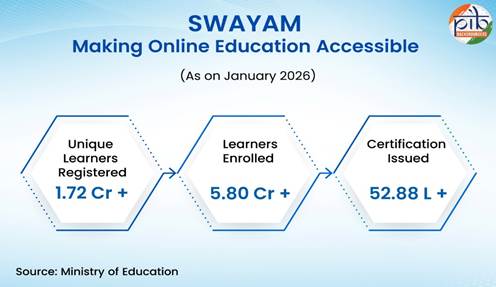
SWAYAM, launched in collaboration with IIT Madras, is a flagship national initiative envisaged to provide learners free access to high-quality educational content in alignment with the vision of “Anyone, Anywhere, Anytime Learning.” The platform offers a diverse range of courses across multiple disciplines, curated by premier institutions to support holistic and well-rounded learning. As of January 2026, over 4,400 unique courses have been developed on SWAYAM by ten National Coordinators, namely NPTEL, UGC, AICTE, CEC, IGNOU, IIMB, NITTTR, INI, NCERT, and NIOS. Since its inception, SWAYAM MOOCs have witnessed cumulative enrolments of approximately 5.80 crore learners, with 52.88 lakh certifications awarded.
In order to facilitate the seamless integration of online learning within the formal higher education system, the University Grants Commission (UGC) notified the Credit Framework for Online Learning Courses through SWAYAM Regulations, 2021, which enables higher education institutions to offer up to 40 per cent of the total courses of a programme in a semester through SWAYAM.
Further, with a view to enhancing academic flexibility and learner convenience, UGC has also notified a framework for universities to conduct examinations for SWAYAM courses. This framework permits universities that have adopted the regulations to conduct SWAYAM examinations, thereby further strengthening institutional participation and student-centric implementation of online learning.
The courses on SWAYAM incorporate four key components: (1) video lectures, (2) downloadable and printable reading materials, (3) self-assessment tests via quizzes and exams, and (4) an online discussion forum to resolve doubts. The learning process is enhanced through the integration of audio-video elements, multimedia, and advanced pedagogical and technological methods.
All courses provided via SWAYAM are free for learners. However, those seeking an official SWAYAM certificate must register for proctored final exams, which involve a fee, and attend them in person at designated centers on scheduled dates. Certificate eligibility details are specified on each course page, and certificates are awarded only upon meeting these requirements. Universities and colleges that approve credit transfers can incorporate the marks or certificates from these courses into students’ academic records.
SWAYAM Prabha
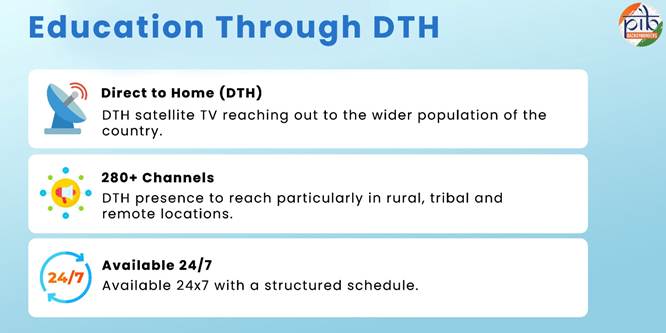
The SWAYAM PRABHA is a group of 48 DTH channels devoted to telecasting of high-quality educational programmes with an aim to make education accessible especially for rural area students. These channels are freely available for all learners across the country and broadcast through DD Free dish and internet applications.
In December 2024, the Government of India launched Channel 31 on DTH, dedicated to Indian Sign Language (ISL) training for hearing-impaired students, special educators, interpreters, and relevant organisations.
SATHEE
Ministry of Education in collaboration with IIT Kanpur has launched Self-Assessment, Test, and Help for Entrance Examination (SATHEE) platform in November 2023.
The platform provides free access to quality content, curated by the academicians from prestigious institutions such as the Indian Institutes of Technology (IITs) and All India Institute of Medical Sciences (AIIMS). These contents are designed to support students/ learners in their preparation for various competitive examinations, including JEE, NEET, SSC, ICAR, CUET, IBPS, etc.
Key features of SATHEE include:
• Recorded and live lectures by expert faculty from IITs and AIIMS
• Daily Practice Problems (DPPs), mock tests, and self-assessment tools to continuously track and improve performance
• Motivational sessions and mentorship from top institutional mentors
• Access to a comprehensive repository of 80,000+ high-quality questions aligned with competitive exam standards.
• Interactive doubt-clearing sessions conducted by IIT and AIIMS students.
• Intensive crash courses before exams, including All India Mock Test Series for real exam simulation.
• Multilingual content, available in Hindi, English, and several regional languages.
In order to facilitate wider outreach and enable effective preparation for various competitive examinations, a set of seven dedicated Direct-to-Home (DTH) channels has been made operational. Furthermore, to enhance accessibility and ensure seamless user experience across devices, mobile applications for both iOS and Android platforms have been launched, allowing learners and students to access the platform’s resources anytime and anywhere.
Aligned with NEP 2020’s emphasis on technology-enabled equitable education and skill development, SATHEE has empowered lakhs of aspirants with data-backed preparation strategies, real-time progress tracking, and mentorship from IIT faculty and toppers. This, in turn, aptly bridges the gap between aspiration and achievement in higher education and employment.
Digital Infrastructure for Knowledge Sharing (DIKSHA)
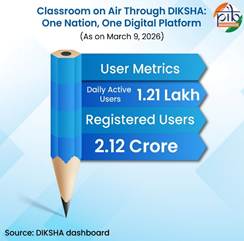
The DIKSHA (Digital Infrastructure for Knowledge Sharing) portal and mobile app serve as India’s flagship national digital ecosystem for school education. It has been developed under the aegis of the Ministry of Education, Government of India. The platform is spearheaded by the National Council of Educational Research and Training (NCERT) in collaboration with the Central Institute of Educational Technology (CIET). Launched in 2017, DIKSHA is an open-source platform that gives students, teachers, and administrators across India easy access to high-quality, curriculum-linked digital learning materials. It can be customised and works in a federated way to suit different needs.
DIKSHA enables complete K–12 digital learning across NCERT, CBSE, NIOS, and State/UT boards, covering foundational literacy and numeracy (FLN) to senior secondary education. It promotes equity by providing standardised, syllabus-aligned digital content accessible to learners nationwide. It features media-rich, interactive resources, including 2D/3D animations, AR experiences, simulations, virtual labs, and sign language videos, designed to enhance conceptual clarity and cater to diverse learning styles. The platform bridges the print-digital divide through QR-coded Energised Textbooks, linking physical NCERT books to videos, interactives, and teacher guides for seamless classroom engagement. For the differently-abled learners it provides inclusive features like DAISY (Digital Accessible Information System) format, text-to-speech, and Indian Sign Language (ISL) videos.
DIKSHA empowers personalised learning with unlimited practice questions, detailed solutions, adaptive assessments, and competency-based question banks that identify gaps and enable timely remediation. It supports teacher professional development via NISHTHA and state-specific TPD modules, offering self-paced, certified training to upskill educators nationwide. This integrated ecosystem—combining content creation, curation, consumption, and analytics—drives inclusive, data-informed, and joyful learning aligned with NEP 2020.
Education on AIR: Mukta Vidya Vani and Shiksha Vani
Under the PM e-Vidya initiative, Mukta Vidya Vani, operated by the National Institute of Open Schooling (NIOS), is India’s pioneering educational web radio, delivering live, interactive audio streaming for learners in Secondary, Senior Secondary, and Vocational streams. Celebrating over five years of impactful service, it facilitates two-way communication through live Personal Contact Programmes (PCPs) on academic subjects, broadcast via web streaming and rebroadcast on Radio Vahini (FM 91.2 MHz),[6] to extend reach to non-digital audiences. All sessions are archived 24×7 on the NIOS platform, with additional dissemination through YouTube and Facebook, ensuring anytime, anywhere access for open school learners. Complementing this, CBSE’s Shiksha Vani Podcast offers over 400 curriculum-aligned audio modules for Classes 9-12[7], covering NCERT topics in a concise, engaging format, freely accessible via the Shiksha Vani mobile app on Google Play.
Complementing digital and broadcast media, Doordarshan (DD) and All India Radio (AIR)[8] deliver nationwide educational programming under PM e-Vidya, broadcasting curriculum-based virtual classes for primary to senior secondary levels, board exam preparation (including model question papers), JEE/NEET entrance guidance, and enrichment content like storytelling and quizzes. Scheduled in morning and afternoon slots for optimal reach, these programs leverage TV, radio, and YouTube to support learners in remote and underserved areas with no internet dependency.
Universal Design, Early Inclusion: Digital Learning for CwSN
Under the PM e-Vidya initiative, inclusive digital education for Children with Special Needs (CwSN) is prioritised through tailored resources on the DIKSHA platform and NIOS systems. Audiobooks in Digitally Accessible Information System (DAISY) format and an Indian Sign Language (ISL) Dictionary[9] are readily available, enabling visually and hearing-impaired learners to access curriculum-aligned content independently.
NIOS has developed over 270 ISL videos covering 7 secondary-level subjects and Yoga[10], hosted on YouTube and distributed via DVDs. Additionally, NCERT has converted textbooks into digital e-books (UNICODE) compatible with Text-to-Speech (TTS) tools and developed tactile maps and low-cost e-learning modules for home-based education for students with severe disabilities—ensuring continuity of learning in alignment with NEP 2020’s vision of equitable and barrier-free education.
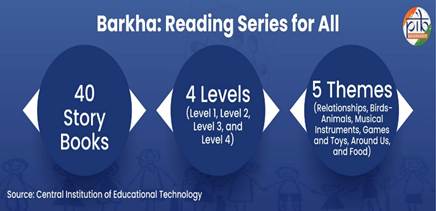
A pioneering effort in early inclusion, Barkha: A Reading Series for ‘All’, developed by the Department of School Education & Literacy, exemplifies Universal Design for Learning (UDL) through 40 multilingual story booklets[11] [12]available in both print and digital formats. Featuring tactile visuals, high-contrast illustrations, accessible scripts, and audio-video introductions in ISL and spoken language, Barkha fosters foundational literacy in diverse learners, including those with visual, cognitive, or motor challenges. The digital version, accessible via NCERT’s website and ePathshala, allows personalised, self-paced reading on any device, promoting privacy, autonomy, and joy in learning. By embedding sign language as a regular communication mode from the foundational stage, Barkha not only supports CwSN but also sensitises all children to inclusive practices, thus serving as a scalable model for developing accessible textbooks and learning materials across all educational stages.
Conclusion
PM e-Vidya has evolved from an emergency response during the COVID-19 pandemic into a robust, scalable, and inclusive digital public infrastructure that embodies the transformative vision of NEP 2020. It ensures multi-modal access—online, on-air, and offline—to high-quality, curriculum-aligned, and multilingual learning resources for over 24.8 crore school-going children, educators, adult learners, and competitive exam aspirants across urban and rural India. PM e-Vidya has effectively bridged the digital divide while advancing foundational literacy, teacher empowerment, and lifelong learning.
As India marches ahead towards Viksit Bharat@2047, PM e-Vidya stands as a global benchmark for technology-enabled, equitable, and adaptive education system. By prioritising inclusion and last-mile connectivity, it empowers every learner regardless of location, language, or ability, to realise their full potential. Sustained investment, stakeholder collaboration, and continuous innovation will ensure that PM e-Vidya not only sustains but accelerates India’s journey toward universal, joyful, and future-ready education.
References:
Press Information Bureau:
https://www.pib.gov.in/PressReleasePage.aspx?PRID=2097864
https://www.pib.gov.in/PressReleasePage.aspx?PRID=1900797
https://www.pib.gov.in/PressReleasePage.aspx?PRID=1997882
PM e-Vidya:
https://pmevidya.education.gov.in/radio.html
https://pmevidya.education.gov.in/cwsn.html
https://pmevidya.education.gov.in/swayam-portal.html
Central Institute of Educational Training:
https://ciet.ncert.gov.in/barkhaa
https://ciet.ncert.gov.in/initiative/nistha
SWAYAM:
SWAYAM Prabha:
https://www.swayamprabha.gov.in/about/competitive
https://www.swayamprabha.gov.in/about
Ministry of Education:
https://www.nios.ac.in/departmentsunits/media-unittelecast/mukta-vidya-vani-and-community-radio.aspx
https://cdnbbsr.s3waas.gov.in/s3kv04a78efe4184c43df899cc8ec2e7bd/uploads/2024/08/2024081655-1.pdf
https://dsel.education.gov.in/en/nep-overview