Ol Chiki Script
Ol Chiki Script
Key Takeaways
Introduction
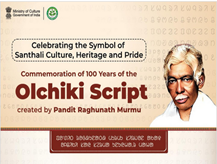
For centuries, knowledge and cultural memory were transmitted through speech rather than writing. Rooted in rich traditions of folklore, songs, rituals, and storytelling, the Santhali language sustained its continuity through a vibrant oral heritage that preserved identity across generations.
The Ol Chiki is the official script of the Santhali language, one of India’s prominent tribal languages spoken widely across Jharkhand, Odisha, West Bengal, Assam, and Bihar. Belonging to the Austroasiatic language family, Santhali has historically thrived through these oral traditions. However, while this strength ensured cultural continuity, the absence of a standardised script posed significant challenges for documentation, formal education, and literary development.
Marking the start of the Ol Chiki script centenary celebrations, the inaugural event brings together key dignitaries and commemorative initiatives to honour its legacy.
Inaugural Ceremony of Ol Chiki Script Centenary Celebrations
The Ministry of Culture, in collaboration with Fagun (a monthly Santhali newspaper), is organising the Inaugural Function of the Centenary Celebrations of the Ol Chiki Script, created by Pandit Raghunath Murmu, on 16th February 2026 at Dr Ambedkar International Centre, New Delhi.
The Hon’ble President of India, Droupadi Murmu, is gracing the occasion as the Chief Guest. The programme is also being attended by the Union Minister of Tribal Affairs, Shri Jual Oram, and the Union Minister of Culture & Tourism, Shri Gajendra Singh Shekhawat.
Programme Highlights
Historical Background
Prior to the 20th century, Santhali was transcribed using various borrowed scripts, including Roman, Bengali, Odia, and Devanagari. These scripts facilitated limited written expression, and hence, were not specifically designed to accurately represent the distinctive phonetic features of Santhali. The language includes unique sounds, such as glottal stops and specific vowel patterns, which have been difficult to accurately represent using external writing systems. Consequently, this often led to distortions in pronunciation and meaning, thereby creating obstacles in educational contexts and hampering systematic linguistic development preservation.
At the heart of the Ol Chiki movement stands the visionary who transformed Santhali from an oral tradition into a written legacy.
Pandit Raghunath Murmu: Architect of Ol Chiki
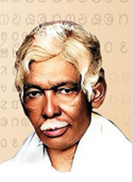
Guru Pandit Raghunath Murmu, a revered figure in the Santhali community, was born in 1905 in Dandbose village of Mayurbhanj district in Odisha. Deeply immersed in Santhali traditions from a young age, he was driven by the need to give his language a distinct written identity. This vision led to the creation of the Ol Chiki script, providing Santhali with its own scientific and phonetic writing system.
Beyond his scholarly pursuit, he actively worked to promote literacy and awareness of Ol Chiki among Santhali communities across regions. His dedication to cultural preservation and education earned him the honorary title of “Pandit”.
Pandit Murmu also wrote influential works such as Bidu-Chandan, which reflected the depth of Santhali culture and emotions through the script. His contributions received wide recognition, including an honorary doctorate from Ranchi University and honours from the Odisha Sahitya Akademi.
Creation of Ol Chiki Script
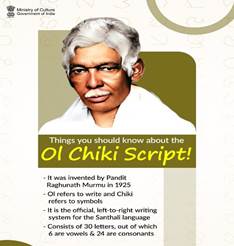
Ol Chiki was developed in 1925 by Pandit Raghunath Murmu to provide Santhali with a scientific and dedicated writing system.
Key Linguistic Features Include:
Unlike adapted scripts, Ol Chiki provided a linguistically precise and culturally rooted medium of written expression.
The introduction of Ol Chiki marked a turning point in the evolution of Santhali as a written language. By providing a script rooted in linguistic authenticity, it enabled the language to transition from an exclusively oral medium to a structured written form.
The script made it possible to record vocabulary, grammar, and pronunciation with accuracy. It also facilitated the standardisation of language use, thereby supporting teaching, translation, and publication.
Constitutional Milestone: Inclusion of Santhali in the Eighth Schedule (2003)
A defining moment in the journey of the Ol Chiki script came in 2003, when the Santhali language was formally included in the Eighth Schedule of the Constitution of India through the 92nd Constitutional Amendment Act. This historic recognition marked the transition of Santhali from a culturally rich but administratively marginalised language into one acknowledged within India’s formal linguistic framework. The inclusion enabled the language to receive institutional support in education, governance, and public communication, while also facilitating its use in competitive examinations, literary promotion, and academic research. Crucially, this recognition strengthened the adoption of the Ol Chiki script in formal domains such as school curricula and state-level publications. It was not merely a linguistic inclusion but an affirmation of the identity, heritage, and intellectual traditions of the Santhal community.
Constitution in Santhali: Advancing Linguistic Justice and Democratic Access
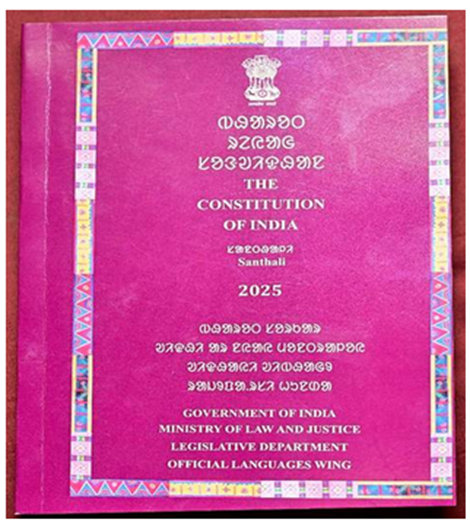
In a landmark initiative to expand constitutional awareness and accessibility, the Constitution of India was officially translated into the Santhali language using the Ol Chiki script and released in December 2025. Published by the Legislative Department, this marked the first time that the nation’s foundational legal text became available in Santhali in its own indigenous script. The translation represents a significant step towards ensuring that constitutional values and rights are accessible to Santhali-speaking citizens in a linguistically familiar form. By enabling direct engagement with constitutional provisions related to governance and equality, and with tribal safeguards under the Fifth and Sixth Schedules, the initiative strengthens participatory democracy. It also reinforces the role of the Ol Chiki script as the principal medium of written expression for the Santhali language.
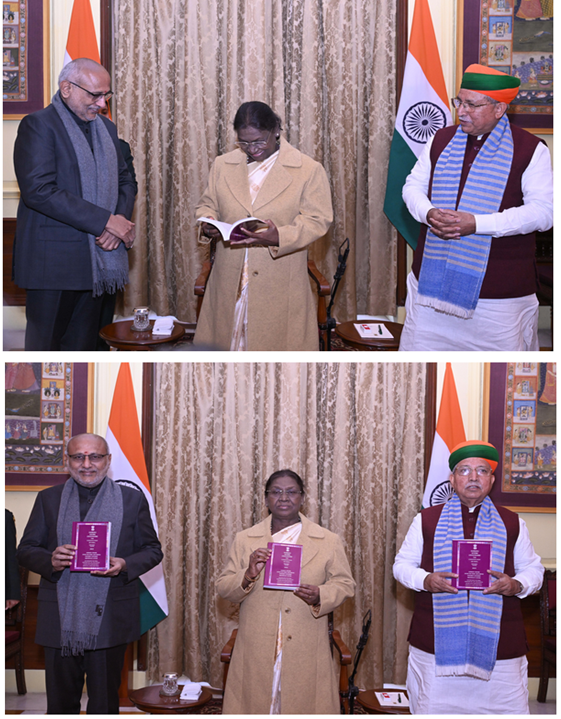
The release, coinciding with the centenary year of the script created by Pandit Raghunath Murmu, reflects the growing institutional recognition of linguistic inclusion in advancing democratic empowerment.
Commemorative Coin and Postage Stamp for 100 Years of Ol Chiki Script
In recognition of the enduring cultural and linguistic contribution of the Ol Chiki script, the Government of India is issuing a ₹100 commemorative coin to mark its centenary (1925–2025).
The design of the coin reflects both national symbolism and cultural tribute: the obverse features the Lion Capital of Ashoka along with the denomination, while the reverse bears the portrait of Pandit Raghunath Murmu set against a backdrop of Ol Chiki characters, accompanied by an inscription commemorating 100 years of the script.
This issuance represents formal national recognition of the script’s transformative role in strengthening linguistic identity, promoting literacy, and preserving indigenous heritage. By placing the Ol Chiki script within India’s commemorative coinage, the initiative acknowledges its significance in the country’s cultural mosaic and reaffirms the importance of safeguarding tribal knowledge traditions for future generations.
Complementing this numismatic tribute, a commemorative postage stamp is also being issued to mark the centenary milestone. Keeping in mind India’s long-standing philatelic tradition of honouring cultural and linguistic achievements, the stamp serves as an enduring symbol of national recognition.
Conclusion
Today, Ol Chiki represents far more than a writing system. It stands as a symbol of linguistic dignity, cultural resilience, and intellectual self-determination. Over the past century, the script has enabled Santhali speakers to assert their identity while engaging with modern education and public life. It has also contributed to strengthening India’s linguistic diversity by ensuring that indigenous voices find expression within formal knowledge systems.
The centenary of the Ol Chiki script marks not just the passage of time, but the enduring power of language as a foundation of identity, dignity, and cultural continuity. From its creation in 1925 by Pandit Raghunath Murmu to its role in enabling education, literature, and constitutional recognition, Ol Chiki has transformed the Santhali language from an oral tradition into a vibrant written medium. Its journey reflects the resilience of indigenous knowledge systems and the importance of preserving linguistic diversity within the national framework.
The inclusion of Santhali in the Eighth Schedule in 2003 and the issuance of a commemorative coin and stamp marking 100 years of Ol Chiki together symbolise the recognition of this script as an integral part of India’s cultural heritage. As Ol Chiki enters its next century, it stands as both a bridge between tradition and modernity and a beacon for future generations, reaffirming the idea that language is not merely a means of communication, but a living expression of collective memory and identity.
References
The President of India
https://presidentofindia.nic.in/press_releases/president-india-releases-constitution-india-santhali-language
Ministry of Culture
https://www.instagram.com/p/DUvMW5jEy61/
Ministry of Finance
https://egazette.gov.in/WriteReadData/2026/269981.pdf
All India Radio
https://www.newsonair.gov.in/president-murmu-releases-constitution-in-santhali-language-at-rashtrapati-bhavan/
Press Information Bureau
https://www.pib.gov.in/PressReleasePage.aspx?PRID=2208484®=3&lang=1
https://www.pib.gov.in/PressReleseDetail.aspx?PRID=2208453®=6&lang=1