North East institute synthesises biobased compound that can substitute lubricants in cosmetic industry
North East institute synthesises biobased compound that can substitute lubricants in cosmetic industry
An institute of the Department of Science and Technology (DST) based in North East India has synthesised a novel biosurfactant with promising antibacterial and cleansing properties using natural substances.
The compound has been found to act effectively against bacterium Staphylococcus aureus responsible for skin and wound infections, and demonstrates enhanced stain removal efficiency when blended with commercial face washes.
It can be used in cosmetics and medicines and can be a replacement for artificial surfactants.
Surfactants are extensively promoted as lubricants, dispersants, and emulsifiers in several industries. Nevertheless, there is a pressing need for bio-based alternatives owing to growing concerns of toxicity and non-biodegradability of synthetic surfactant analogues.
A study led by Prof. Ashis K. Mukherjee, Director of IASST, and his colleagues Prof. M. R. Khan and Ms. Anushree Roy, SRF, synthesized biosurfactants employing the probiotic Lactobacillus plantarum JBC5, employing ghee, a ubiquitous and culturally relevant milk product, as a new, lipid-rich substrate.
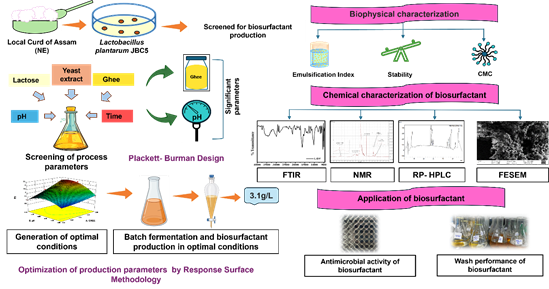
Fig: Schematic representation of biosurfactant production from Lactobacillus plantarum JBC5 using ghee as a lipid-rich substrate including process optimisation, characterisation and application thereof
The optimum production of biosurfactant was achieved by a technique called response surface statistical analysis. The lipopeptide biosurfactant achieved a maximum emulsification index of 60% for edible oils and demonstrated surface tension-reducing properties similar to other surfactants. It demonstrated exceptional stability at elevated temperatures (up to 276 °C) and across diverse pH levels.
Its antibacterial efficacy against Staphylococcus aureus and enhanced stain removal capabilities when used with commercial face wash underscore its potential use in cosmetics and medicines, substituting detrimental artificial surfactants.
The scientists are carrying out further toxicity assessments, dose standardization, and collaborative industry-driven research to expedite commercialization of the compound.
Publication Link: https://doi.org/10.1016/j.procbio.2025.08.015