Ministry of Steel organizes Chintan Shivir at Mandi Gobindgarh to deliberate on Green Steel with a focus on Secondary Steel Sector
Ministry of Steel organizes Chintan Shivir at Mandi Gobindgarh to deliberate on Green Steel with a focus on Secondary Steel Sector
A one-day Chintan Shivir was conducted at National Institute of Secondary Steel Technology (NISST), Mandi Gobindgarh, initiating the deliberations on green steel Production in the country. The event was inaugurated by Shri Sandeep Poundrik, Secretary, Ministry of Steel, Additional Secretary & Financial Advisor, Joint Secretary and other officials of the Ministry of Steel, CPSEs, technical experts, Industry associations and representatives from secondary sector participated in the event.
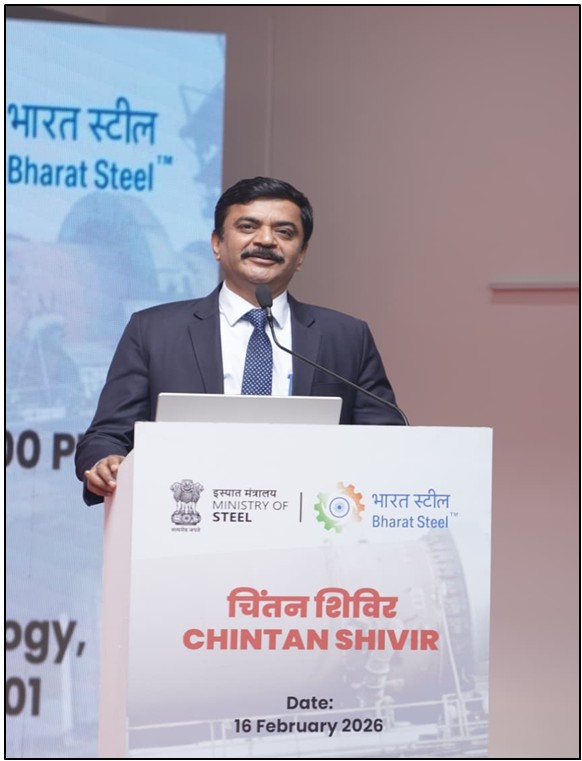
In his address, Shri Sandeep Poundrik, Secretary (Steel) highlighted the importance of secondary steel sector which contributes almost 47% of total steel production in India. India is the only country where the production, consumption and installed capacity is on increasing trend each year with annual growth of 8-10%. He appreciated the role of the NISST in development of secondary steel sector and informed the gathering that NISST is now fulfilling its objectives by conducting training programs twice a month across the different steel clusters in the country. NISST has been designated as nodal agency for green steel certification and issued green steel certificate to 76 industries (10.98 MT) till now. He informed the participants that Ministry of Steel is working on an incentive scheme to encourage the secondary steel sector for technology improvement and consequently reducing the carbon emissions. Shri Daya Nidhan Pandey, Joint Secretary, Ministry of Steel and Chairman NISST also highlighted the role of NISST for capacity building of secondary steel sector.
The Chintan Shivir 2026 featured focused deliberations on emerging low-carbon technologies in the steel sector, including green hydrogen injection in blast furnaces for CO₂ reduction and the use of hydrogen in rotary kiln–based iron making. Sessions also covered deployment of Battery Energy Storage Systems (BESS) in the secondary steel sector to reduce grid dependence and optimize off-peak renewable power utilization. Discussions highlighted vertical shaft–based DRI production using water gas as a reductant, enabling fuel and raw material flexibility with lower emissions. Export opportunities for alloy steel products were reviewed, along with challenges arising from the Carbon Border Adjustment Mechanism (CBAM).
The discussions focused on upcoming green steel technologies, new breakthroughs and challenges towards green steel production. The deliberations brought together perspectives from policymakers, industry leaders and technical experts, with the aim of moving on path of green steel production and sustainable growth.