M.A.N.A.V.
M.A.N.A.V.
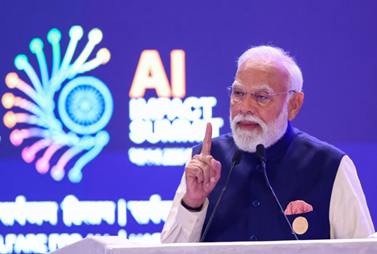
At the India AI Impact Summit 2026, India is bringing together technology leaders and policymakers across the globe to deliberate on the future of artificial intelligence. At Bharat Mandapam, the discussions reflect a shared aspiration, to shape AI in a manner that places humanity at its core.The India AI Impact Summit is being held in New Delhi from February 16-20, 2026.
Home to one-sixth of the world’s population, the largest youth cohort globally, and one of the most dynamic technology talent pools, India stands as both a creator and a rapid adopter of emerging technologies. This unique position confers not only scale, but also responsibility in shaping the global AI discourse.
During his inaugural address at the India AI Impact Summit on February 19, Prime Minister Narendra Modi outlined a nuanced approach to AInot as an autonomous force driven solely by data and algorithms, but as an extension of human aspirations, ethics, and dignity. He encapsulated this human-centric vision in the acronym M.A.N.A.V., presenting a roadmap where technological advancement progresses in harmony with societal values: Moral and Ethical Systems, Accountable Governance, National Sovereignty, Accessible and Inclusive AI, and Valid and Legitimate Systems.
India’s M.A.N.A.V. vision is not merely a conceptual framework articulated by the Prime Minister; it also reflects an ongoing national commitment to building a strong foundation through coordinated programmes and policy initiatives. These measures translate guiding principles into actionable outcomes across education, digital infrastructure, governance, and innovation ecosystems. Anchored in inclusivity, security, and public good, they ensure that India’s AI strategy remains both forward-looking and socially responsible. Together, they underscore that the vision is backed by concrete action and sustained institutional commitment.
The first pillar of the MANAV vision underscores that AI must be rooted instrong Moral and Ethical system. The Prime Minister emphasised fairness, transparency, and human oversight as non-negotiable principles in AI design and deployment. India is embedding these values early, beginning in classrooms and extending to society at large.
The National Education Policy 2020 prioritises digital and AI literacy, integrating computational thinking and AI concepts across educational levels. This ensures early exposure to data-driven decision-making and ethical AI principles, fostering a culture of innovation while preparing future-ready citizens for a rapidly evolving technological landscape.
Ethics also found powerful public expression at the Summit, where India set a global benchmark in responsible AI engagement by securing a Guinness World Records title for the highest number of pledges received for an AI responsibility campaign within 24 hours. An extraordinary 250,946 pledges transformed ethical AI from a policy principle into a collective national commitment.
The second pillar of MANAV vision, Accountable Governance, transparent rules and robust oversight, reinforces that trust in AI must be anchored in transparency, robust oversight, and clear institutional responsibility.
At the heart of this vision is the IndiaAI Mission, approved with an outlay exceeding ₹10,300 crore. This not only strengthens compute, data, skilling, and innovation capacity, but also embeds governance mechanisms into the AI ecosystem from the outset. By institutionalising standards for responsible development, deployment, and monitoring of AI systems, the Mission ensures structured oversight across public-sector applications and emerging technologies.
Complementing this are India’s AI Governance Guidelines, which establish a people-centric framework rooted in trust, equity, accountability, and fairness. Together, these measures create a transparent regulatory architecture that ensures AI systems in India remain explainable, lawful, and aligned with democratic values and constitutional principles.
National Sovereignty forms the third pillar of the MANAV vision. The Prime Minister asserted that in an AI-driven world, sovereignty extends beyond territorial boundaries to encompass data, algorithms, and digital infrastructure.
For India, this means securing critical datasets, strengthening domestic compute capacity, and fostering indigenous AI model development. Initiatives such as the India Semiconductor Mission, trusted data governance frameworks, and investments in secure digital public infrastructure reflect a commitment to technological self-reliance without digital isolation.
By building resilient domestic capabilities in chips, cloud, and advanced technologies, India is ensuring that its AI ecosystem remains globally collaborative yet strategically autonomous, safeguarding economic security and democratic institutions in the age of intelligent systems.
The fourth pillar of MANAV is Accessible and Inclusive AI, It affirms that artificial intelligence must serve as a multiplier for society, not a monopoly of a privileged few.
India’s Digital Public Infrastructure is enabling AI solutions to scale rapidly and affordably across healthcare, education, agriculture, and governance. Platforms such as MeghRaj GI Cloud and the IndiaAI Compute Portal are democratising access to shared computing resources including Graphics Processing Units (GPUs) and Tensor Processing Units (TPUs) significantly lowering entry barriers for startups, researchers, and institutions.
IndiaAI Kosh provides datasets and AI models across sectors, while the AI Data Labs Network and the National Supercomputing Mission are strengthening grassroots skills and high-performance computing capacity nationwide. Collectively, these initiatives ensure that AI innovation in India remains broad-based, affordable, and inclusive.
The fifth pillar of MANAV places Trust, Safety, and Legality at the centre of AI deployment. The Prime Minister underscored that AI systems must be verifiable, lawful, and transparent particularly at a time when deepfakes and synthetic media pose risks to democratic discourse and social trust.
The Information Technology (Intermediary Guidelines and Digital Media Ethics Code) Amendment Rules, 2026 formally define and regulate synthetically generated content, strengthening accountability in the digital ecosystem.
At the operational level, the IndiaAI Mission’s Safe and Trusted AI pillar supports projects focused on bias mitigation, privacy-preserving system design, algorithmic auditing tools, and risk assessment frameworks. These safeguards translate ethical intent into enforceable standards, ensuring that AI innovation remains credible, responsible, and socially beneficial.
Through M.A.N.A.V., Prime Minister Narendra Modi has articulated more than a vision; he has presented a civilisational perspective on artificial intelligence to the world. By aligning innovation with ethics, governance with accountability, sovereignty with openness, inclusion with scale, and legitimacy with trust, India is shaping an AI future that advances not only technology, but humanity itself.
References:
Prime Minister’s Office:
Ministry of Electronics and Information Technology
PIB Headquarters: