Launch of Rail Tech Portal to Engage Innovators, Startups, Industry and Institutions to Promote Innovation in Indian Railways and Digitization of Procedures in Claims Tribunal Announced as Third & Fourth Reform
Launch of Rail Tech Portal to Engage Innovators, Startups, Industry and Institutions to Promote Innovation in Indian Railways and Digitization of Procedures in Claims Tribunal Announced as Third & Fourth Reform
In a major push towards technology-driven governance and innovation-led transformation, the Union Minister for Railways, Information & Broadcasting, and Electronics & Information Technology, Shri Ashwini Vaishnaw, today announced the RailTech Policy and the complete digitisation of the Railway Claims Tribunal (RCT) as Reform Number Three and Reform Number Four under Indian Railways’ flagship “52 Reforms in 52 Weeks” initiative.
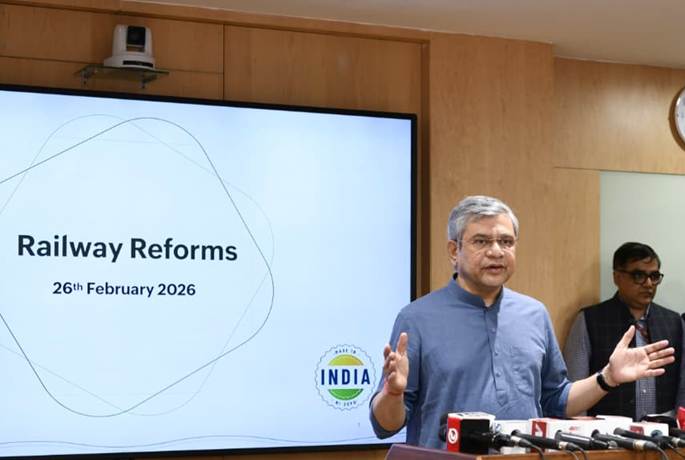
Rail Tech Policy Reform
The Rail Tech Policy aims to engage innovators, startups, industry and institutions to promote innovation in Indian Railways. The new policy simplifies the selection of innovators and introduces a dedicated “Rail Tech Portal” for innovation. Innovation challenges can be initiated by any innovator or departmental user, with a single-stage detailed submission of proposals.
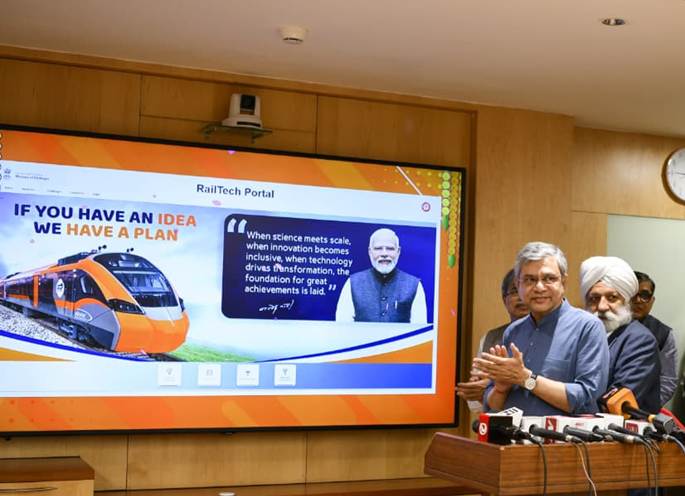
The policy provides a user-friendly interface, increases the scale-up grant more than three times and doubles the maximum grant for prototype development and trials.
🚆 3rd Railway Reform in 2026
➡️ Rail Tech Policy & Portal launched: Driving innovation in Indian Railways
✅ Simplified single-stage proposals | Open innovation challenges | 3x scale-up grants pic.twitter.com/ihrSS1F5kW
Key innovation areas include AI-based Elephant Intrusion Detection System (EIDS), AI-based fire detection system in coaches, drone-based broken rail detection system, rail stress monitoring system, sensor-based load calculation device on parcel vans (VPUs), solar panels on coaches, AI-based coach cleaning monitoring system, obstruction detection in foggy environments, and AI-based pension and dispute resolution systems.
Outlining the third reform, Shri Vaishnaw said the RailTech Policy is designed to enable massive and systematic induction of technology into the Railways. He emphasised that startups, researchers and innovators must be able to connect with Indian Railways in a structured, meaningful and simplified manner. He said that anyone with a strong technological idea should be able to approach the Railways through a dedicated RailTech portal, which will function through a completely digital, end-to-end process. The objective, he explained, is to shift away from the earlier complex system of vendor selection based strictly on rigid specifications and to instead create a simplified, innovation-driven framework focused on trial and adoption of new technologies.
Shri Vaishnaw stated that the RailTech Policy has been designed after studying successful models such as the iDEX initiative in defence, the startup frameworks in the Ministry of Electronics & IT, and telecom sector innovation policies. Drawing from these experiences, the Railways has attempted to remove procedural bottlenecks and create a transparent, simplified and innovation-friendly ecosystem. He said that if successful, this model could serve as a template for other sectors as well.
Explaining the funding structure, he noted that when a startup or innovator proposes a viable technological solution, for example, AI-based camera systems to detect elephants near railway tracks — the Railways would support up to 50 percent of the development funding required. Once the project proves successful, substantial long-term orders would be placed to enable scaling of the solution. The policy is designed not merely to experiment but to ensure that successful innovations are implemented at scale.
He cited several potential application areas for innovation, including AI-enabled CCTV systems for passenger security, referencing how CCTV footage in a recent incident in Kerala helped in quickly apprehending culprits. He said proactive crime detection systems, predictive monitoring and enhanced passenger safety technologies could significantly strengthen railway security. He also highlighted the need for advanced track monitoring solutions using radar, AI, infrared cameras and ultrasonic technologies to detect deformation or defects in tracks before they lead to accidents. Predictive technologies capable of analysing electrical parameters in overhead wires to foresee potential failures were also mentioned as promising areas where startups are already working.
Shri Vaishnaw further referred to drone-based systems for detecting rail fractures, broken grills, and monitoring overhead equipment, including identifying overheating insulators through AI-based analytics. He added that technology solutions could also address administrative challenges such as faster processing of pension documents for retired railway employees, ensuring timely commencement of pension payments. The policy, he said, has been framed with an open and forward-looking mindset to encourage such comprehensive innovation across operational and administrative domains.
E-RCT: Reform in disposal of ‘Railway Claims Tribunal’ Cases
In Reform Number Four, Shri Vaishnaw announced the complete digitisation and AI-enabled transformation of the Railway Claims Tribunal (RCT). The E-RCT system will enable end-to-end computerisation and digitisation of the Railway Claims Tribunal. It will transform the filing, processing and adjudication of claims by making the process faster, more transparent and accessible from anywhere in the country.
🚆 4th Railway Reform in 2026
➡️ e-RCT: Reform in disposal of Railway Claims Tribunal cases
✅ 24/7 e-filing | Nationwide digital access | Centralized records | Real-time case monitoring pic.twitter.com/1LJAAhWjXp
Shri Vaishnaw stated that there are 23 RCT benches across the country and that filing claims currently poses challenges, especially for passengers who may be travelling across states when an incident occurs. Determining the appropriate jurisdiction for filing a claim often becomes a significant issue.
He said the reform aims to make claim filing simple, digital and accessible from anywhere in the country. Under the new system, aggrieved passengers will be able to file claims electronically, irrespective of their location, even while travelling or upon reaching their destination. The entire process, from e-filing to case information systems will be digitised and AI-enabled. Shri Vaishnaw stated that within the next 12 months, all benches of the Railway Claims Tribunal will be fully digitised under this initiative.
He further indicated that if the model proves successful, similar digital solutions could be extended to other tribunals such as the Central Administrative Tribunal. The goal, he said, is to ensure faster processing, improved transparency and a citizen-centric approach to justice delivery.
From Physical Filing to Digital Access
Earlier, claimants and advocates were required to physically visit Tribunal offices for filing cases, submitting documents and tracking case progress, which involved travel, time and procedural delays. With the introduction of the e-RCT System, cases can now be filed online from anywhere at any time, significantly improving accessibility, convenience and transparency for litigants.
The Railway Claims Tribunal, constituted under the Railway Claims Tribunal Act, 1987, adjudicates claims against Railway Administration relating to compensation for death or injury in railway accidents and untoward incidents, loss or non-delivery of goods, and refund of fares and freight. At present, RCT functions through 23 Benches located in 21 cities across India, with the Principal Bench at Delhi, each comprising a Judicial Member and a Technical Member.
Integrated Digital Platform for Paperless Courts
The e-RCT System will digitally connect all 23 Benches on a single platform and enable:
The system also includes a revamped dynamic microsite for all RCT Benches, promoting transparency and public access to information.
Key Modules of e-RCT
The platform comprises three core components:
1. E-Filing
2. Case Information System (CIS)
3. Document Management System (DMS)
Hybrid e-Hearings and Automated Case Flow
The system enables online hearings, digital evidence recording, electronic communication with parties, automated alerts, and online compliance tracking, thereby reducing manual intervention and improving efficiency.
Faster, Transparent and Citizen-Friendly Justice Delivery
The e-RCT System will deliver multiple benefits:
The platform will particularly benefit claimants, advocates, Railways and the Tribunal by enabling easy tracking, improved scheduling and data-driven decision-making.
Earlier this month, Union Minister Shri Ashwini Vaishnaw announced two major reforms under the “52 Reforms in 52 Weeks” initiative, including continuous end‑to‑end cleaning of general coaches and expansion of the Gati Shakti Cargo Terminals to over 500 hubs to boost logistics capacity across Indian Railways.