International Women’s Day 2026
International Women’s Day 2026
Key Takeaways
From Collective Voices to Global Recognition
 Change rarely arrives with spectacle. More often, it begins as a quiet insistence, a refusal to accept the limits imposed by circumstance. The story of women’s rights unfolded much the same way, in factory floors, community gatherings and public squares where voices rose not only in protest, but in hope.
Observed each year on March 8, International Women’s Day stands as a reminder of the long journey towards women’s rights and equality.
From labour movements and suffrage campaigns to global rights conventions, women’s collective action has reshaped institutions and advanced social progress. The United Nations’ recognition of International Women’s Day in 1977 acknowledged a movement that was already transforming societies.
Why is International Women’s Day observed on 8th March?
International Women’s Day grew out of labour movements in North America and Europe at the turn of the twentieth century and was officially recognised by the United Nations in 1977. The date is linked to 1917, when women in Russia went on strike demanding “bread and peace.” The protest began on 23 February in the Julian calendar, which corresponds to 8 March in the Gregorian calendar used internationally.
Today, International Women’s Day is celebrated in many countries worldwide, recognising women’s achievements across social, economic and political spheres and serving as a platform to strengthen global support for women’s rights and participation.
Today, International Women’s Day serves both as a reflection on past struggles and a call to action, urging nations and institutions to move beyond symbolism toward justice, equity and leadership.
Theme of International Women’s Day 2026
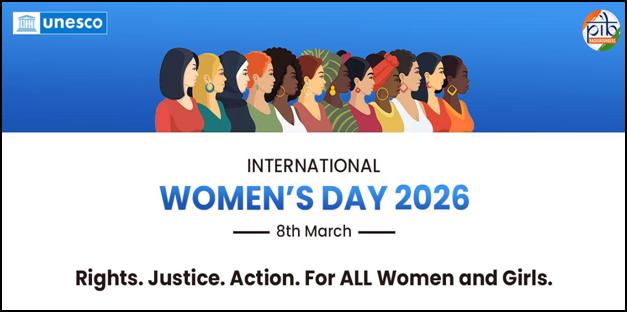
The United Nations is observing International Women’s Day 2026 under the theme “Rights. Justice. Action. For ALL Women and Girls.” The observance highlights the need to strengthen women’s rights, ensure access to justice and accelerate action toward gender equality worldwide.
Across the UN system, events and discussions are being organised globally, including in Europe through the WHO Regional Office for Europe, bringing together policymakers, experts and civil society to advance policies and initiatives that support women’s rights and participation.
Global Give to Gain Campaign
The International Women’s Day 2026 is marked by a global campaign theme, “Give to Gain,” that highlights the power of collective support in advancing gender equality. It encourages individuals, organisations and communities to contribute time, resources, mentorship and opportunities that help women grow and succeed.
The idea is simple yet powerful – when people invest in supporting women’s aspirations and achievements, the benefits extend far beyond individuals, strengthening communities and creating more inclusive and resilient societies.
Nari Shakti at the Centre of India’s Development
Across India, change often begins in places that rarely make headlines, in a village meeting where a woman speaks up for the first time, in a small enterprise that grows from a kitchen to a marketplace, or in a classroom where a girl decides her future will be different from her past. Individually, these moments may seem ordinary. Together, they are shaping an extraordinary shift in India’s development story.
For decades, the focus was on expanding access to food, education, healthcare and essential services for women. These efforts laid the groundwork for empowerment. Today, the narrative has evolved from development for women to women-led development, recognising women not just as beneficiaries but as drivers of economic and social progress.
Supporting this transition is a growing ecosystem of opportunity — access to credit, self-help groups, digital platforms, education pathways and safety mechanisms — enabling more women to participate, lead and shape India’s growth.
On International Women’s Day, the focus turns not only to celebrating progress but also to recognising this deeper transformation. Across enterprises, farms, classrooms and governance forums, women are actively shaping India’s development journey.
Marking International Women’s Day 2026 in New Delhi
As part of the nationwide observance of International Women’s Day 2026, a series of commemorative events will be organised in New Delhi.
The key highlights of the celebrations are outlined below:
International Women’s Day 2026
8th March 2026 | New Delhi
Shakti Walk – #SheLeadsBharat
Route: Along Kartavya Path (from India Gate to Vijay Chowk)
The walk will bring together women from diverse fields representing the breadth of our institutional and social landscape. Envisioned as a symbolic stride of the women of Bharat, this walk will celebrate a defining decade marked by the rise of women-led development and increasing women’s work-force participation.
International Women’s Day Celebration
Venue: Manekshaw Centre Auditorium
The celebration, to be graced by the Hon’ble President of India, will bring together women achievers from governance, science, enterprise, security, arts and grassroots leadership, highlighting the central role of Nari Shakti in advancing the vision of Viksit Bharat@2047.
Guaranteeing Rights
National Commission for Women
In January 1992, the Government set-up this statutory body with a specific mandate to study and monitor all matters relating to the constitutional and legal safeguards provided for women, review the existing legislation to suggest amendments wherever necessary, etc.
India’s commitment to gender equality is firmly rooted in its constitutional framework, which guarantees equality before the law and prohibits discrimination on the basis of sex. From the 1990s onwards, there has been a gradual yet decisive shift, from viewing women primarily as beneficiaries of protectionist policies to recognising them as key stakeholders in development.
Key Constitutional Provisions Supporting Gender Equality
The principle of gender equality is enshrined in the Indian Constitution in its Preamble, Fundamental Rights, Fundamental Duties and Directive Principles.
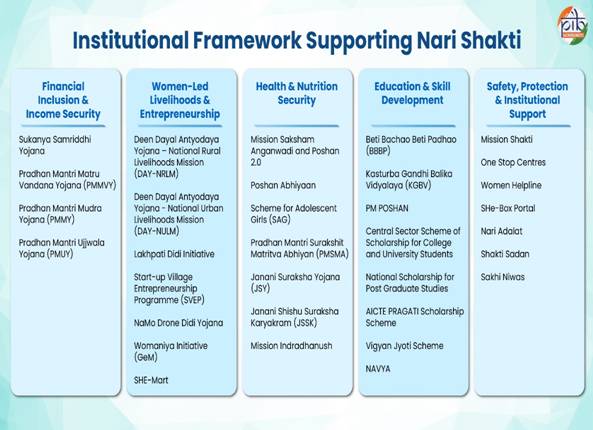
Women’s leadership grows stronger when rights are protected and opportunities are expanded across every stage of life. In India, a range of initiatives are working to ensure that women and girls have access to education, health, safety and dignity, creating the foundations for women-led development.
Building on this foundation, the Sukanya Samriddhi Yojana (SSY) encourages families to invest in the long-term future of the girl child. Launched on 22 January 2015 as part of the Beti Bachao Beti Padhao campaign, the small savings scheme provides a secure financial pathway for girls’ education and future aspirations. Deposits earn interest at government-notified rates, currently 8.2%, and the scheme has seen strong public participation, with over 4.53 crore accounts opened and deposits exceeding ₹3.33 lakh crore as of December 2025. By promoting savings in the name of the girl child, SSY helps build financial security and reinforces the importance of investing in daughters’ futures.
Maternal health and nutrition remain a key focus. Under the Pradhan Mantri Matru Vandana Yojana, over ₹20,060 crore has been transferred to 4.26 crore beneficiaries, providing income support during maternity. Initiatives such as the Pradhan Mantri Surakshit Matritva Abhiyan and Poshan Abhiyan further strengthen maternal care and nutrition services nationwide. These sustained efforts have contributed to a decline in India’s Maternal Mortality Ratio from 130 (2014–16) to 88 (2021–23).
Access to clean energy and essential household services has also significantly improved women’s health and dignity. Under the Pradhan Mantri Ujjwala Yojana, more than 10.56 crore LPG connections have been provided to women from economically vulnerable households, reducing exposure to indoor air pollution and easing the daily burden of cooking.
Similarly, improved access to water and sanitation is transforming everyday life. Since its launch in August 2019, the Jal Jeevan Mission (Har Ghar Jal) has expanded rural tap water coverage from 16.72% to over 81.57% of households, reducing the time and effort women often spent fetching water. Complementing this, the Swachh Bharat Mission has enabled the construction of over 12 crore toilets, improving sanitation, enhancing privacy and dignity for women, and contributing to better public health outcomes.
As of January 2026, a total of 2,153 child marriages has been prevented, and 60,262 Child Marriage Prohibition Officers has been appointed across the country.
Together, these initiatives strengthen the ecosystem that enables women to pursue education, participate in the workforce, and lead enterprises and institutions across the country.
Justice: Equal Voice, Equal Power
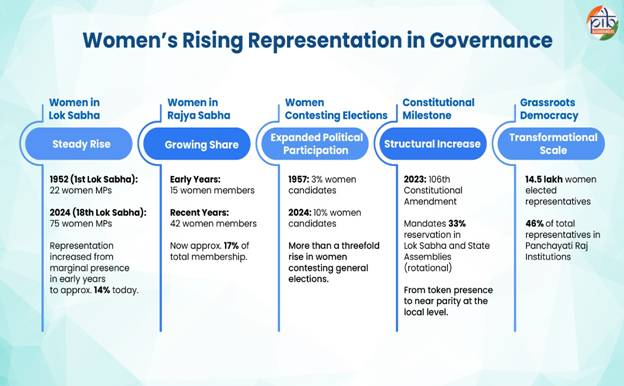
Justice for women is not limited to legal protection. It is realised when women participate fully in shaping laws, policies and public priorities. Representation in decision-making spaces is central to this promise.
Over the decades, women’s presence in Parliament and electoral politics has steadily increased, reflecting a gradual but meaningful shift in political participation. From a marginal share in the early years of the Republic, women today hold a significantly stronger presence in both Houses of Parliament and across State legislatures.
At the grassroots, this transformation is even more pronounced. Nearly half of all elected representatives in Panchayati Raj Institutions are women, making India home to one of the largest pools of elected women leaders in the world. Their leadership has reshaped local governance priorities — placing greater emphasis on drinking water, sanitation, health services, education, and social welfare delivery.
A historic milestone was the enactment of the 106th Constitutional Amendment Act (Nari Shakti Vandan Adhiniyam), 2023, which provides for one-third reservation for women in the Lok Sabha and State Legislative Assemblies. This constitutional guarantee strengthens the foundation of gender-balanced democracy.
Justice, in this context, means more than representation. It means authority. It means influence. It means women not only voting in elections, but shaping the institutions that define India’s future.
Action: Turning Commitment into Change
Action: For ALL Women and Girls
Abolition of Triple Talaq
The abolition of Triple Talaq serves as a historic reform ensuring dignity, equality, and true empowerment for crores of Muslim women. The Triple Talaq Act criminalizes the practice of instant divorce, ensuring legal protection and greater equality for Muslim women by enabling them to escape longstanding domestic violence and discrimination.
Women-led development is strengthened when policy commitments translate into economic opportunity. In recent years, India has expanded investments, financial access and skill ecosystems that enable women to participate more actively in the economy, build enterprises and lead institutions.
• Gender-responsive public investment: India recorded its highest-ever gender budget in FY26, with 9.37% of the Union Budget directed toward programmes advancing gender equality. Across sectors, ₹5.01 lakh crore has been earmarked by 53 Ministries/Departments and 5 Union Territories, reflecting a shift from symbolic inclusion to sustained investment in women’s development.
• Women building rural economies: Through the Deendayal Antyodaya Yojana – National Rural Livelihood Mission (DAY-NRLM), millions of women have moved from unpaid labour to organised enterprise. Today, 10.05 crore rural households are mobilised into 90.90 lakh Self-Help Groups, which have accessed ₹12.18 lakh crore in institutional credit since 2013–14. Initiatives such as the Lakhpati Didi programme are enabling rural women to scale sustainable livelihoods, with over 3,07,33,820 women already progressing towards the goal of becoming ‘Lakhpati Didis’.
New initiatives are also opening pathways into technology-enabled work. Under the NaMo Drone Didi Yojana, Self-Help Groups are being supported to operate agricultural drones, with 80% subsidy for procurement and a ₹1,261 crore allocation targeting 15,000 SHGs. The initiative is expected to enhance incomes while integrating rural women into emerging technology ecosystems.
From SHG Member to Entrepreneur: The Journey of Badashisha Dkhar
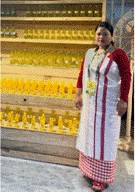 When Badashisha Dkhar, from Tluh village of East Jaintia Hills district of Meghalaya, joined a Self-Help Group in 2019, she simply wanted to connect with other women in her village. She did not imagine it would change her life.
Through NRLM, she accessed financial support and technical training, beginning with food processing training in 2020 and later advancing her skills at the Institute of Hotel Management, Shillong. Armed with confidence and knowledge, she secured a ₹2.5 lakh bank linkage loan in 2024 and invested her own savings to set up a juice processing micro-enterprise at Umpleng.
Her products soon travelled beyond her village, reaching the Pineapple Festival at Delhi Haat in 2024. Today, her enterprise employs three people and generates an annual income of around ₹1.8 lakh.
What began as a space for social interaction became a pathway to independence. Badashisha’s journey reflects how collective support, access to credit, and skill development can transform rural women into confident entrepreneurs shaping their own futures.
• Finance fuelling entrepreneurship: Expanding financial inclusion has enabled many women to transition from savings to enterprise creation. Since 2015, the Pradhan Mantri MUDRA Yojana has sanctioned 52 crore loans worth ₹32.61 lakh crore, with 68% of beneficiaries being women. Women also constitute 56% of Jan Dhan account holders, while Stand-Up India has supported over 2.01 lakh women entrepreneurs in establishing greenfield enterprises. Complementing financial access, initiatives such as Womaniya on the Government e-Marketplace (GeM) are helping women entrepreneurs and Self-Help Groups connect directly with government buyers. Over two lakh women-led MSEs are registered on GeM, securing more than ₹80,000 crore in public procurement orders, expanding market access and strengthening women-led enterprises.
• Skills and innovation ecosystems: Women are increasingly entering new-age sectors through expanded skilling and startup ecosystems. Nearly 45% of Pradhan Mantri Kaushal Vikas Yojana beneficiaries are women, while over 75,000 women-led startups have been supported under Start-Up India. Programmes such as NAVYA (2025) are further strengthening vocational training for adolescent girls in aspirational districts.
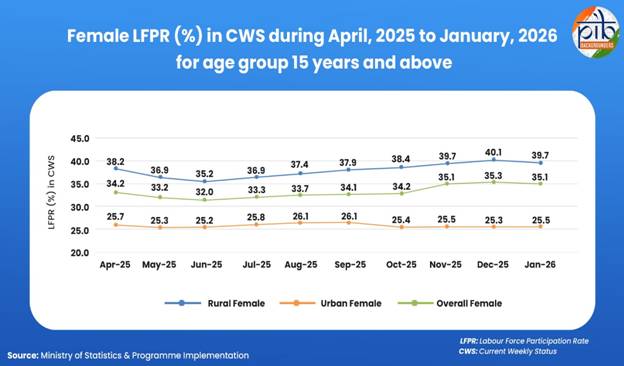
• Rising participation and leadership: Women are increasingly expanding their presence across public life. India adopted universal adult franchise at Independence, and today women form a powerful electoral constituency, with over 47 crore registered women voters participating in the democratic process. Their growing role is also visible in sectors once considered inaccessible, reflected in developments such as the graduation of the first cohort of women cadets from the National Defence Academy in 2025, signalling broader participation of women across national institutions.
Together, these initiatives reflect a broader shift in India’s development approach, from enabling participation to supporting leadership. Women-led development today is visible across rural enterprises, startups, technology platforms and governance institutions, shaping a more inclusive growth trajectory.
Women Who Lead
Women-led development is most visible in the lives of women who transform opportunity into progress. Supported by government schemes that expand access to credit, skills, technology and markets, many women are building enterprises, strengthening livelihoods and shaping change within their communities.
Reena’s Cooperative: Building Health, Building Power
At 54, Reena does not describe her work as a business. She calls it a movement.
What began with small steps has grown into Prakritik Health Services, a women-led and women-run health cooperative dedicated to serving women in the informal economy. Registered in 1990, the cooperative today has 1,500 members and operates a chain of medical shops and health services with an annual revenue of ₹60.25 million.
The idea was simple yet powerful: affordable healthcare keeps informal women workers healthy, productive and out of poverty. But building this ecosystem required resilience, collaboration and access to finance.
Over the years, the cooperative secured bank loans, working capital from an NBFC and support from a women’s federation. With a strong repayment record and sustainable business model, the collective is now credit-ready and seeking ₹5–6 million to establish a manufacturing unit for ayurvedic products.
Today, the enterprise supports 300 active members, creating not just livelihoods but leadership opportunities. For Reena and her colleagues, finance was not just capital — it was confidence. What started as collective survival has become collective strength.
Priya: Innovation with Purpose
At 35, Priya is building more than a business — she is building solutions for a warming world. Driven by her commitment to sustainable development, she founded a drone technology company powered by renewable energy, focused on delivering essential healthcare supplies to remote and climate-vulnerable communities.
What began as research into emerging technologies evolved into a Minimum Viable Product that has been operating successfully for over two years. Today, her urban-based enterprise generates ₹12 million in annual revenue and employs 10 people.
Priya began with traditional loans but soon realised that grants and equity from impact investors better aligned with her climate-tech vision. With a proven growth record and scalable model, she is now well-positioned to expand — seeking financial partnerships that match both her ambition and her purpose.
Conclusion
The story of women-led development in India is reflected in the everyday achievements of women across the country. It can be seen in women leading cooperatives, building enterprises, adopting new technologies and participating in local governance. Together, these journeys reflect a broader shift in India’s development landscape.
Rights have strengthened dignity and protection, justice has expanded voice and representation, and sustained action has created greater opportunities for women to participate in economic and social life.
Today, millions of women are part of self-help groups, many serve in elected local bodies, and increasing numbers are accessing formal financial systems and entrepreneurship opportunities. These changes are gradually expanding pathways for women’s leadership and participation.
As India moves forward on its development journey, women are playing an increasingly important role in shaping families, communities and the nation’s future.
References
https://www.pib.gov.in/PressReleasePage.aspx?PRID=2150216®=3&lang=2
https://www.pmuy.gov.in/index.aspx
https://www.pib.gov.in/PressReleasePage.aspx?PRID=2212747®=3&lang=1
https://www.pib.gov.in/PressReleasePage.aspx?PRID=2224413®=3&lang=1
https://www.pib.gov.in/PressReleasePage.aspx?PRID=2160547®=3&lang=2
https://www.pib.gov.in/PressReleasePage.aspx?PRID=2220140®=3&lang=2
https://www.pib.gov.in/PressReleasePage.aspx?PRID=2178389®=3&lang=2