INS Vikrant: India’s First Indigenous Aircraft Carrier and a Landmark in Naval Capability
INS Vikrant: India’s First Indigenous Aircraft Carrier and a Landmark in Naval Capability
Key Takeaways
Introduction
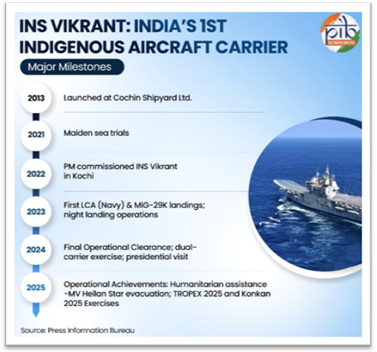
INS Vikrant, the nation’s first Indigenous Aircraft Carrier (IAC 1), stands as a proud statement of an aspirational and self-reliant India. Designed by the Indian Navy’s Warship Design Bureau and built by Cochin Shipyard Limited (CSL), it is the largest warship ever constructed in the country. Commissioned into the Indian Navy by the Hon’ble Prime Minister on 2 September 2022, INS Vikrant is a symbol of indigenous potential, indigenous resources, and indigenous skills.
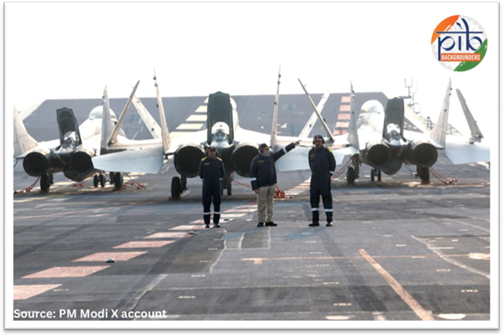
The Hon’ble Prime Minister of India, Shri Narendra Modi, celebrated Diwali 2025 onboard the Indian Naval Ship (INS) Vikrant, honouring the dedication and courage of Indian Naval sailors and armed forces personnel. The visit continued his tradition of celebrating Diwali with troops deployed in forward and strategic areas, symbolising solidarity with those who safeguard the nation across all domains of warfare. The ship hosted the Prime Minister for an overnight sea sortie from 19 to 20 October 2025. The following activities were undertaken during the sortie:
History and Development
INS Vikrant takes its name from India’s first aircraft carrier, INS Vikrant (R11), which was decommissioned in 1997. The erstwhile INS Vikrant played a crucial role in the 1961 Goa Liberation Operation and the 1971 Indo-Pak War, earning a lasting place of pride in India’s naval history. The current INS Vikrant, India’s first Indigenous Aircraft Carrier (IAC 1), carries forward this legacy and represents a significant milestone in the country’s naval self-reliance and shipbuilding capability.
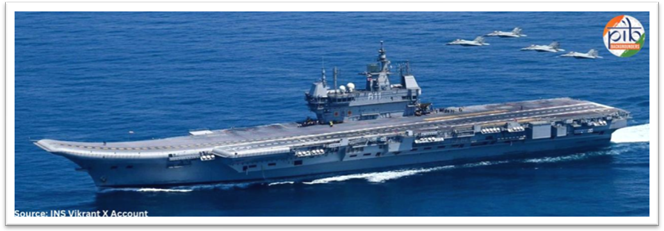
A symbol of self-reliance in defence, INS Vikrant is not just a warship. It is a testament to the hard work, talent, influence and commitment of India in the 21st century.
Capabilities and Specifications
INS Vikrant’s technical and operational strengths are reflected in the following features:
Achievements of INS Vikrant
Since its commissioning, INS Vikrant has solidified its role as a cornerstone of the nation’s maritime strength. These accomplishments not only showcase the carrier’s advanced capabilities but also reinforce India’s commitment to the SAGAR (Security and Growth for All in the Region) vision, fostering peace, stability, and cooperation in the Indo-Pacific.
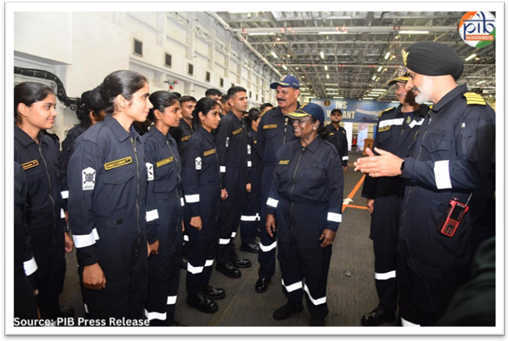
• PM Day at Sea (October 2025): The ship hosted the Hon’ble Prime Minister for an overnight sea sortie
from 19 to 20 October 2025, on the occasion of Diwali.
INS Vikrant: A Pillar of Humanitarian Assistance and Disaster Relief (HADR)
Beyond its strategic military capabilities, Vikrant has proven to be a formidable asset in Humanitarian Assistance and Disaster Relief (HADR) operations.
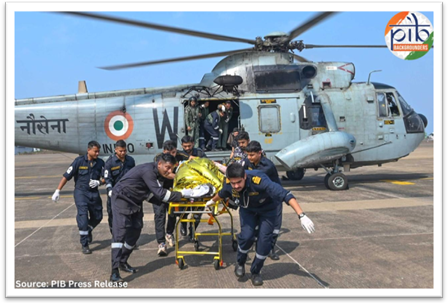
Vikrant is equipped with state-of-the-art technology and infrastructure, making it a versatile platform for various operations. Its design incorporates a high degree of automation for machinery operations, ship navigation, and survivability, enhancing its efficiency during emergency deployments. One of Vikrant’s notable features is its robust power generation system, capable of supplying electricity equivalent to that needed for 5,000 households, facilitating sustained operations in remote or disaster-affected areas. Additionally, the carrier’s extensive aviation facilities enable it to serve as a mobile command centre, hospital, and supply hub during emergencies.
INS Vikrant’s role in HADR operations aligns with India’s broader maritime strategy, particularly the ‘SAGAR’ (Security and Growth for All in the Region) initiative. The Indian Navy has been at the forefront of providing humanitarian assistance and disaster relief during calamities and contingencies. These actions have enhanced India’s stature as the ‘Preferred Security Partner’ and ‘First Responder’ in the Indian Ocean Region.
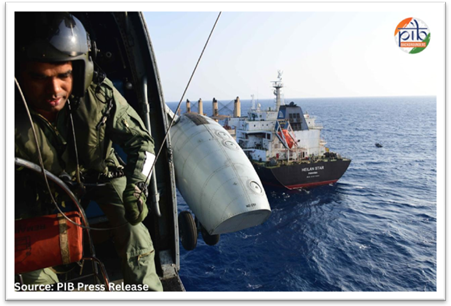
Responding to a distress call from the Panama-flagged MV Heilan Star about 230 nautical miles west of Goa, a Sea King helicopter from INS Vikrant successfully airlifted three injured crew members to INS Hansa for medical care. The operation exemplified the Indian Navy’s steadfast commitment to Humanitarian Assistance and Disaster Relief (HADR) beyond national waters.
A Milestone in India’s Maritime Self-Reliance
Since 2014, Indian shipyards have delivered over 40 indigenous warships and submarines to the Navy, with a new platform being inducted on average every 40 days. It is a true testimony to the country’s zeal and fervor in pursuing capability build up towards enhanced maritime security. The development and operationalization of INS Vikrant mark a landmark chapter in the Indian Navy’s journey toward self-reliance.
Indigenous Design and Construction
INS Vikrant was designed by the Indian Navy’s Warship Design Bureau (WDB) and constructed at Cochin Shipyard Limited (CSL). The ship has large number of indigenous equipment and machinery, involving major industrial houses in the country viz. BEL, BHEL, GRSE, Keltron, Kirloskar, Larsen & Toubro, Wartsila India etc. as well as over 100 MSMEs. The development and production of indigenous warship grade steel for the ship was through a partnership between Navy, DRDO and Steel Authority of India (SAIL), which has enabled the country to become self-sufficient with respect to warship steel.
Enhancing Maritime Capabilities
In June 2023, the Indian Navy showcased its formidable maritime capabilities through a multi-carrier operation involving INS Vikrant and INS Vikramaditya, along with a diverse fleet of ships, submarines, and aircraft, demonstrating India’s technological expertise in the maritime domain.
Strategic Procurement: Rafale-Marine Jets
In April 2025, India signed a ₹63,000 crore deal with France for the procurement of 26 Rafale-Marine fighter jets, which are capable of operating from aircraft carriers. This acquisition includes pilot training, flight simulators, weapons, and long-term maintenance support, and features technology transfer to boost Indian defence manufacturing. The Rafale-Marine jets will enhance the air wings of both INS Vikrant and INS Vikramaditya, ensuring unparalleled combat readiness.
Commitment to Indigenous Shipbuilding
The Indian Navy’s vision for a second indigenous aircraft carrier and plans to station INS Vikrant in Visakhapatnam to strengthen the Eastern Naval Command further underscore its commitment to self-reliance and regional security. With over 133 ships and submarines built and commissioned in India as of December 2024, the Indian Navy continues to be a key pillar supporting the growth of the Indian shipbuilding sector. As of December 2024, 63 out of the 64 warships planned to be inducted in the Navy, are being built in India. This includes the majestic INS Vikrant aircraft carrier and nuclear submarines like INS Arihant and INS Arighaat.
Conclusion
INS Vikrant stands as a lasting symbol of India’s maritime resurgence, with the indigenously built carrier cutting through the ocean and showcasing the nation’s military prowess. Beyond enhancing the Indian Navy’s regional security role, Vikrant inspires future generations toward complete defence indigenization. As India strengthens its presence in the Indo-Pacific, the carrier also highlights the nation’s ambition to become one of the world’s top defence exporters. INS Vikrant has filled the country with a new confidence, and has created a new confidence in the country.
References:
Press Information Bureau:
https://www.pib.gov.in/PressReleaseIframePage.aspx?PRID=1856230
https://www.pib.gov.in/Pressreleaseshare.aspx?PRID=1856121
https://www.pib.gov.in/PressReleaseIframePage.aspx?PRID=2113906
https://www.pib.gov.in/PressReleasePage.aspx?PRID=1856215
https://www.pib.gov.in/PressReleasePage.aspx?PRID=2180962
https://www.pib.gov.in/newsite/PrintRelease.aspx?relid=98029
https://www.pib.gov.in/Pressreleaseshare.aspx?PRID=1768294
https://www.pib.gov.in/PressReleasePage.aspx?PRID=1742282
https://www.pib.gov.in/PressReleseDetail.aspx?PRID=1743815
https://www.pib.gov.in/PressReleasePage.aspx?PRID=1896759
https://www.pib.gov.in/PressReleasePage.aspx?PRID=1927354
https://www.pib.gov.in/PressReleseDetailm.aspx?PRID=2088180
https://www.pib.gov.in/PressReleaseIframePage.aspx?PRID=2071628
https://www.pib.gov.in/PressReleasePage.aspx?PRID=2100813
https://www.pib.gov.in/PressReleasePage.aspx?PRID=2175054
https://www.pib.gov.in/Pressreleaseshare.aspx?PRID=1845871
https://www.pib.gov.in/PressReleasePage.aspx?PRID=2093018
https://www.pib.gov.in/PressReleaseIframePage.aspx?PRID=1931254
https://www.pib.gov.in/PressNoteDetails.aspx?ModuleId=3&NoteId=154353
https://www.pib.gov.in/PressReleasePage.aspx?PRID=21ADARaf24851
https://www.pib.gov.in/FactsheetDetails.aspx?Id=149099
https://www.pib.gov.in/FeaturesDeatils.aspx?NoteId=151135
https://www.pib.gov.in/newsite/erelcontent.aspx?relid=98029
https://static.pib.gov.in/WriteReadData/specificdocs/documents/2024/nov/doc2024117431801.pdf