India’s Power Sector:
India’s Power Sector:
Key Takeaways
Introduction
Electricity is among the most invisible yet indispensable elements of modern life. Lights switch on, irrigation pumps run, factories operate, hospitals function, and digital networks stay connected. For a country as large and diverse as India, ensuring reliable, affordable, and universal access to power is both a technical challenge and a governance achievement. Over the past decade, India’s power sector has undergone a period of major structural change, transitioning to a system defined by adequacy, expanded capacity, and improved reliability. It reflects years of consistent investment, institutional strengthening, regulatory discipline, and policy continuity.
Bharat Electricity Summit 2026, a premier global conference-cum-exhibition dedicated to the power and electricity sector, will take place from 19th to 22nd of March, 2026, at Yashobhoomi, New Delhi.
Held under the theme “Electrifying Growth. Empowering Sustainability. Connecting Globally,” the four-day summit will highlight India’s leadership in the global energy transition while addressing key challenges and emerging opportunities across the power sector. The event aims to foster cross-sector dialogue, strengthen international cooperation, and build strategic partnerships for advancing sustainable energy systems worldwide.
The Summit will convene a diverse spectrum of stakeholders, including policymakers, industry leaders, regulators, investors, academia, innovators, and civil society from India and across the globe. It is expected to feature more than 100 high-level conference sessions, expert-led panel discussions, thematic pavilions, and technology showcases covering the entire electricity and clean energy value chain.
With participation from over 500 exhibitors, including over 100 startups, more than 25,000 attendees, representatives from more than 80 countries, 1,000+ delegates, and over 300 speakers, the Summit will serve as a dynamic platform for knowledge exchange, collaboration, and business engagement.
With investment opportunities exceeding ₹50 lakh crore across generation, transmission, distribution, and energy storage through 2032, the summit seeks to drive innovation, enhance competitiveness, and strengthen resilience in India’s electricity sector.
Scaling Up: Expanding Capacity and Reinforcing the National Grid
As India’s economy grows and living standards rise, electricity demand continues to expand across households, industry, agriculture, and services. Meeting this demand at scale requires not only more power generation but a system capable of delivering it across vast geographies. Focusing on building this scale, the generation capacity has expanded steadily across conventional and renewable sources. During the financial year 2025–26 (up to 31 January 2026), a record 52,537 MW of generation capacity from all sources has been added. Of this, 39,657 MW comes from renewable energy, including 34,955 MW of solar power and 4,613 MW of wind power. This represents the highest ever capacity addition in a single year, surpassing the previous record of 34,054 MW achieved in FY 2024–25.
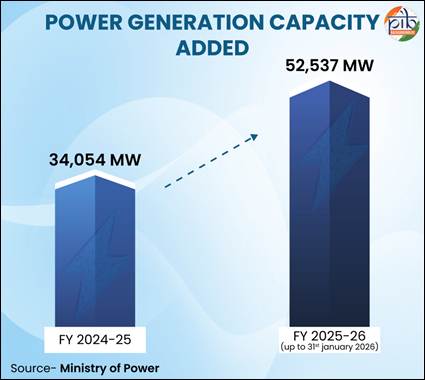
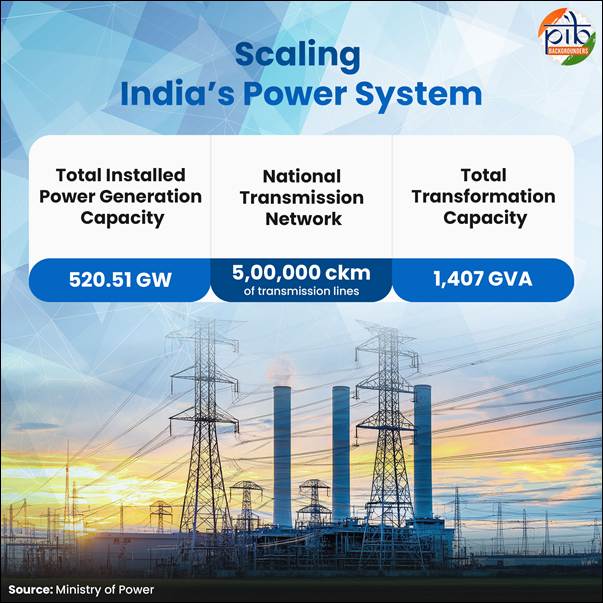
This addition accounts for an increase of over 11 per cent in the country’s total installed capacity. As of January 2026, India’s total installed power generation capacity stands at 520.51 GW. This sustained growth ensures that the country remains well-positioned to meet rising consumption needs while supporting economic momentum.
Adding generation capacity alone is not sufficient. Equal attention has been given to strengthening the transmission and transformation backbone of the power system. New substations, upgraded transformers, and expanded high-capacity transmission corridors have been developed to move electricity efficiently from generation centres to load centres across states. These investments reduce bottlenecks, improve grid stability, and enable smoother integration of diverse energy sources into the national grid.
India’s national transmission network, the world’s largest synchronous national grid, has crossed a major milestone, exceeding 5 lakh circuit kilometres (ckm) of transmission lines and reaching a total transformation capacity of 1,407 gigavolt amperes (GVA). By reinforcing both generation and networks simultaneously, India has laid the foundation for a power sector that can support growth not just today, but well into the future.
From Deficit to Balance: Delivering Reliable Power Across India
India’s power sector transformation is most clearly reflected in two outcomes: the elimination of shortages and the extension of electricity to every household. Together, these mark a shift from managing scarcity to ensuring dependable access.
Closing the Demand–Supply Gap
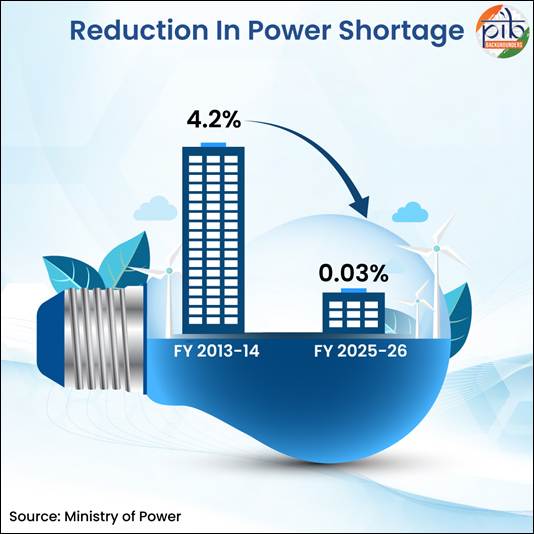
A decade ago, electricity shortages were a recurring constraint on both economic activity and daily life. Power cuts disrupted manufacturing, irrigation, healthcare services, and household routines. Bridging the gap between rising demand and available supply was therefore a central priority.
This progress has been particularly significant outside major urban centres. Rural and semi-urban regions now experience longer and more predictable hours of power supply. Reliable electricity has also reduced reliance on diesel generation and traditional fuels, lowering costs and improving environmental outcomes.
Adequate generation alone does not guarantee access. Electricity must reach homes, farms, and enterprises through a strong and efficient distribution network. Recognising this, focused attention was given to strengthening last-mile infrastructure across the country. Under the Deen Dayal Upadhyaya Gram Jyoti Yojana (DDUGJY) and the Integrated Power Development Scheme (IPDS) both launched in December 2014, significant investments were made to strengthen and modernise distribution infrastructure. DDUGJY focused on creating basic electricity infrastructure in villages through the strengthening and augmentation of existing networks, along with metering of feeders and distribution transformers. IPDS targeted urban areas by upgrading sub-transmission and distribution networks, introducing metering of distribution transformers, feeders, and consumers, and implementing information technology-enabled systems such as Enterprise Resource Planning, smart metering, Gas Insulated Substations, and Real-Time Data Acquisition Systems. These efforts were complemented by the Pradhan Mantri Sahaj Bijli Har Ghar Yojana (Saubhagya), recognised as one of the world’s largest universal electrification initiatives. It focused on providing last-mile connectivity and electricity connections to all unelectrified households in the country.
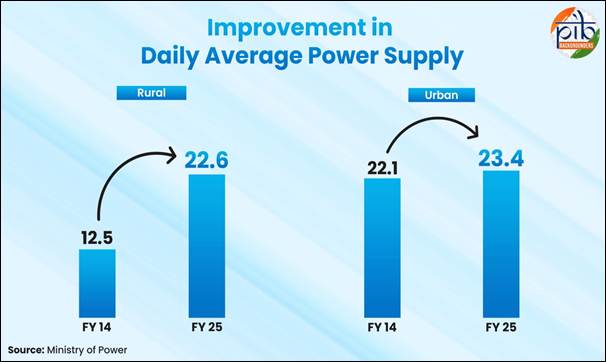
Collectively, these initiatives involved investments of approximately ₹1.85 lakh crore. Over 18,374 villages were electrified, and around 2.86 crore households received electricity connections during the Saubhagya period from October 2017 to March 2022. Daily average power supply has improved significantly across both rural and urban areas over the past decade. In rural India, average daily supply increased from 12.5 hours in FY14 to 22.6 hours in FY25, reflecting substantial gains in reliability and access. Urban areas also saw improvement, with daily average supply rising from 22.1 hours to 23.4 hours over the same period. Per capita electricity consumption in India has also risen to 1,460 kilowatt-hours in 2024–25, registering an increase of 503 kilowatt-hours (about 52.6%) compared to 957 kilowatt-hours in 2013–14.
DISCOMs: Strengthening the Foundation of the Power Sector
In 2021, the Revamped Distribution Sector Scheme (RDSS) was launched with a total outlay of about ₹3.03 lakh crore. Projects worth ₹2.8 lakh crore have already been approved under the scheme. The Scheme was launched to support States and Union Territories in improving the operational efficiency and financial sustainability of distribution utilities, to provide a reliable and quality power supply.
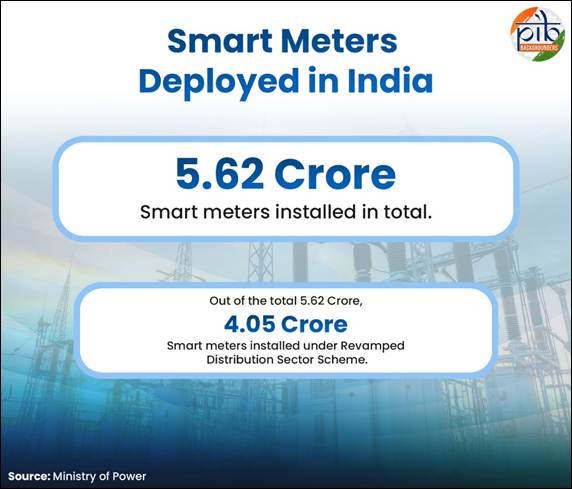
A key component of the scheme is the rollout of smart metering for consumers, distribution transformers, and feeders. Smart meters give consumers near real-time visibility of their electricity usage through mobile applications. These apps allow users to monitor consumption, manage budgets, recharge conveniently, receive low-balance alerts, and access historical usage data to optimise consumption. As of 15th January 2026, 4.05 crore smart meters have been installed under RDSS. In addition, States have installed smart meters under their own plans and other schemes. In total, 5.62 crore smart meters have been installed across the country under various initiatives.
In parallel with RDSS, additional measures have been introduced to improve financial discipline:
A transformer is a static device used for stepping up or stepping down voltage in transmission and distribution of electricity. Power received at high voltage from primary sub-stations is transformed to lower voltage at sub-stations of the distribution companies. Transformation capacity refers to the total capacity of transformers installed in substations to convert electricity between different voltage levels so that it can be transmitted and distributed to consumers. It is measured in Volt-Amperes (VA), Megavolt-Amperes (MVA), or Gigavolt-Amperes (GVA).
The National Electricity Plan (2023–2032) for central and state transmission systems has been finalised to meet a projected peak demand of 458 gigawatts (GW) by 2032. The plan involves an estimated investment of ₹9.15 lakh crore. During the previous plan period (2017–2022), about 17,700 ckm of transmission lines and 73 GVA of transformation capacity were added each year. Under the new plan, the transmission network will expand from 5 lakh ckm in January 2026 to 6.48 lakh ckm by 2032. Over the same period, transformation capacity will increase from 1,407 GVA to 2,345 GVA, and inter-regional transfer capacity will rise from 120 GW to 168 GW. Covering transmission systems of 220 kilovolts and above, the plan is designed to meet rising electricity demand, support large-scale integration of renewable energy, and accommodate emerging requirements such as green hydrogen within the national grid.
The Electricity (Amendment) Bill, 2026, marks an important step in strengthening India’s power system to meet the demands of a rapidly growing economy. It seeks to reform the existing market structure by rationalising cross-subsidies, promoting cost-reflective tariffs, and allowing industrial consumers to procure power directly. The objective is to improve the competitiveness of Indian manufacturing by making electricity more affordable, reliable, and responsive to market needs, while continuing to safeguard subsidised tariffs for farmers and other eligible consumers.
Alongside structural reforms, several policy measures have been introduced to make the power sector more transparent, efficient, and supportive of the clean energy transition. The Electricity (Promoting Renewable Energy Through Green Energy Open Access) Rules provide Green Open Access for consumers with a load above 100 kW, with time-bound approvals, and uniform and reasonable charges. Additional frameworks, such as Renewable Consumption Obligations, waiver of inter-state transmission charges, and policies to promote energy storage deployment, have also been notified to facilitate greater integration of renewable energy into the grid. Further, the introduction of a monthly automatic pass-through of the Fuel and Power Purchase Adjustment Surcharge ensures timely recovery of power procurement costs.
Signs of a Turnaround: Measurable Improvements
The impact of these reforms is now visible in measurable financial and operational outcomes.
These improvements reflect stronger cost recovery, improved billing efficiency, and better operational management. More importantly, they signal a structural shift from persistent financial stress to a pathway of sustainability.
Accelerating the Renewable Energy Transition
The country’s renewable energy expansion has evolved into a policy-driven transformation marked by scale, speed, manufacturing growth, and global engagement. According to the International Renewable Energy Agency (IRENA) Renewable Energy Statistics 2025, India ranks fourth globally in total installed renewable energy capacity.
Solar energy has been at the forefront of this expansion. Installed solar capacity increased sharply from 3 gigawatts in 2014 to 140 gigawatts in January 2026. Wind energy has also contributed significantly, with cumulative installed wind capacity reaching 54.65 gigawatts.
A defining milestone was achieved on 29 July 2025, when India recorded its highest-ever renewable energy share in electricity generation. On that day, renewable sources met 51.5 per cent of the country’s total electricity demand of 203 gigawatts. For the first time, more than half of India’s daily electricity demand was met through renewable sources, a significant marker of the country’s clean energy transition. The generation mix on that day included:
This milestone reflects not only expanded capacity but growing integration of renewable energy into the national grid, positioning India firmly on the path toward a more sustainable and diversified power future. The PM Surya Ghar: Muft Bijli Yojana, launched in February 2024, aims to install rooftop solar systems in 1 crore residential households by FY 2026–27, with a total outlay of ₹75,021 crore to promote distributed renewable energy adoption. As of February 2026, rooftop solar installations under the scheme have already benefited 31.04 lakh households.
To support the rapid expansion of renewable energy and the growing electricity demand, the Government has enhanced investment delegation to POWERGRID, the country’s largest transmission utility. The revised approval increases the permissible equity investment limit per subsidiary from ₹5,000 crore to ₹7,500 crore, while maintaining the overall cap linked to the company’s net worth.
This enhanced financial flexibility will enable POWERGRID to undertake large, capital-intensive transmission projects, including Ultra High Voltage Alternating Current and High Voltage Direct Current systems. By strengthening the transmission backbone and improving participation in competitive bidding for major projects, this step supports efficient evacuation of renewable energy and contributes to the broader goal of expanding non-fossil fuel capacity in the national grid.
Conclusion: Powering Progress, Quietly and Consistently
India’s power sector today reflects the cumulative outcome of years of reform rather than the impact of any single initiative. Capacity expansion has kept pace with rising demand, electricity has reached nearly every household, and reliability has improved across regions. At the same time, long-standing financial and operational challenges in distribution are being addressed through a combination of infrastructure investment, regulatory discipline, and performance-linked reform. Most importantly, the sector is preparing for a future in which consumers play a more active role. Digital public infrastructure, smarter networks, and new market arrangements are reshaping how electricity is produced, consumed, and valued. As these changes continue to take root, electricity remains a quiet but essential enabler of growth, inclusion, and opportunity.
References
Ministry of Power
https://powermin.gov.in/en/content/overview-5
https://www.pib.gov.in/PressReleasePage.aspx?PRID=2228348®=3&lang=2
https://www.pib.gov.in/PressReleseDetailm.aspx?PRID=2217216®=20&lang=1
https://www.pib.gov.in/PressReleasePage.aspx?PRID=2215187®=3&lang=1
https://www.pib.gov.in/PressReleasePage.aspx?PRID=2222217®=3&lang=2
https://www.pib.gov.in/PressReleasePage.aspx?PRID=2183866®=3&lang=1
https://www.pib.gov.in/PressReleasePage.aspx?PRID=2215078®=3&lang=1
https://static.pib.gov.in/WriteReadData/specificdocs/documents/2025/jun/doc2025610568001.pdf
https://static.pib.gov.in/WriteReadData/specificdocs/documents/2022/may/doc202253060201.pdf
https://www.pib.gov.in/PressReleaseIframePage.aspx?PRID=1811898®=3&lang=2
https://powermin.gov.in/en/content/saubhagya
https://www.pib.gov.in/PressReleasePage.aspx?PRID=2204122®=3&lang=1
https://www.pib.gov.in/PressReleasePage.aspx?PRID=2236994®=3&lang=1
https://www.pib.gov.in/PressReleasePage.aspx?PRID=2241656®=3&lang=1
Ministry of New and Renewable Energy
https://www.pib.gov.in/PressReleasePage.aspx?PRID=2209478®=3&lang=1
Ministry of Finance
https://www.indiabudget.gov.in/economicsurvey/doc/eschapter/echap09.pdf
Cabinet Committee on Economic Affairs
https://www.pib.gov.in/PressReleasePage.aspx?PRID=2232104®=3&lang=2
Press Information Bureau
https://www.pib.gov.in/PressReleasePage.aspx?PRID=2233832®=3&lang=2
https://www.pib.gov.in/PressReleasePage.aspx?PRID=2192895®=3&lang=2
*****