India’s Drone Ecosystem
India’s Drone Ecosystem
Key Takeaways
Introduction
Over the past two decades, drone technology has emerged as a transformative tool globally. India is rapidly leveraging its potential across governance and development sectors. What began as limited experimental deployment has evolved into a structured and expanding drone ecosystem that is reshaping public service delivery, infrastructure management, agriculture, and national security.
Today, drones are used in India for land and property surveys, precision agriculture, infrastructure inspection, disaster management, railway and highway monitoring, and defence applications etc. This growing adoption reflects the maturation of a comprehensive ecosystem comprising manufacturers, software and component developers, service providers, training institutions, certified pilots, start-ups, research organisations, and enabling digital platforms working within a unified regulatory framework.
This ecosystem-wide expansion has been supported by a series of deliberate and enabling policy interventions. The Government of India has played a pivotal role in accelerating this transition through progressive policy reforms, simplified regulations, and robust digital governance mechanisms. Liberalised Drone Rules, the Digital Sky single-window platform, targeted skill development programmes, and manufacturing incentives have reduced entry barriers, improved compliance, and enabled drones to be seamlessly integrated into flagship government schemes and routine public service operations.
Transformation of Public Service Delivery through Drone Technologies
Drone technology has become a key enabler of efficient and responsive public service delivery in India. Integrated into flagship government schemes such as Survey of Villages and Mapping with Improvised Technology in Village Areas (SVAMITVA) and Pradhan Mantri Fasal Bima Yojana (PMFBY), drones are enhancing agility, precision, and transparency in governance. Their deployment in land surveys, crop assessment, infrastructure monitoring, disaster management, and defence is not only improving service delivery but also accelerating the adoption of drones across government programmes, fostering innovation and efficiency at every level.
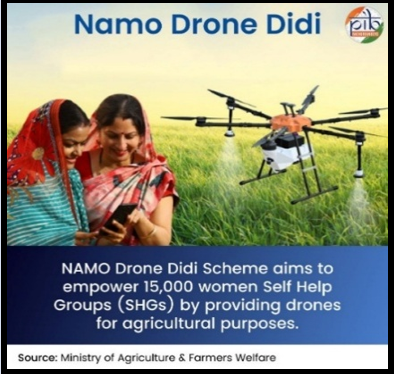
Impact of Namo Drone Didi in Agriculture and Farmer Services
Impact of SVAMITVA Scheme
Do you know?
The Railway Protection Force (RPF) has adopted drones for security surveillance in rail yards, station premises, and along railway tracks. These drones provide real-time tracking, video streaming, and aerial monitoring, supporting crowd management and anti-trespass operations.
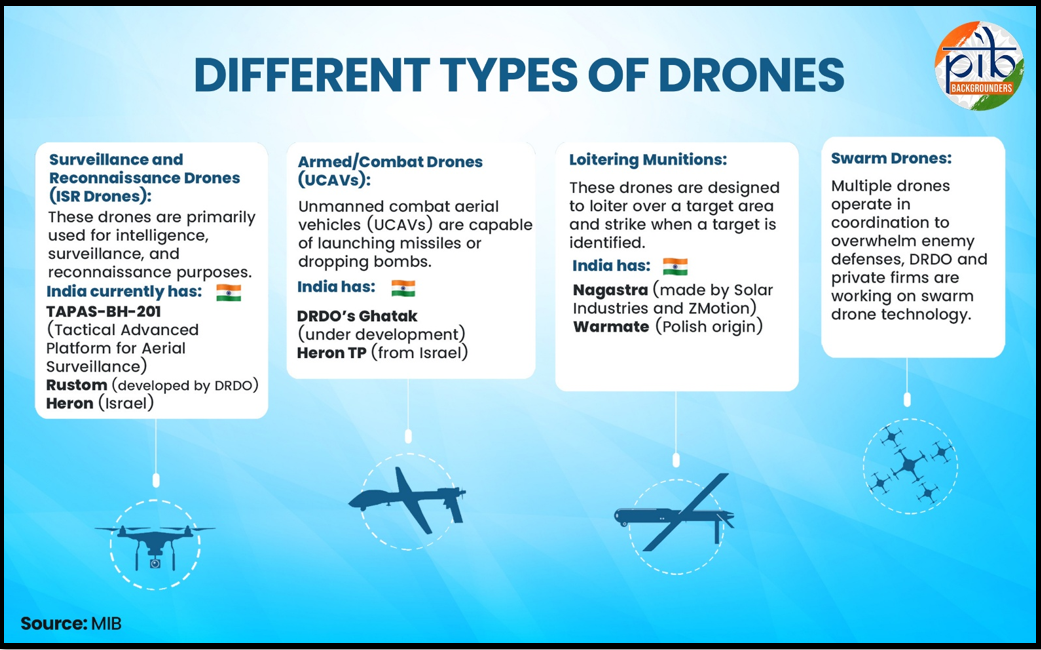
Drones in India are driving transformative socio-economic and developmental outcomes across sectors. Their use in agriculture has empowered women farmers and improved risk assessment, while in infrastructure and urban planning they have enabled proactive monitoring and better resource management. In disaster management and national security, drones have strengthened preparedness and rapid response capabilities. Together, these applications underscore the role of drone technology as a scalable, future-ready solution that is reshaping service delivery and advancing smarter, more resilient, and sustainable governance in India.
Accelerating Drone Adoption in India via Policy, Programs and Reforms
The Government of India has established a comprehensive policy and financial framework to accelerate the adoption and manufacturing of drones. These measures are designed to encourage innovation, simplify compliance, and strengthen domestic production.
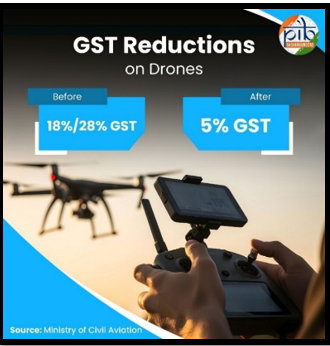
Collectively, these reforms significantly lowered entry barriers, encouraged both rural and commercial adoption, and supported the growth of Drone-as-a-Service models.
Key Achievements of Digital Sky Platform
Through progressive regulations, financial incentives, and dedicated capacity-building initiatives, India has created a comprehensive ecosystem that accelerates drone adoption and manufacturing. Simplified compliance under the Drone Rules, support for domestic production via PLI, reduced GST, and platforms like Digital Sky, combined with skill development and innovation programs, are collectively enabling widespread commercial, industrial, and societal use of drones while fostering a self-reliant and future-ready sector.
Conclusion
India’s drone ecosystem has transitioned from pilot projects to a mainstream, innovation-driven sector, underpinned by progressive policies, regulatory facilitation, and targeted financial incentives. With initiatives supporting women-led entrepreneurship, rural access, and domestic manufacturing, the government has created a structured framework that encourages both technological innovation and widespread adoption. Drones are now embedded across critical sectors—agriculture, land and property surveys, infrastructure monitoring, disaster assessment, and public service delivery—demonstrating their potential to enhance efficiency, transparency, and precision in governance.
Looking ahead, continued expansion of indigenous manufacturing, skill development for remote pilots, and integration with state and central programmes positions India to leverage drones for socio-economic empowerment, infrastructure oversight, and national security. With increasing government support, including budget allocations, innovation grants, and strategic deployment, India is set to become a global leader in unmanned aerial systems, fostering an ecosystem that balances commercial growth, technological self-reliance, and inclusive development.
References
Press Information Bureau
Lok Sabha
Rajya Sabha
Ministry of Information and Broadcasting
National Highways Authority of India
Ministry of Civil Aviation
Others
- Agriculture and Farmer Services: The Namo Drone Didi Scheme, launched in November 2023, is a flagship initiative of the Government of India. The scheme aims to provide drones to Women Self Help Groups (SHGs) to support modern farming practices. Its key objectives are to improve farm efficiency, increase crop productivity, reduce input costs, and create sustainable livelihood opportunities for women.