India AI Impact Summit 2026 Session on Resilient, High-Performance Data Centres Highlights Energy Implications of AI-Driven Compute Growth
India AI Impact Summit 2026 Session on Resilient, High-Performance Data Centres Highlights Energy Implications of AI-Driven Compute Growth
The session “From Insights to Action for Resilient, High-Performance Data Centres”, held today on the second day of the India AI Impact Summit 2026 and organised in collaboration with the U.S. Department of Energy (US DOE) and the National Lab of the Rockies, earlier known as the National Renewable Energy Laboratory (NREL), discussed the growing pressure that AI-driven data centre expansion is placing on energy systems and infrastructure planning.
The discussion highlighted how the rapid rise in compute demand is leading to highly variable and concentrated power loads, challenging traditional grid planning assumptions and reshaping the role of data centres from passive consumers of electricity to dynamic assets with a direct bearing on grid reliability, costs and long-term investment decisions.
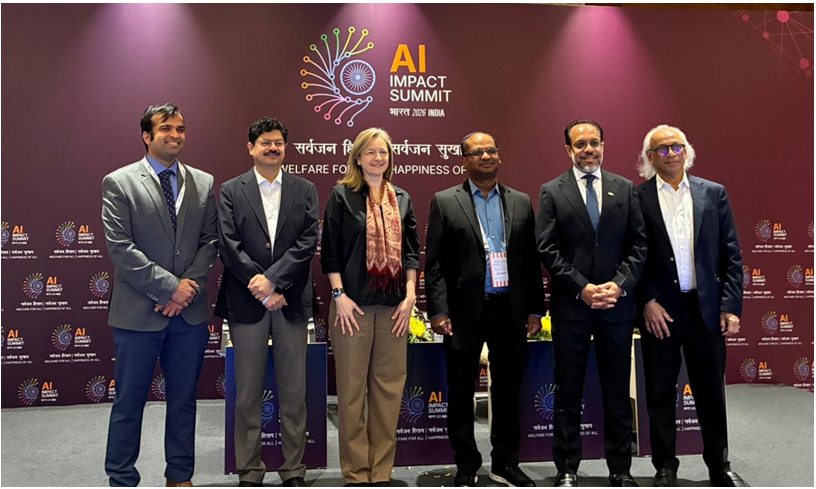
Leading experts as panellists deliberated on the policy and planning considerations required to scale data centre capacity sustainably and climate-resiliently. Key themes included the energy–water nexus, cooling technologies, siting strategies and the implications of fragmented regulatory approaches in the absence of a binding national framework.
Jaqueline Cochran, Associate Laboratory Director, National Lab of the Rockies (NRL), said, “AI and data centres represent one of the defining energy challenges of our time. Data centres are complex, interconnected systems, and meeting their rapid growth requires an integrated approach, from chips and cooling to grids, infrastructure and power generation, while optimising for affordability, reliability and speed of deployment.”
Arunabha Ghosh, Chief Executive Officer, Council on Energy, Environment and Water (CEEW) – a policy research institute, added, “India’s data centre growth is being driven by competitive federalism, with states stepping in where as a binding national framework is still evolving. The policy challenge now is to move from fragmented incentives to a coherent approach that aligns investment, resource efficiency, and long-term infrastructure planning.”
The Data Centre workings related session was also attended by Murali Baggu, Lab Program Manager, US Department of Energy, Abhijit Abhyankar, Professor, Electrical Engineering, IIT Delhi, and Reji Kumar, President, India Smart Grid Foundation.
Reji Kumar, President, India Smart Grid Foundation, said “AI-driven data centres introduce unprecedented scale and volatility in electricity demand, challenging long-standing grid planning and reliability assumptions. Policymakers and regulators will need to rethink how grids are planned, financed and regulated to manage these dynamic loads while protecting system reliability and consumer interests.”
Murali Baggu, Lab Program Manager, Grid Integration at National Lab of the Rockies (NRL), emphasised the importance of integrated energy planning for AI infrastructure, stating, “Data centres are deeply interconnected systems—from chips and innovative cooling methods to distribution, transmission, and generation. Our ‘chip-to-grid’ approach focuses on co-optimising the entire system so data centres and the grid can operate in harmony, supporting reliability, flexibility, and stability at scale.” Focussing on the Grid side of data centres, he went on to describe activities at NRL’s Colorado based High Performance Computing (HPC) Data Centre which spans over a 10,000 sq. ft facility with up to 10 MW of computing power enabling large scale modelling, simulation and AI-driven research for energy innovation.
Highlighting the resource and carbon implications of AI infrastructure, Abhijit Abhyankar, Professor, Electrical Engineering, IIT Delhi, said, “AI data centres are among the most energy-intensive components of digital infrastructure. Addressing their power, cooling, water, and carbon footprint requires an integrated approach, where energy systems, AI, and grid planning are designed together rather than in silos.” AI data centres are power and even water guzzlers; like input to a data centre is energy while output is meaningful computation in this process significant carbon footprints are involved globally.
The session ended with emphasis on the need for integrated planning across the energy and digital infrastructure sectors, supported by regulatory mechanisms that balance innovation with affordability, reliability and efficient resource utilisation, enabling the growth of AI along with strengthening long-term system resilience.