Global Leaders Emphasise Human-Centred Governance as AI Scales Across Digital Public Infrastructure at India AI Impact Summit 2026
Global Leaders Emphasise Human-Centred Governance as AI Scales Across Digital Public Infrastructure at India AI Impact Summit 2026
On the third day of the India AI Impact Summit 2026, the session on “Governing Safe and Responsible AI within Digital Public Infrastructure (DPI)” brought together global leaders and experts to examine how artificial intelligence can be embedded in public systems in ways that are safe, accountable and inclusive.
As digital public infrastructure increasingly underpins service delivery across health, education, social protection and public administration, the session underscored that AI systems integrated into these frameworks shape decision-making, allocation of resources and the exercise of rights at scale. In such contexts, trust, legitimacy and accountability were framed not as technical add-ons, but as foundational principles of governance.
Alar Karis, President of the Republic of Estonia, praised India’s leadership in digital public infrastructure, stating it’s shaping the global conversation on technology, governance, and inclusion. Emphasising the structural role of DPI in modern state capacity, H.E. Alar Karis, President of Estonia, said “Digital public infrastructure is no longer just a technical backbone for service delivery; it is a foundation of how modern states operate. When AI is embedded into these systems, algorithmic transparency and human oversight are not optional additions; they are essential conditions for public trust and legitimacy”.
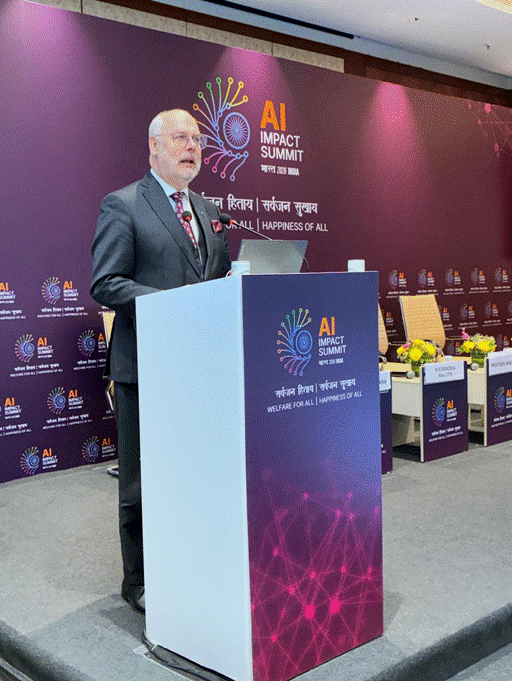
Highlighting the responsibility of public institutions in AI-enabled governance, H.E. Bernard Maissen, State Secretary and Head of the Federal Office for Communications, Switzerland, said “International cooperation and capacity building are essential parts in leveraging AI for good governance across the world. Sharing good practices among countries will help each other learn and grow. India AI summit demonstrates the value of convening inclusive global south focusing conversation on AI Governance. Digital public infrastructure must reflect the highest standards of human rights, accountability, inclusivity and transparency. Public authorities remain responsible for decisions taken or supported by AI, even when systems are developed or operated by private actors. Without accountability, trust cannot be sustained.”
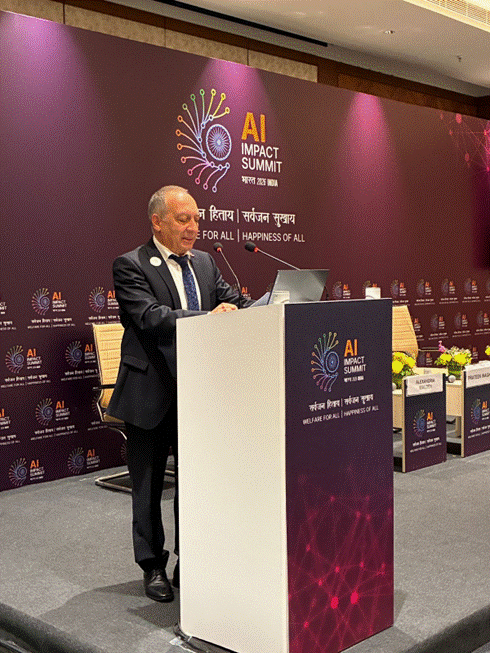
Furthermore, stressing upon the need for safeguards by design, H.E. Taurimas Valys, Vice Minister of Lithuania, “Responsible AI begins with strong public sector foundations. AI in digital public infrastructure must never become a tool for surveillance or discrimination; technology must serve people, not the other way around, and inclusion must be built into systems by design”.
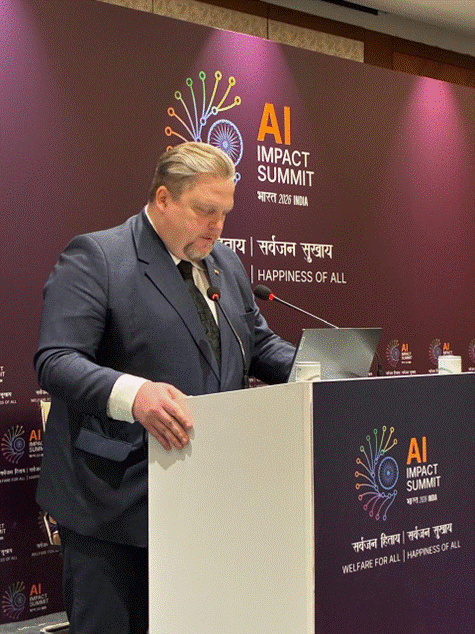
Framing the governance within DPI as central to democratic legitimacy, H.E. Harry Verweij, Ambassador-at-Large for Artificial Intelligence at the Ministry of Foreign Affairs of the Netherlands, said “AI governance in digital public infrastructure is about public trust and democratic legitimacy. Human rights, transparency, accountability and inclusion are not optional add-ons; they are foundational design principles, and efficiency can never come at the cost of dignity and fairness”.

Following the addresses by the Heads of Delegation, a panel discussion deepened the conversation by examining practical governance mechanisms, lifecycle accountability and lessons from Global South deployments. The discussion focused on rights-respecting and human-centred governance frameworks, including algorithmic transparency, impact assessments, grievance redressal mechanisms and participatory design processes. Speakers noted that governance failures often originate well before deployment, at the level of institutional design and political decision-making, making early-stage accountability essential.
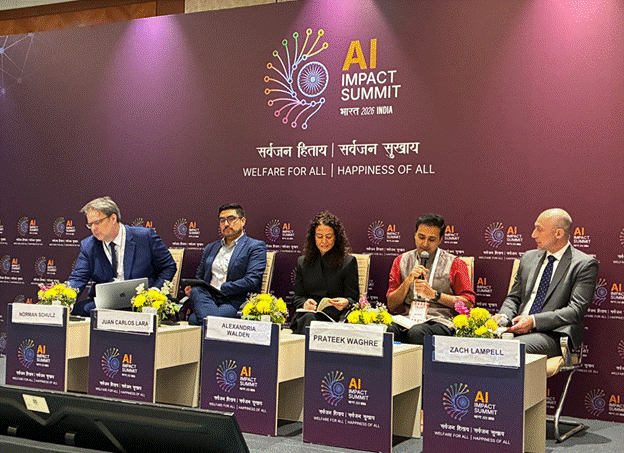
The panel featured Prateek Waghre, Head, Programs and Partnerships at Tech Global Institute; Juan Carlos Lara, Executive Director of Derechos Digitales; Alexandria Walden, Global Head of Human Rights at Google; and Norman Schulz, Deputy Head of Unit, Coordination Staff for AI and Digital Technologies in Foreign Policy, Federal Foreign Office, Germany.
Drawing on experiences from Europe and the Global South, the session concluded that inclusive global forums and shared standards are essential to ensure that AI embedded in digital public infrastructure strengthens democratic accountability, safeguards human rights and delivers tangible public value at scale. As countries expand AI integration into public systems, the discussion reinforced that responsible governance must evolve alongside technological capability, placing people, rights and trust at the centre of digital transformation.