From Regional Flavours to Food Innovation: Entrepreneurial Stories from AAHAR 2026
From Regional Flavours to Food Innovation: Entrepreneurial Stories from AAHAR 2026
The 40th edition of AAHAR 2026 has brought together stakeholders from across the food and hospitality ecosystem in New Delhi. The five-day international exhibition from 10th to 14th March, 2026, provides a platform for producers, exporters, hospitality businesses, and technology providers to connect and explore new opportunities. Over the years, AAHAR has emerged as one of Asia’s leading trade exhibitions in the food and hospitality sector. With nearly 1,800 exhibitors from India and abroad, the event showcases a wide range of products, including processed foods, beverages, dairy products, bakery items, and agri-produce.
Spread across multiple halls at Bharat Mandapam, the exhibition highlights both traditional flavours and modern food-processing innovations while facilitating business-to-business (B2B) engagement among producers, exporters, buyers, and hospitality businesses. Beyond product displays, AAHAR also brings forward the stories of entrepreneurs and enterprises shaping India’s evolving food processing landscape.[1]
From Sikkim to the National Stage
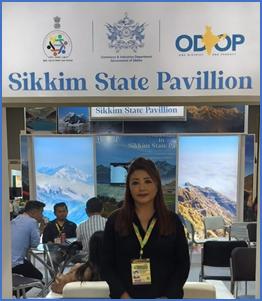
At the vibrant stalls of the One District One Product initiative, the Sikkim State Pavilion showcases distinctive flavours from the Himalayan state, attracting visitors and buyers alike.
Among the participants is Sangidoma Bhutia, an entrepreneur from Gangtok, Sikkim, whose journey reflects how government support is facilitating small food businesses to grow. Sangidoma began her entrepreneurial journey nearly 16 years ago, producing traditional Sikkimese food products on a small scale. In the early years, she relied entirely on her personal savings to sustain the business. Now, she runs the brand “Taste of Sikkim,” known for its traditional pickles. Along with producing pickles, she, as a master trainer, also trains rural women in food processing skills, creating new opportunities for them to earn and become self-reliant.
A major breakthrough in her journey came when she availed the benefits of the Pradhan Mantri Formalisation of Micro Food Processing Enterprises (PMFME) Scheme, a flagship Central Government initiative that supports small food processing businesses. She availed a loan of ₹10 lakh, which enabled her to invest in modern processing equipment and expand the production capacity. She also received a subsidy of ₹3.5 lakh, making it easier for her to repay the loan and manage her enterprise with confidence.
Reflecting on her journey, Ms. Sangidoma recalls that her business started on a very small scale. “After receiving the loan, I could invest in machinery and expand my production. The scheme has opened new opportunities for entrepreneurs like me, especially women with fewer financial resources.”
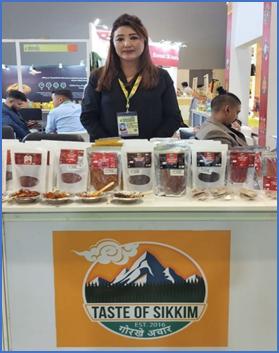
Her enterprise focuses on value-added products made from Sikkim’s famous organic ‘Dalle Khursani’ chilli, which carries a Geographical Indication (GI) tag. The chillies are sourced directly from local farmers and processed into products such as fermented chilli pickles, spice mixes, and blended condiments. The product range also incorporates locally grown fruits such as lapsi (plum), combined with the distinctive flavour of Dalle chilli to create unique regional delicacies. She explains
“Our products are unique to Sikkim. People in big cities are very curious to try them and appreciate the authentic taste.”
With the policy support, she has taken her products to several cities across India, including Delhi, Hyderabad, Chennai, Kolkata, Maharashtra, and Arunachal Pradesh. At AAHAR 2026, Sangidoma is participating for the first time and aspires to return again next year.
Traceability and Quality Innovation in India’s Tea Value Chain
In a conversation with Dheeraj Arjun K S, a representative of Iron Kettle, a tea brand from Karnataka, shared insights about the company’s focus on transparency, traceability, and quality sourcing in the tea supply chain. Iron Kettle offers tea across three main categories: CTC (Crush, Tear, Curl) chai sourced from Assam, a range of flavoured and green teas, and a specialised Sanjeevani green tea line. Quality sourcing is central to the company’s model. The company operates with a head office in Bengaluru, Karnataka, while processing facilities are located in Assam and the Nilgiris, Tamil Nadu, near the sourcing regions. It holds several certifications, including Rainforest Alliance, HACCP (Hazard Analysis and Critical Control Points), and ISO (International Organization for Standardization).
“Hand-plucking ‘two leaves and a bud’ takes more effort and results in lower yield, but it produces a much better cup of tea,” says Dheeraj Arjun K. S. “That is why we offer premium prices to farmers who maintain higher fine-leaf standards.”
To ensure quality standards, the company deploys agronomy officers in Assam and the Nilgiris who work directly with farmers and provide training on cultivation practices, pesticide usage, and plucking techniques. New farmers joining the network undergo one to two months of guidance and observation to ensure adherence to quality protocols.
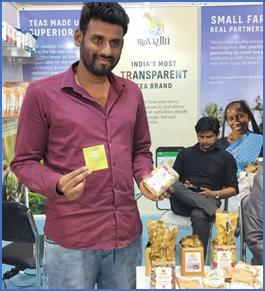
Iron Kettle has introduced a QR-code-based traceability system to enhance transparency in the tea supply chain. Each retail tea pack carries a unique QR code that allows consumers to trace their tea’s journey, from farm to cup. By scanning the code, consumers can access detailed information, including:
This digital traceability model strengthens consumer trust and promotes accountability across the value chain.
Participating in AAHAR 2026 for the first time, the company sees the exhibition as an opportunity to introduce its traceable tea model to a wider audience. The dedicated efforts highlight how digital traceability, farmer-centric sourcing, and quality-driven pricing can reshape agricultural value chains while building stronger consumer trust.
A Spice Enterprise from Kanpur Expanding Its Reach
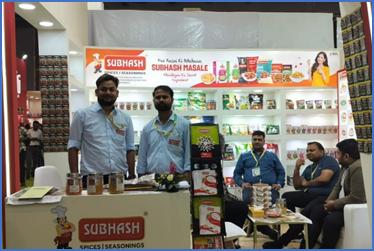
Subash Agro Industry Pvt Ltd, a spice manufacturing company based in Kanpur, Uttar Pradesh, reflects the journey and steady growth of small- and medium-sized food processing enterprises in India. Established in 1992, the enterprise began by producing essential spices commonly used in Indian kitchens. Over the past three decades, it has gradually expanded its operations and built a strong network of distributors and retail partners across several states. Today, the company produces a wide range of kitchen staples, including turmeric, coriander, chilli, and blended spices. According to Jitendra Mohan Tiwari, a representative of Subash Agro Industry Pvt Ltd, mentioned that the company also supplies seasoning blends to snack manufacturers, particularly for products such as namkeen. Over time, the enterprise has diversified its product portfolio beyond spices to include papad, pickles, agarbatti, dhoop sticks, hing, and soy nuggets (soya badi).
“Today, we offer more than 100 products while maintaining high standards of aroma, purity, and freshness in every pack,” says Jitendra Mohan Tiwari.
Its products are distributed across several states, including Uttar Pradesh, Madhya Pradesh, Bihar, Chhattisgarh, Jharkhand, and Uttarakhand through an established network of distributors and retailers. Participation in AAHAR 2026 provides the company with an opportunity to showcase its product range, connect with potential buyers, and explore new market opportunities within India’s growing food processing sector.
From Fresh Fruits to Frozen Innovations
Among the enterprises attracting attention at AAHAR 2026 is Ganpati Frozen World, based in Nagpur. Mr. Gaurav, a representative, mentioned that the company represents a growing segment of businesses focusing on value-added fruit ingredients for the food processing and hospitality sectors. Founded around eight years ago, the enterprise initially focused on processing seasonal fruits and converting them into convenient, ready-to-use ingredients for businesses.
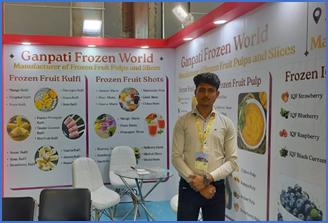
Over time, it has developed a diverse product portfolio that includes frozen fruit pulps, fruit shots, kulfi premixes, and frozen berries, widely used in beverages, desserts, and processed food products. By transforming fresh fruits into frozen pulps and ingredients, the company enables food manufacturers to access fruit flavours year-round, regardless of seasonal availability.
Products such as Alphonso mango pulp, custard apple pulp, and jamun pulp are commonly used in the preparation of milkshakes, ice creams, and desserts. The products are preserved at around-18 °C, which helps maintain freshness, flavour, and shelf stability while simplifying storage and transportation for commercial users.
Operating primarily in the business-to-business (B2B) segment, Ganpati Frozen World supplies fruit ingredients to manufacturers producing milkshakes, beverages, desserts, and other fruit-based products. The company also serves the HoReCa (Hotels, Restaurants, and Catering) sector, providing ingredients that enable efficient large-scale food preparation.
Having participated in the exhibition three times since 2023, Ganpati Frozen World continues to use AAHAR 2026 as a platform to showcase its product range and connect with food processors, hospitality businesses, and distributors from across the country.
Mr. Gaurav says, “AAHAR has been an important platform for us to showcase our products and connect with buyers from across the country. Each year, we see new opportunities and partnerships emerging here.”
Dehydrated Food Innovations from Gujarat
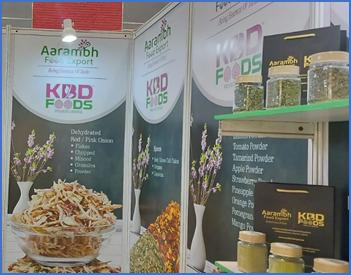
India’s growing food processing sector is witnessing the emergence of innovative startups that are transforming how agricultural produce is processed and consumed. One such example is Aarambh Food Export, represented by Manging Director, Dhruv Bhalariya, showcasing its products at AAHAR 2026. The company, established around 2021 and based in Bhavnagar, Gujarat, focuses on producing ready-to-use dehydrated ingredients (dehydrated fruits, vegetables, and flavouring powders) for both household kitchens and the food processing industry.
At the exhibition stall, the company is displaying a diverse range of products, including tomato, lemon, beetroot, potato, and onion flakes, as well as fruit powders such as apple and lemon powders. The product line also features dehydrated herbs like mint, curry leaves, and kasuri methi, which are widely used in seasoning blends, instant foods, bakery products, beverages, and smoothies. The company’s approach highlights the growing importance of dehydration technology in food processing. By converting fresh produce into shelf-stable powders and flakes, such enterprises add value to agriculture while reducing post-harvest losses.
Showcasing India’s Evolving Food Processing Ecosystem
The diverse stories emerging from AAHAR 2026 highlight the growing dynamism of India’s food processing sector. From small entrepreneurs promoting regional flavours to startups introducing innovative technologies and value-added products, the exhibition reflects how businesses across the country are exploring new opportunities. By bringing together entrepreneurs, industry stakeholders, and buyers under one roof, platforms like AAHAR help strengthen connections across the food value chain while showcasing the richness and innovation within India’s food processing ecosystem.
References
Ministry of Commerce & Industry
https://www.itpo.gov.in/aahar-2026-delhi