From Digitisation to Intelligence: How AI is Enhancing Access to Justice in India
From Digitisation to Intelligence: How AI is Enhancing Access to Justice in India

Key Takeaways
Introduction: India’s Measured Shift to AI-Enabled Courts
On any ordinary morning, India’s courts reveal a busy rhythm: files moving, cause lists being called, lawyers navigating packed corridors and litigants waiting for brief hearings. For decades, this system has managed rising caseloads, linguistic diversity, and the tension between access and procedural rigour.
Recently, digital transformation is modernising the judiciary through a co-ordinated push. Under e-Courts Phase III starting from 2023, courtrooms and registries have begun to change in steady, visible ways. Paper-based submissions have been progressively replaced by digital filings; cause lists are updated in real time;
DID YOU KNOW?
Cause list contains the details of cases listed for hearing on a particular date.
eCourts is a Pan-India Mission Mode Project under the Department of Justice, Ministry of Law & Justice to make judicial processes across courts more efficient, transparent, and accessible by using Information and Communication Technology.
video-conferencing hearings are routinely conducted; and judicial records are accessible seamlessly across the country.
Within the broader lens of digital transformation, Artificial Intelligence (AI) has begun to play a careful – calibrated role. Supported by the Government, the Supreme Court, High Courts, National Informatics Centre (NIC) and institutions such as IIT Madras, AI tools are now assisting various functions such as:
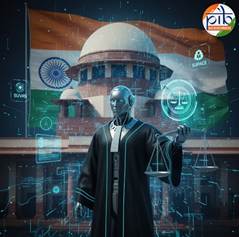
Latest technologies like AI and its subsets Machine Learning (ML), Optical Character Recognition (OCR), Natural Language Processing (NLP) are being used in the e-Courts software applications developed under the eCourts Project. New application like Digital Courts 2.1 and tools such as LegRAA and SUPACE represent early but significant steps towards smarter judicial workflows.
What is emerging today is an ecosystem where technology complements judicial work, improving speed, accuracy, and transparency, while preserving the independence and centrality of human decision-making.
From Digitisation to AI: The Judicial Technology Continuum
The integration of AI into India’s judiciary is part of a steady and deliberate digital transformation, not a sudden technological leap. Over the past decade, courts have moved from basic computerisation to nationwide digital platforms, real-time data systems, virtual courts and multilingual judgment access.
The initial steps toward digitisation began with the launch of the e-Courts Mission Mode Project in 2007, which focused on:
• Computerising court records so that case files could be stored, retrieved, and managed digitally.
• Digitising cause lists to allow daily case schedules to be published and updated online in real time.
• Enabling electronic Case Information Systems (CIS) to give courts a unified platform for tracking case progress and administrative actions.
Phase I was primarily about making court information more visible and easily accessible to both administrators and litigants.
As digitisation matured with Phase II and Phase III, the challenge shifted from availability of data to managing scale. Under the successive phases of the e-Courts project, following were introduced:
AI represents the next layer in this continuum. Unlike earlier digital tools, AI systems are now capable of:
Importantly, AI in the Indian judiciary has been positioned not as a replacement for existing systems, but as an augmentation of them, embedded within platforms such as the Integrated Case Management & Information System (ICMIS), e-filing modules and judgment databases.
AI Advancing Across Multiple Domains: Live and Pilot Deployments
AI is already operational in the judiciary, used selectively and with institutional supervision in defined administrative and support areas. These deployments are either fully operational or in controlled pilot stages.
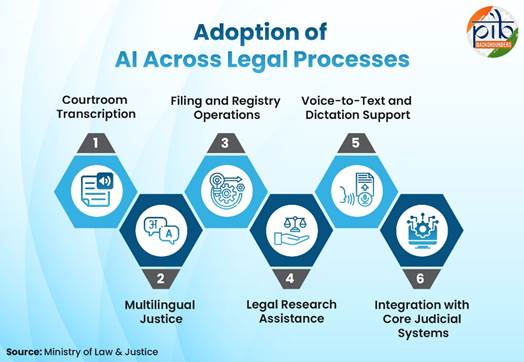
AI in Courtroom Transcription: Capturing the Spoken Record
One of the earliest and most visible uses of AI in the Supreme Court has been in the transcription of oral arguments, particularly in Constitution Bench matters. Traditionally, court proceedings relied on handwritten notes, selective dictation, or post-hearing summaries.
AI speech recognition is enabling near real-time transcription of oral arguments, with transcripts released on Supreme Court’s official platforms for greater transparency and record accuracy. The system is being gradually extended to regular hearing days after successful use in Constitution Bench proceedings.
This deployment uses Automatic Speech Recognition (ASR), a subset of ML, trained to recognise legal vocabulary, accents, and courtroom dialogue, while final validation remains human-led.
AI for Multilingual Justice: Translation of Judgments
Language accessibility has long been a structural barrier in India’s justice system. While judgments are authored primarily in English, a large section of litigants operates in regional languages. AI has been deployed to bridge this gap through large-scale judgment translation.
DID YOU KNOW?
The eSCR (Electronic Supreme Court Reports) portal is a free, digital, and user-friendly service to search, read, and download Supreme Court judgments.
In collaboration with the NIC, AI tools using Natural Language Processing (NLP) are translating Supreme Court judgments into 18 Indian languages. For this, SUVAS (Supreme Court Vidhik Anuvaad Software), an AI-driven translation tool of the Supreme Court, converts English judgments and orders into vernacular languages, enhancing accessibility and regional language use in courts. These translated judgments are hosted on the e-SCR portal, significantly expanding public access.
Supreme Court and High Court AI Translation Committees oversee quality and constitutional accuracy. AI use remains assistive, with translations reviewed within judicial frameworks to support access to justice.
AI in Filing and Registry Operations: Reducing Procedural Friction
AI is also being deployed in court registries, where procedural scrutiny is resource-intensive. The Supreme Court Registry, with IIT Madras, has built AI tools to flag defects in e-filings.
These tools use Machine Learning (ML) and Optical Character Recognition (OCR) to examine petitions, annexures, formatting, metadata, and compliance with filing rules. Instead of manual scrutiny alone, AI systems flag potential defects, allowing registry officials to focus on substantive checks.
Currently, this system is in a pilot phase, with access provided to a limited group of Advocates-on-Record for testing and feedback. The objective is not automation of acceptance, but early detection and faster correction, reducing delays at the threshold stage.
AI in Legal Research Assistance: LegRAA and SUPACE
AI tools have been developed to assist judges in navigating large volumes of case law without substituting judicial analysis. The Legal Research Analysis Assistant (LegRAA) supports judges by analysing documents, extracting relevant legal references, and organising research material. These tools rely on NLP and ML techniques but operate strictly as research aids, with no role in recommending outcomes or drafting judgments autonomously.
The Supreme Court Portal for Assistance in Court Efficiency (SUPACE) is an AI-based system designed to help identify relevant precedents and understand the factual matrix of cases. SUPACE remains in an experimental stage and is not yet deployed for regular judicial use.
AI in Voice-to-Text and Dictation Support: ASR-SHRUTI and PANINI
To support judicial writing and reduce manual drafting time, AI-enabled dictation and translation tools have been introduced within applications like Digital Courts 2.1.
These tools assist judges in drafting while preserving full editorial and judicial control. They enhance efficiency without altering authorship or reasoning.
AI in Integration with Core Judicial Systems
All AI tools are being integrated within existing judicial infrastructure such as:
DID YOU KNOW?
It ensures AI functions within institutional boundaries, not as standalone or external systems reinforcing judicial independence and constitutional accountability.
AI and the Criminal Justice Ecosystem
AI’s role in the criminal justice ecosystem spanning investigation, evidence, prosecution and adjudication is expanding alongside structured digital reforms. By digitally connecting police, forensics, prosecution, prisons, and courts, AI is helping address longstanding interoperability that once caused delays and information gaps.
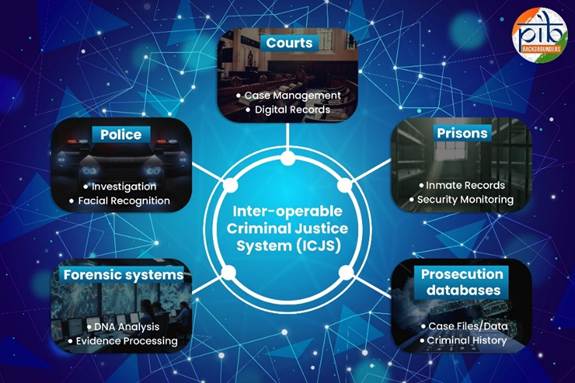
AI within the Inter-operable Criminal Justice System (ICJS)
AI-enabled tools are being layered onto the ICJS, which digitally links police, courts, prisons, forensic systems, and prosecution databases on the principle of ‘one data, one entry’. AI assists in managing large volumes of criminal case data, tracking procedural milestones, and improving the reliability of information exchange between agencies.
For courts, this enables faster access to verified FIRs, charge sheets, custody status and forensic reports, reducing reliance on manual files. AI-based data handling improves consistency and timeliness without altering evidentiary standards.
The National Automated Fingerprint Identification System (NAFIS) has been developed to create a centralised, searchable national repository of criminal fingerprints, comprising over 1.23 crore records. It replaces legacy systems and ensures accurate, timely and uniform fingerprint-based identification across law enforcement agencies nationwide.
AI-Supported Recording of Proceedings and Evidence
AI-enabled systems are also improving the recording and preservation of court proceedings. Daily proceedings are digitally captured within the CIS, while live-streaming of hearings in selected courts enhances transparency.
Applications such as Nyaya Shruti, introduced under ICJS, facilitate virtual appearances and testimonies through secure video conferencing. AI-supported voice processing ensures clarity, continuity, and accurate documentation, particularly in criminal trials involving multiple stakeholders across locations. Additionally, digital recording of evidence on platforms like e-Sakshya improves accuracy and reduces procedural disputes related to record integrity.
Institutional Governance, Safeguards and Investments
To ensure structured oversight, the Supreme Court constituted an AI Committee, later reconstituted to strengthen its mandate. The Committee, chaired by a sitting Supreme Court judge, oversees AI initiatives in the judiciary such as translation, research assistance and process automation and reviews pilots before wider adoption.
Most AI tools are being developed under the e-Courts Project Phase III within Detailed Project Reports (DPRs) approved boundaries. The Supreme Court’s eCommittee sets policy and strategy, while High Courts handle implementation allowing local adaptation within national standards.
Safeguards around data privacy, security and bias mitigation have been explicitly acknowledged by the judiciary. Dedicated sub-committees comprising High Court judges and technical experts have been constituted to examine secure connectivity, authentication mechanisms, and protection of judicial data.
In regards to Investments and capacity building, AI integration in India’s judiciary is being driven by sustained government efforts in this direction. Under Phase III of the e-Courts Project, with an outlay of ₹7,210 crore, funds have been earmarked for “Future Technological Advancement” including AI, ML and blockchain.
Conclusion: Technology with Constitutional Temperament
At the end of a long cause list, a judge still pauses, listens, weighs facts and applies the law. That moment has not changed. What has changed is everything around it, the time taken to find precedents, the effort required to sift records, the delay caused by language and logistics. AI is quietly working in these spaces, reducing friction without touching the core of judicial decision-making.
As India moves forward with technological reforms, digital tools in the justice system are increasingly shaped by ideas like the democratisation of technology, ensuring access across all courts; technology for “Welfare for All, Happiness for All,” grounding innovation in public good; and AI for Humanity, ensuring that AI upholds dignity, fairness, and trust. India’s judiciary is integrating AI in a balanced, constitutionally grounded manner leveraging technology for efficiency while ensuring human judgment remains paramount. This measured approach reinforces justice delivery without compromising constitutional values.
References
MINISTRY OF LAW & JUSTICE
https://nalsa.gov.in/lok-adalats/
https://cdnbbsr.s3waas.gov.in/s3ec0490f1f4972d133619a60c30f3559e/uploads/2024/07/2019-2020.pdf
https://www.pib.gov.in/PressReleasePage.aspx?PRID=2100326®=3&lang=2
https://doj.gov.in/access-to-justice-for-the-marginalized/
https://nalsa.gov.in/faqs/#1743592297157-684e9890-2d0b
https://nalsa.gov.in/faqs/#1743592298196-ba4b10d1-37f2
https://nalsa.gov.in/national-lok-adalat/
https://nalsa.gov.in/permanent-lok-adalat/
https://nalsa.gov.in/the-legal-services-authorities-act-1987/
https://nalsa.gov.in/lokadalats/#:~:text=Lok%20Adalat%20is%20one%20of,Legal%20Services%20Authorities%20Act%2C%201987
https://www.pib.gov.in/PressReleasePage.aspx?PRID=1848734®=3&lang=2
https://cdnbbsr.s3waas.gov.in/s39f329089b8d9644b96ba05d545355d67/uploads/2025/06/202506042007507813.pdf
https://www.pib.gov.in/PressReleasePage.aspx?PRID=2223646®=3&lang=1
LOK SABHA
https://sansad.in/getFile/loksabhaquestions/annex/184/AU4710_TmG1Ss.pdf?source=pqals
PRESS INFORMATION BUREAU
https://www.pib.gov.in/PressReleasePage.aspx?PRID=2187718®=3&lang=2
OTHERS
From Digitisation to Intelligence: How AI is Enhancing Access to Justice in India