Export Promotion Mission: Building an Integrated Pathway for MSMEs in Global Trade
Export Promotion Mission: Building an Integrated Pathway for MSMEs in Global Trade
Key Takeaways
Introduction
India’s export ecosystem is being strengthened through a mission-mode approach under the Export Promotion Mission (EPM), aimed at expanding global market access and enhancing the competitiveness of Indian exporters, particularly Micro, Small and Medium Enterprises (MSMEs).
Building on the interventions that were already supporting exporters, the Government has now launched 7 additional interventions under EPM, significantly expanding the scope of support across trade finance, compliance enablement, logistics and overseas market access. With this expansion, 10 interventions under the Mission are now operational, marking a major milestone in the rollout of EPM and reinforcing India’s commitment to inclusive and export-led growth.
What is the Export Promotion Mission?
The Export Promotion Mission (EPM) is a flagship initiative designed to provide coordinated support across key elements of the export ecosystem, including trade finance, standards compliance, logistics, overseas warehousing and market development.
Approved by the Government in November 2025, the Mission brings together multiple export-support measures under a single, unified and digitally driven framework. With a total outlay of ₹25,060 crore for the period FY 2025–26 to FY 2030–31, EPM seeks to enhance export competitiveness and expand India’s global presence.
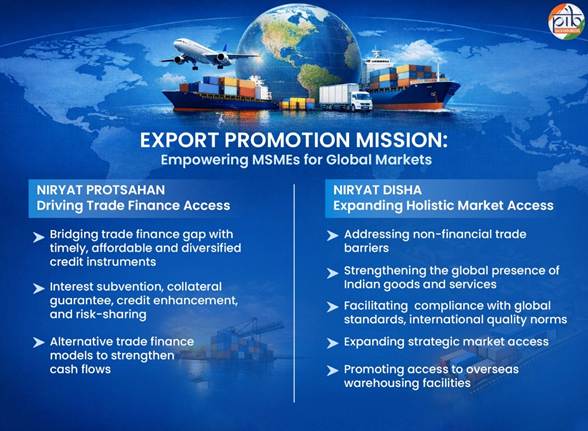
The Mission is implemented through two integrated sub-schemes: Niryat Protsahan, which focuses on financial enablers and trade-finance support, and Niryat Disha, which addresses non-financial, market-access and ecosystem enablers.
Through this framework, the Export Promotion Mission aims to:
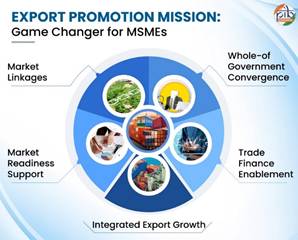
Overall, EPM adopts a whole-of-government approach by converging policy support, trade-finance enablement, market readiness and market linkages within a single institutional framework. By reducing fragmentation in exporter support and strengthening delivery across finance, standards, logistics and buyer connectivity, EPM enables integrated export growth for MSMEs.
Through this convergence-driven, mission-mode design, the Mission is envisaged as a game changer in enabling MSMEs to scale up and sustain their participation in global trade.
End-to-End Support Across the Exporter Journey
The Export Promotion Mission delivers stage-wise support aligned to the key phases of the export process, enabling exporters to access appropriate assistance from early-stage market exploration to post-shipment activities and overseas market presence.
Through its integrated interventions, the Mission provides coordinated support for:
Progress Under the Mission: Expansion of Interventions
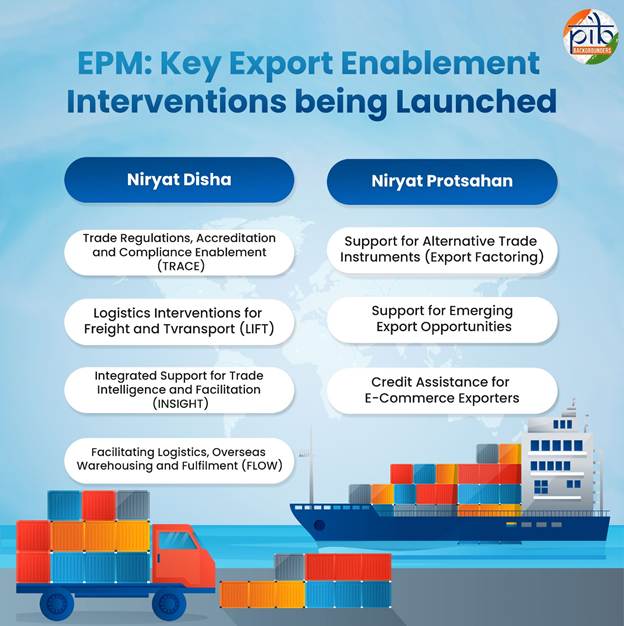
Prior to the latest launch, three key interventions under the Export Promotion Mission were already operational, providing support in areas such as interest subvention, collateral-free export credit and market access.
The launch of seven additional interventions marks a significant expansion of the Mission, extending support to new areas such as alternative trade-finance instruments, e-commerce exports, compliance enablement, logistics cost mitigation, trade intelligence and overseas fulfilment. With this expansion, the Mission now offers comprehensive and integrated support architecture covering both financial and ecosystem-level needs of exporters.
Niryat Protsahan – Financial Enablers
Niryat Protsahan addresses access-to-finance constraints faced by exporters, particularly MSMEs, by providing timely, affordable and diversified trade-finance instruments.
Newly Launched Interventions
1) Support for Alternative Trade Instruments (Export Factoring): This intervention promotes export factoring as an affordable and accessible trade finance instrument for MSMEs, with the objective of unlocking working capital and ensuring smoother business cycles.
Support under this component is available to MSME exporters undertaking merchandise exports under the notified list of six-digit tariff lines. Export factoring services are provided through registered export factoring firms (NBFCs).
Under this intervention, interest subvention of 2.75% is provided on the factoring cost, subject to a maximum limit of ₹50 lakh per IEC. Both recourse and non-recourse factoring are supported, and factoring can be undertaken in Indian Rupees as well as freely convertible foreign currencies.
Export Factoring
Export factoring is a financial tool that allows exporters to receive immediate cash by selling their export receivables to a financial institution. It provides working capital support, helps manage payment risk and forms part of Government-backed export finance support for MSMEs.
2) Credit Assistance for E-Commerce Exporters: This intervention provides credit facilities to MSME exporters to meet working-capital requirements for exports through postal, courier and overseas inventory-based fulfilment channels.
The support is available to MSME e-commerce exporters with a valid IEC and Udyam Registration, as well as new MSME exporters with prior domestic e-commerce turnover of at least one year. The intervention is implemented through the Export-Import Bank of India (EXIM Bank).
Under this component, the Direct E-Commerce Credit Facility provides up to 90% guarantee coverage, capped at ₹50 lakh, while the Overseas Inventory E-Commerce Credit Facility provides up to 75% guarantee coverage, capped at ₹5 crore. Interest subvention of 2.75% on eligible financing is provided, subject to an annual ceiling of ₹15 lakh per applicant.
3) Support for Emerging Export Opportunities: This intervention enables MSME exporters to expand into new or higher-risk export markets through access to shared-risk and credit instruments.
Risk-sharing support ranging from 10% to 90% of the transaction value is provided based on a defined risk model. Maximum Liability Permissible (MLP) limits include a 15% country-wise exposure cap, 5% exporter-wise exposure cap, 1% transaction-wise exposure cap, and 10% issuing bank-wise exposure cap.
Interventions Already Operational
4) Interest Subvention for Pre- and Post-Shipment Export Credit: This intervention provides interest subvention support on pre- and post-shipment export credit availed by MSME exporters, with the objective of reducing the cost of export finance and improving working-capital liquidity.
Under this component, interest subvention of 2.75% on the interest cost is provided, subject to a maximum limit of ₹50 lakh per exporter.
Under the current implementation status, arrears amounting to ₹850 crore under the erstwhile Interest Equalisation Scheme have been cleared. Since January 2026, around 3,000 exporters have registered for interest subvention support.
5) Collateral Support for Export Credit: This intervention facilitates collateral-free access to formal export credit for MSME exporters by providing credit guarantee support to lending institutions.
Under this component, credit guarantee coverage of 85% is available for micro and small enterprises, while 65% coverage is available for medium enterprises. The maximum eligible credit limit is ₹10 crore per exporter. Around 60 exporters have registered for support under this intervention since January 2026.
Niryat Disha – Non-Financial and Market Access Enablers
Niryat Disha is the non-financial enablers sub-scheme under the Export Promotion Mission. The sub-scheme focuses on addressing non-financial trade barriers faced by exporters and strengthening the global presence of Indian goods and services. It facilitates compliance with global standards and international quality norms, while expanding strategic market access through buyer–seller meets, trade fairs and exhibitions, and promoting access to overseas warehousing and fulfilment facilities.
Through its interventions, Niryat Disha supports exporters in improving market readiness, enhancing trade visibility, mitigating logistics-related disadvantages and strengthening institutional and information support systems across the export ecosystem.
Newly Launched Interventions
1) Trade Regulations, Accreditation and Compliance Enablement (TRACE): This intervention provides financial support to exporters to meet international testing, inspection, certification and other conformity requirements necessary for accessing global markets.
Support under TRACE is available to MSME exporters with a valid Importer Exporter Code (IEC) and valid MSME Udyam Registration Number. Assistance is provided for certifications included in the notified positive list, with higher levels of support extended for certifications under the notified priority positive list.
For certifications under the Positive List, financial assistance of 60% of the actual cost net of taxes, or ₹25 lakh, whichever is lower, is provided. For certifications under the Priority Positive List, assistance of 75% of the actual cost net of taxes, or ₹25 lakh, whichever is lower, is provided. The annual cap for support under TRACE is ₹25 lakh per exporter.
Notified Positive List & Priority Positive List
Under TRACE, the Positive List covers commonly required international certifications such as CE Marking, FDA certification, ISO standards and SABER/SASO. The Priority Positive List covers strategically important, higher-cost certifications critical for priority markets, including food safety (BRCGS, FSSC 22000, HACCP), marine certifications (MSC, ASC) and ethical supply chains (SMETA).
2) Logistics Interventions for Freight and Transport (LIFT): This intervention mitigates geographical disadvantages and inland connectivity gaps faced by exporters located in hinterland regions by providing support to reduce transportation and logistics costs.
Support under LIFT is available to all MSME exporters of notified eligible products from notified districts. Eligible shipments include export movement from MSME premises to Inland Container Depots (ICDs), Container Freight Stations (CFSs), Sea Ports and Air Cargo Complexes (ACCs). Shipments through rail and road are eligible, and shipments through air are permitted for certain regions.
Financial support of up to 30% of the actual cost incurred for availing eligible transport services is provided, subject to a maximum cap of ₹20 lakh per exporter per financial year.
3) Integrated Support for Trade Intelligence and Facilitation (INSIGHT): INSIGHT aims to strengthen exporter preparedness and develop institutional support systems by addressing information asymmetries and capacity gaps within the export ecosystem.
The intervention covers all exporters, transport and logistics service providers, and other stakeholders engaged in export-related activities. Both private and government entities are eligible for support.
Financial assistance is provided for multiple activities, including development of modules and toolkits, training and capacity building, district and cluster-level facilitation, research, innovation and pilot initiatives, and trade intelligence and analytics. Support of up to 50 % of the approved project cost is provided for eligible activities, subject to prescribed ceilings for each category. Government entities may receive up to 100 % of the approved project cost.
4) Facilitating Logistics, Overseas Warehousing and Fulfilment (FLOW): This intervention addresses logistics and warehousing constraints faced by exporters by enabling access to overseas storage, distribution and fulfilment infrastructure, thereby supporting faster, more reliable and cost-effective exports.
Support under FLOW is available to Export Promotion Councils, Commodity Boards, logistics, warehousing and fulfilment service providers, industry associations, and organisations recommended by the Central or State Government.
Financial assistance under this component is provided for a maximum period of three years. Support is available for the following categories:
Intervention Already Operational
5) Market Access Support (MAS): Market Access Support facilitates the conduct of market access activities aimed at developing, expanding and sustaining international markets, thereby enabling market diversification and enhancing international visibility of Indian products and services.
Under this intervention, financial assistance is provided for Buyer Seller Meets, Trade Fairs, Trade Delegations and Reverse Buyer Seller Meets. Support of up to ₹5 crore per event is available for Buyer Seller Meets, Trade Fairs and Trade Delegations, while support of up to ₹10 crore per event is provided for Reverse Buyer Seller Meets. Airfare support is extended to MSMEs for participation in eligible market access activities, and preferential support is provided for priority sectors.
Under the current implementation status, arrears amounting to ₹118.65 crore under the erstwhile Market Access Initiative (MAI) Scheme have been approved. A total of 34 events, comprising 24 Trade Fairs and 10 Reverse Buyer Seller Meets, have been approved with cumulative financial support of ₹45.5 crore.
Procedure for Application
Niryat Protsahan
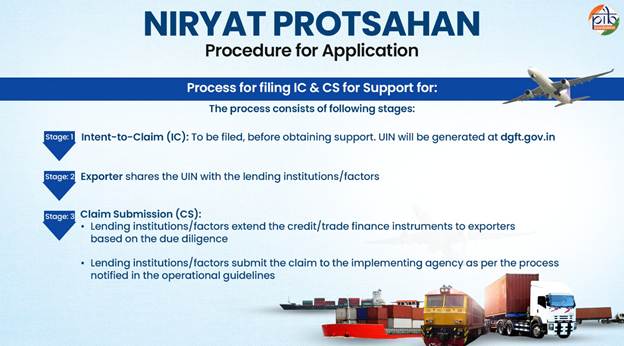
For Niryat Protsahan interventions, exporters file an Intent-to-Claim (IC) on dgft.gov.in prior to obtaining support, upon which a Unique Identification Number (UIN) is generated. The exporter shares the UIN with the lending institution or factoring entity. Lending institutions extend the credit or trade finance instruments to exporters and submit the Claim Submission (CS) to the implementing agency as per notified guidelines.
Niryat Disha
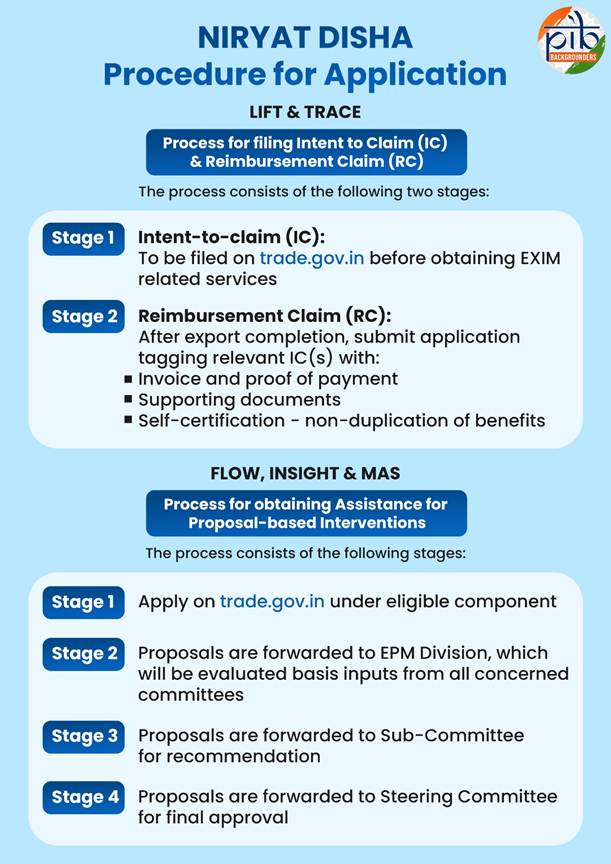
For LIFT and TRACE, exporters file an Intent-to-Claim (IC) on trade.gov.in before obtaining EXIM-related services and submit a Reimbursement Claim (RC) after export completion with supporting documents and self-certification.
For FLOW, INSIGHT and MAS, assistance is provided through a proposal-based approval mechanism, with applications submitted on trade.gov.in, followed by evaluation by the EPM Division, recommendation by the Sub-Committee and final approval by the Steering Committee.
Conclusion
The Export Promotion Mission represents a coordinated export support ecosystem combining financial enablers, market access support and ecosystem-level interventions. By addressing both credit-related and non-financial barriers faced by exporters, particularly MSMEs, the Mission aims to reduce the cost of exporting, improve compliance readiness and enhance global market integration.
Through coordinated implementation by Central Ministries, State and District authorities, financial institutions, Export Promotion Councils and Indian Missions abroad, EPM is envisaged to promote inclusive, decentralised and sustainable export growth.
References
Ministry of Commerce & Industry
https://www.pib.gov.in/PressReleasePage.aspx?PRID=2230664®=3&lang=1
https://www.pib.gov.in/PressNoteDetails.aspx?NoteId=156349&ModuleId=3®=3&lang=1
https://www.pib.gov.in/PressReleasePage.aspx?PRID=2189383®=3&lang=2
https://content.dgft.gov.in/Website/TF.pdf