Education Is Key to Making AI Work Responsibly, says Alar Karis, President of Republic of Estonia at India AI Impact Summit 2026
Education Is Key to Making AI Work Responsibly, says Alar Karis, President of Republic of Estonia at India AI Impact Summit 2026
On the third day of the India AI Impact Summit 2026 today on 18th February 2026, the session on “AI and Education: From Innovation to Impact”, hosted in collaboration with the Estonian Embassy, New Delhi at the India AI Impact Summit 2026, explored how countries can move beyond pilots to system-wide adoption of artificial intelligence in public education. The discussion highlighted that AI is already present in classrooms and that the central challenge is its responsible, equitable, and learning-focused deployment at scale.
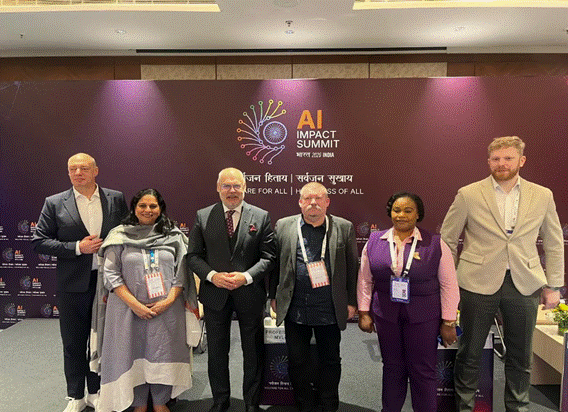
Speakers stressed that technology alone cannot transform education; investments in teachers, pedagogy, governance, and evidence-based implementation are crucial for delivering measurable learning outcomes through AI usage. The session highlighted a consensus that AI should bolster public education systems, ease teachers’ administrative loads, foster multilingual and inclusive learning, and avoid exacerbating the digital divide, especially in low-resource, low-bandwidth settings.
Alar Karis, Hon’ble President of the Republic of Estonia, said, “AI has already arrived in our schools, students and teachers are using it on a daily basis. The question, therefore, is not whether AI is to be used, but whether it is being used knowingly, critically, and responsibly by everyone. In this AI era, it is not how smart machines are that matters most, but how smart the people who use them are. Education is the key to this, and in Estonia we are bringing AI into schools and education with a dedicated policy at speed and scale.”
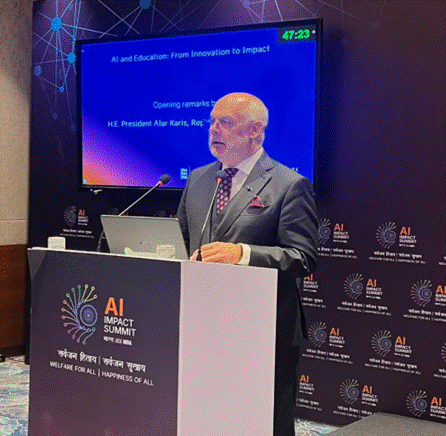
The President added that data and technology literacy are the foundation of our democracy. We are working as per policy to make sure that the majority of the population of Estonia gain basic AI tools’ knowledge and half at least intermediate to international level AI skills. Our AI push in education will focus on Serving the learning just like our digital AI in governance helps us in serving people better. Above all, AI education needs to be transparent and ethical, this will generate trust, which will lead to willingness to learn.
Mary N. Kerema, OGW Secretary ICT, E-Government and Digital Economy, Republic of Kenya, said, “We have realised that without embracing technology, we will be left behind. But the most stable and capable infrastructure in education is the teacher. You may have limited connectivity and limited devices, but you will always find a teacher in the classroom. That is why AI training for teachers must come first. If we empower the teacher, then there will be clear ethical AI use, because it all starts in the classroom.”
Dr. Pia Rebello Britto, Global Director, Education, UNICEF in her address, said, “We want innovation, especially technological ones like AI to strengthen public education rather than bypass it. On one hand we see exciting times with AI emergence, while there remains major challenges: in most lower/ middle income countries a majority of almost 70% 10-years olds around the world cannot read or understand a simple text. Thus hundreds of millions of children are at risk of being left behind due to the emergence of enormous progress in technologies like AI. When we speak about AI and education, we have to talk not about marginal gains. We have to talk about how innovation can reverse structural inequity. What creates equity is an ecosystem that supports teachers, protects children, and is accountable to public systems.”
Professor Petri Myllymäki, Finnish Center for Artificial Intelligence, said, “When ChatGPT was launched, there was panic. Everyone thought that AI will write all the essays and students will learn nothing.’ But we realised that outsourcing essays was always possible; it just became easier. The point of education is not to produce another essay in the world, it is to learn something in the process. By all means, use AI tools, but make sure learning happens.”
Ivo Visak, CEO, AI LEAP (Estonia), said, “It is not only the Ministry of Education and Research concern, It is a whole nation’s question. We have Estonian companies supporting the initiative, and there is general public trust toward such programs. If you have trust, people will follow. But you cannot break that trust you have to deliver. That is why we have a strong pedagogical plan behind it which is supported by technology, not a technological program supported by pedagogy.”
The session positioned 2026 as a year of implementation, calling for coordinated national strategies, teacher-centric capacity building, interoperable digital infrastructure, and strong public governance frameworks to ensure that AI strengthens learning systems and delivers equitable outcomes for all learners.