Democratising AI in India
Democratising AI in India

Key Takeaways
Introduction
Artificial Intelligence (AI) has become a central pillar of India’s development journey. It is strengthening governance, improving public service delivery, and enabling solutions that can reach citizens at scale. Human advancement has always been shaped by technology. Electricity transformed daily life and work. Computers changed how information was processed. The internet connected people and systems across borders, and mobile phones placed technology directly in the hands of citizens. AI builds on these foundations and now works alongside humans to transform sectors such as agriculture, healthcare, education, manufacturing, climate action and governance. For India, the democratisation of AI is essential to ensure that these benefits are widely shared and aligned with the vision of Viksit Bharat by 2047.
Democratisation of AI depends on equitable access to computing power, data repositories and model ecosystems, which increasingly determine who can innovate, compete and govern effectively in the digital economy. India’s development-focused approach places democratisation at the core of its AI strategy, enabling participation by startups, researchers, public institutions and innovators across regions.
Building on this vision, the India–AI Impact Summit 2026 will be held from 16 to 20 February 2026 at Bharat Mandapam in New Delhi. As the first global AI summit to be hosted in the Global South, it will bring together global leaders, policymakers, technology companies, innovators and experts to showcase and deliberate on the transformative potential of AI for inclusive growth, governance and sustainable development.
What is Democratisation of AI?
Democratisation of AI refers to making artificial intelligence accessible, affordable and usable for a wide and diverse set of users. It goes beyond access to finished applications. It includes access to the core building blocks of AI such as computing power, datasets and model ecosystems. As these resources become available at scale, individuals and institutions are expanding what they can achieve with AI.
Democratisation is also about widening economic opportunity. This momentum is reflected in India’s workforce, with over 6 million people employed across the technology and AI ecosystem. NITI Aayog’s report AI for Inclusive Societal Development released in October 2025 underscores AI’s potential to empower India’s 490 million informal workers by widening access to services, markets and financial systems. The approach builds on India’s established digital philosophy. UPI made digital payments open and inclusive. Aadhaar enabled digital identity at population scale. Indigenous 4G and 5G stacks strengthened technological self-reliance. AI is now following the same path, with openness, affordability and accessibility guiding innovation so that progress uplifts society as a whole.
Democratising AI Applications for Public Impact
AI creates value only when it reaches people at scale. India’s approach focuses on practical deployment across sectors so that AI improves everyday life and public services. Just as the internet and mobile phones transformed society through widespread use, AI is now following the same path. By prioritising applications that are easy to use and widely accessible, India is ensuring that AI delivers inclusive and measurable public impact.
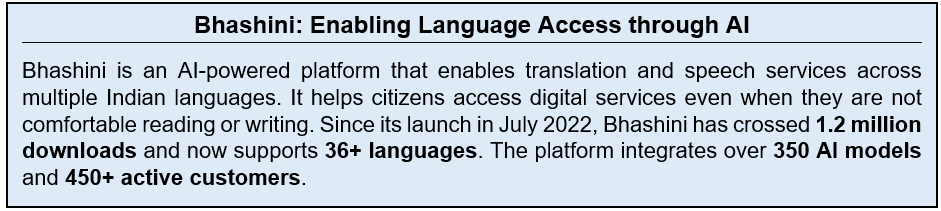
Across key sectors, AI applications are already making a difference. In agriculture, AI supports farmers by predicting weather, identifying pest risks, and guiding irrigation and sowing decisions. Platforms such as Kisan e Mitra simplify access to government schemes, while the National Pest Surveillance System and Crop Health Monitoring use satellite and weather data to protect crops and improve income security. In healthcare, AI enables early disease detection, assists in analysing medical images, and strengthens telemedicine services, connecting rural patients with specialists and improving the quality and reach of care.
AI is also strengthening disaster preparedness. The India Meteorological Department uses AI to forecast rainfall, fog and extreme weather, while tools like the Advanced Dvorak Technique support cyclone intensity assessment and MausamGPT is being developed to offer real-time advisories. This widespread application is reflected in India’s innovation landscape. As of January 2026, India ranks among the top three startup ecosystems globally, with over two lakh startups. Nearly 90 percent of these startups are estimated to be AI-powered in some form, highlighting how deeply AI has been integrated into innovation and problem-solving across the country.
Democratising Access to AI Infrastructure
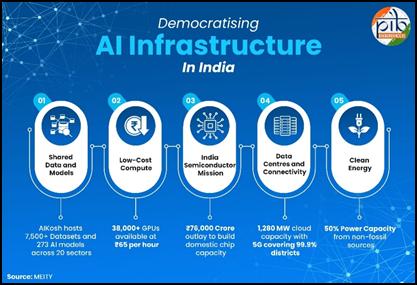
Democratising AI requires ensuring that the foundational infrastructure powering artificial intelligence is open, affordable and widely accessible. India’s approach is guided by its full AI stack, which spans applications, models, compute, infrastructure and energy, and treats these layers as interconnected national capabilities. Approved in March 2024 with a financial outlay of ₹10,371.92 crore over five years, the IndiaAI Mission is laying the groundwork for this approach by expanding access, strengthening data availability and enabling responsible use of AI for public good.
Access to Datasets and Models
Access to high-quality datasets and reusable models is a key driver of AI democratisation. National platforms are enabling developers to work with ready-to-use data and model resources rather than building from scratch. Supporting this effort is AIKosh, a national platform for AI datasets and models. It brings together datasets from government and non-government sources and makes them available across sectors. This shared access allows innovation to move faster and reach a wider community of users.

Alongside data access, India is developing its own large multimodal AI models trained on Indian data and languages. This approach strengthens technological self-reliance while ensuring relevance to local needs at scale. Under the IndiaAI Mission, more than 500 proposals were received, and 12 startups were selected across the first two phases. These include Sarvam AI, Soket AI, Gnani AI, Gan AI, Avaatar AI, BharatGen led by IIT Bombay, Zenteiq, Gen Loop, Intellihealth, Shodh AI, Fractal Analytics and Tech Mahindra Maker’s Lab.
Access to Compute
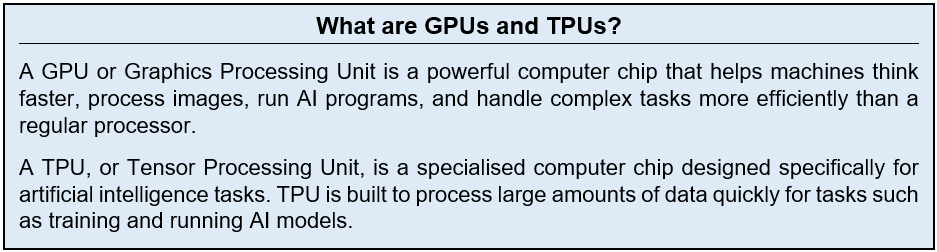
Limited access to computing power has historically restricted AI development to a few large institutions. This barrier is being addressed through subsidised and shared compute resources. Under the IndiaAI Mission, more than 38,000 high-end GPUs have been onboarded and are available at ₹65 per hour, which is nearly one third of the global average cost. In addition, 1,050 TPUs have also been onboarded to further expand access to advanced AI processing capabilities.
High-performance computing is also being made accessible through the National Supercomputing Mission. Over 40 petaflops of capacity has been deployed across IITs, IISERs and research institutions. Systems such as PARAM Siddhi-AI and AIRAWAT support shared use for applications including language processing, weather prediction and drug discovery.
Access to Chips and Semiconductor Capabilities
Long-term democratisation of compute depends on domestic chip capabilities. India is strengthening its semiconductor ecosystem to support AI workloads and reduce dependence on external supply chains. The India Semiconductor Mission, with an outlay of ₹76,000 crore, supports manufacturing, design and talent development. As of December 2025, 10 projects had been approved with cumulative investments of around ₹1.60 lakh crore across 6 states. India’s chip market is projected to reach $100 to $110 billion by 2030, reflecting rapid growth in this critical sector.
The Union Budget 2026–27 marked a further step in this direction with the announcement of India Semiconductor Mission 2.0. A provision of ₹1,000 crore has been made for FY 2026–27, with a strong focus on industry-led research and training centres. This phase aims to deepen technology development and build a future-ready skilled workforce, strengthening the long-term foundations for accessible and resilient AI compute in India.
Access to Data Centres and Connectivity
Scalable data centres and reliable connectivity are essential for widespread AI deployment. Fifth generation (5G) mobile services are now available in 99.9 percent of districts, covering 85 percent of the population. As of October 2025, 5.08 lakh 5G base transceiver stations had been installed nationwide.
India’s data centre ecosystem is expanding rapidly due to rising digitalisation, cloud adoption, and AI usage across government and industry. Current cloud data centre capacity stands at approximately 1,280 MW and supports critical sectors such as banking, power and public infrastructure. This capacity is expected to grow by 4 to 5 times by 2030.
The rising mobile coverage and expansion of the data centre ecosystem will open up the possibility of the common man even in remote areas to make use of systems and applications supported by these data centres and also contribute to creating the same.

India hosts nearly 20 per cent of the world’s data, while its data centre capacity stands at three per cent of the global total. Mumbai and Navi Mumbai form the largest hub, holding over 25 per cent of live capacity, supported by a dense subsea cable network and favourable policies. Bengaluru and Hyderabad each account for about 22 per cent of the country’s capacity. Chennai contributes around 13 per cent, followed by the Delhi NCR region at 14 per cent. Pune and Kolkata add six per cent and three per cent respectively. The data centre landscape in India is expanding steadily across regions.
Access to Reliable and Sustainable Energy
Reliable energy supply underpins all AI infrastructure. AI data centres are energy intensive, making sustainability and stability essential. India’s clean energy transition supports this requirement. In June 2025, India achieved 50 percent of its cumulative installed electricity capacity from non-fossil fuel sources, five years ahead of its 2030 target under the Paris Agreement. By November 2025, renewable energy capacity reached 253.96 GW, marking an increase of over 23 percent compared to November 2024. India added a record 44.5 GW of renewable capacity in 2025 alone.
Nuclear energy also plays an important role by providing stable and continuous power. The Sustainable Harnessing and Advancement of Nuclear Energy for Transforming India (SHANTI) Act 2025 aims to modernise the nuclear sector, promote public private partnerships, and enable foreign investment. India’s current nuclear capacity stands at 8.78 GW and is projected to rise to 22.38 GW by 2031–32 with the development of indigenous 700 MW and 1000 MW reactors through international cooperation.
By expanding access to data, compute, chips, connectivity and energy, India is ensuring that AI capabilities are available to innovators and institutions across the country.
Regulatory and Policy Environment for AI Democratization
A supportive regulatory and policy framework is critical for democratising AI infrastructure. India has focused on building trusted digital foundations that enable access to AI while ensuring security, affordability and public accountability.
Together, these measures expand access to data while protecting citizen rights, creating a stable environment for AI infrastructure to grow.
Education, Skilling and AI Literacy
Democratisation of AI depends as much on people as it does on technology. Building a skilled and informed workforce is essential to ensure that AI is understood, used responsibly and applied to solve real problems. India’s approach focuses on creating pathways for learning at every stage, from school education to advanced research, while ensuring that opportunities extend beyond major urban centres.
Together, these initiatives are strengthening AI literacy, expanding skill development and building a talent pipeline that supports inclusive and sustainable growth in the AI ecosystem.
Global Cooperation for Democratising AI Resources
For many countries, particularly in the Global South, democratising AI depends on fair and affordable access to foundational resources such as data, compute and digital infrastructure. Addressing this challenge requires coordinated global cooperation. The India–AI Impact Summit 2026 provides a platform for collective engagement, bringing together 15 to 20 Heads of Government, over 50 international ministers, and more than 100 global and Indian CXOs. Its deliberations are organised through Chakras, or Working Groups, structured around seven interconnected thematic areas. Among these, the Democratizing AI Resources Working Group stands out as a key initiative. Co-chaired by India, Egypt and Kenya, it brings together countries and stakeholders to advance a more inclusive and balanced global AI ecosystem through shared access, collaboration and capacity building.
The Working Group seeks to ensure that essential AI resources are accessible and affordable, so that all nations can participate meaningfully in the development, deployment and use of AI in line with their national priorities.
Objectives of the Working Group:
By promoting equitable access, cooperation and capacity building, the Democratizing AI Resources Working Group supports a future where all countries can harness AI in ways that advance inclusive growth and sustainable development.
Conclusion
India’s approach to the democratisation of AI shows that scale, inclusion and innovation can progress together. The focus on affordability, openness and trust ensures that benefits of AI reach farmers, students, researchers, startups and public institutions alike. As India hosts the India–AI Impact Summit 2026, it also places this experience within a global context, offering a model shaped by the priorities of the Global South. The path ahead is clear. Democratising AI is not a one-time effort but a continuing commitment to ensure that technological progress strengthens societies, reduces inequalities and supports sustainable development for all.
References:
PIB Backgrounders:
Ministry of Electronics & IT:
Ministry of Information and Broadcasting:
Office of the Principle Scientific Advisor:
Ministry of Skill Development and Entrepreneurship:
Ministry of New and Renewable Energy:
Ministry of Communications: