DECODING EVOLUTION OF THE LADAKH MAGMATIC ARC IN NW HIMALAYA DOCUMENTING FORMATION OF THE RANGE
DECODING EVOLUTION OF THE LADAKH MAGMATIC ARC IN NW HIMALAYA DOCUMENTING FORMATION OF THE RANGE
Scientists have decoded the evolution of the Ladakh Magmatic Arc in the NW Himalaya, that acts as a around 130-million-year, record of plate tectonics that document the subduction, maturation, and collision between the Indian and Eurasian plates.
Millions of years before the Himalaya became the tallest mountains on Earth, the region that is now called Ladakh lay above an ocean called the Neo-Tethys Ocean. Below that ancient sea, giant slabs of Earth’s crust slowly plunged into the mantle in a process known as subduction leading to the formation of the Ladakh Magmatic Arc (LMA). LMA is a  belt of igneous rocks in the Trans-Himalaya formed in the period Jurassic to Eocene- 201.3 million years ago to 33.9 Million Year (Ma).
Scientists from the Wadia Institute of Himalayan Geology, an autonomous institute of Department of Science and Technology (DST) have now traced this slow but powerful motion of subduction that formed the LMA by probing into the chemistry of rocks. They found that it was formed by the northward subduction of the Neo-Tethyan oceanic plate beneath the Eurasian margin.
They compared geochemical and isotopic results from the pre-collisional Dras-Nidar Island Arc Complex (DNIAC), pre-to syn-collisional Ladakh Batholith (LB) that formed the part of the well-known Kohistan-Ladakh Batholith, and post-collisional mafic dykes.
The researchers observed that the long-term magmatic evolution was controlled by the Neo-Tethyan Ocean geodynamics. The pre-, syn-and post-collisional history of the Ladakh magmatic arc shows three main magmatic episodes (160– 110 Million Year (Ma), 103–45 Ma, and < 45 Ma) of distinct geochemical signatures that are closely linked to the subducting slab dynamics involving the slab, the sub-arc mantle wedge, and the crustal com-ponents.
The LMA is a long-extinct volcanic system that once produced enormous amounts of molten rock that evolved through three major phases of geological activity over tens of millions of years.
In the earliest phase, the region resembled a chain of volcanic islands rising from the Neo-Tethys Ocean. Rocks from the Dras–Nidar Island Arc Complex preserve evidence of this stage. Their chemical fingerprints suggest that the magma mainly emerged from the mantle with only a small contribution from sediments dragged down by the subducting oceanic plate.
The arc evolved as tectonic plates continued to converge. Large bodies of granite known as the Ladakh Batholith formed deep below the ground. These rocks show stronger chemical signals from continental materials, implying that sediments and crustal fragments were being recycled into the magma.
This is because the approaching collision between the Indian Plate and Eurasia began to reshape the entire system. The plate that subducted carried more sediments into the mantle, enriching the magma and changing its chemistry.
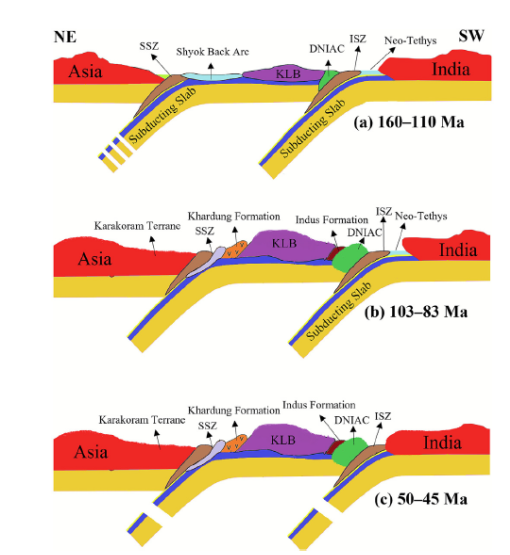
Fig: A 2-D geodynamic model for the evolution of the DNIAC-KLB compiled and modified after Ahmad et al. (2008). Abbreviations: KLB, Kohistan Ladakh Batholith; DNIAC, Dras Nidar Island Arc Complex; SSZ, Shyok Suture Zone; ISZ, Indus Suture Zone.
The two plates eventually collided and the Neo-Tethys Ocean closed and the dramatic collision uplifted the Himalaya. Even after the main collision, molten rock still forced its way upward through cracks, forming mafic dykes—narrow sheets of dark volcanic rock cutting through older formations.
These later magmas came from a mantle source that was already enriched by earlier tectonic processes.
They reconstructed the techtomagmatic events by measuring rare elements and isotopes such as strontium and neodymium, that record whether magma formed from deep mantle material, recycled sediments, or continental crust and hence act as a geological time machine.
The researchers concluded that the contribution from the sediment subduction is more pronounced in the KLB Kohistan Ladakh Batholith compared to the DNIAC.
Publication link: https://doi.org/10.1016/j.gsf.2026.102260