Creative Industries as Growth Engines
Creative Industries as Growth Engines
Creativity at the Centre of Economic Power
The twenty-first century is being shaped as much by imagination as by industry. Economic strength is no longer measured only in factories and freight corridors, but in intellectual property, digital platforms, and cultural influence. Ideas travel faster than goods, narratives move markets, and creative ecosystems increasingly determine how nations are seen, heard, and partnered globally. In this environment, the creative economy has emerged as a defining arena of growth and strategic presence.
The creative economy includes industries where value is generated primarily from creativity, culture, technology, and intellectual property. It includes media and entertainment, animation and visual effects, gaming, live cultural experiences, and digital content platforms that operate across borders at scale. These are not peripheral cultural pursuits. They are technology-intensive, globally tradeable sectors embedded within modern services economies and international value chains.
Globally, creative industries have moved from cultural margins to economic mainstream. Across countries, they contribute between 0.5 and over 7 percent of GDP, with live entertainment generating strong spillovers across tourism and urban services. Within this global transformation, India’s creative economy is emerging as a major pillar of growth, employment, and value creation.
India at Scale:
This trajectory reflects more than sectoral expansion. It signals the consolidation of creativity as a strategic capability, linking economic growth with global influence in an increasingly platform-driven world.
Media and Entertainment as Economic Infrastructure
Segment
2024
2025
2026
2027
Digital media
802
903
1,004
1,104
Television
679
676
671
667
260
262
264
267
Online gaming
232
260
288
316
Filmed entertainment
187
196
204
213
Animation and VFX
103
113
130
147
Live events
101
119
142
167
Out-of-home media
59
66
73
79
Music
53
60
68
78
Radio
25
27
28
30
Total
2,502
2,682
2,873
3,067
India’s media and entertainment sector is on a steady expansion path, with revenues projected to grow at around 7 percent annually through 2027. Total sector size is estimated to rise from ₹2,502 billion in 2024 to ₹3,067 billion in 2027, underscoring its role as a durable growth engine within the services economy.
AVGC-XR: Engines of Digital Creativity and Innovation
Animation, Visual Effects, Gaming, Comics and Extended Reality, collectively referred to as AVGC-XR, represent the most technology-driven frontier of the creative economy. Behind every blockbuster visual effect, immersive game world, or interactive digital experience is a generation of artists, coders, designers, and engineers working at the intersection of imagination and advanced computing. These industries combine creative talent with real-time rendering, immersive design, and digital production tools that now power global film, streaming platforms, advertising campaigns, and virtual production pipelines.
Gaming has evolved into a mainstream digital medium woven into daily life, while animation and VFX shape the visual language of global entertainment. Together, these sectors convert creativity into scalable intellectual property, positioning AVGC-XR and gaming at the heart of the next phase of the global creative economy.
Animation, Visual Effects, Comics and XR
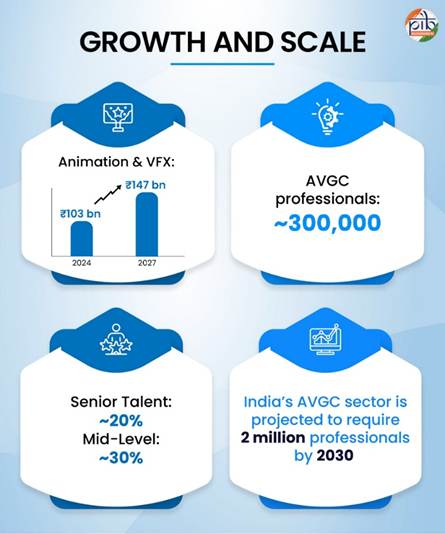
India’s animation, visual effects, comics, and XR ecosystem now operates as a globally connected production base. Indian teams contribute to international films, streaming content, advertising, and immersive experiences, working within tightly integrated global workflows. The sector reflects growing technical depth and creative confidence.
A strong and layered talent pool underpins this expansion. Experienced professionals lead complex international assignments, supported by a broad mid-level workforce capable of sustaining scale. This balance of capability and continuity has positioned India as a dependable creative collaborator in the global AVGC-XR landscape.
Gaming
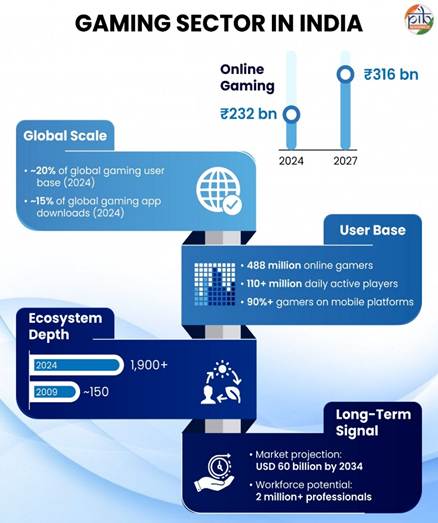
Gaming has become one of the most visible expressions of India’s digital transformation. Across metros and small towns, millions log in each day to compete, collaborate, and build virtual worlds of their own. Mobile devices double as arenas and social spaces, blurring the line between entertainment and interaction. For a digitally native generation, gaming is not a passing trend. It is part of everyday life.
That scale of participation has translated into structured market growth. India now ranks among the world’s largest gaming markets, supported by a vast and deeply engaged user base. Rising monetisation, expanding domestic studios, and stronger integration with global platforms are transforming gaming from mass engagement into a scalable digital industry. It reflects how consumer behaviour, technology adoption, and creative capability are converging to shape a new growth frontier within India’s media and entertainment landscape.
Policy and Institutions: Structuring the AVGC-XR Ecosystem
India’s push in AVGC-XR is not just about building an industry. It is about creating pathways for young designers, animators, coders, and storytellers to turn creative skill into stable, global careers. A dedicated national roadmap now focuses on talent development, original intellectual property, industry collaboration, and international market access. With projections of nearly 20 lakh direct and indirect jobs over the next decade, the sector is being positioned as a meaningful employment engine for the digital generation.
At the heart of this effort is the Indian Institute of Creative Technologies (IICT), established as a National Centre of Excellence for AVGC-XR and gaming. IICT brings structured training, advanced infrastructure, and industry collaboration under one roof, helping bridge the gap between classroom learning and real-world production demands. For aspiring creators, it offers not just certification, but entry into global workflows.
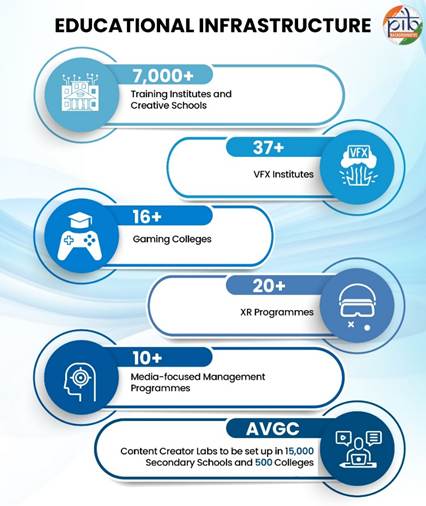
This effort is reinforced by a wide training ecosystem and growing regional hubs across the country. Established centres such as Bengaluru, Hyderabad, Mumbai, Pune, Chennai, and Thiruvananthapuram anchor the industry, while emerging cities are building their own creative clusters. Together, these networks expand opportunity beyond a few metropolitan pockets, allowing talent from across India to participate in and contribute to a rapidly evolving global creative economy.
Live Entertainment and Experiential Economies
India’s live entertainment landscape has moved far beyond occasional spectacles. It is about shared experiences that bring cities alive. From stadium nights in Ahmedabad and Navi Mumbai to festival weekends in Mumbai and Delhi, concerts now shape travel plans, anchor cultural calendars, and turn large gatherings into collective memories. What was once dependent on sponsorship cycles has evolved into an audience-driven ecosystem where people actively choose to participate, spend, and return.
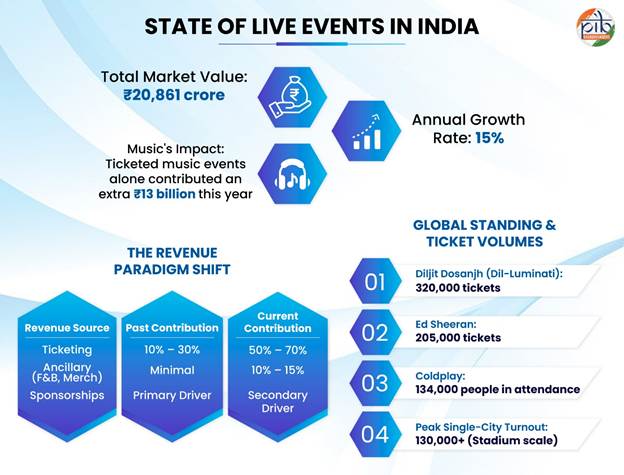
India today features regularly on global touring routes, with international performers and homegrown artists drawing massive crowds across cities such as Mumbai, Delhi, Bengaluru, Hyderabad, and Ahmedabad. The growth is visible not only in ticket lines but in expanding venue infrastructure — from Narendra Modi Stadium to premium spaces like NMACC — supported by professional production networks and specialised event companies operating at global standards. Behind every headline performance is an ecosystem of technicians, stage designers, logistics teams, hospitality workers, and local businesses that move in rhythm with the show.
Live entertainment has therefore become more than a cultural outlet. It energises urban economies, stimulates tourism, creates employment, and strengthens India’s cultural presence on the world stage. It reflects a society increasingly confident in gathering at scale and participating in a global cultural circuit.
The Orange Economy: Policy, Platforms, and Global Integration
The Orange Economy treats culture and creativity as sources of real economic value. It includes cultural industries, creative services, heritage-based activities, and experience-driven sectors where ideas and intellectual property generate income and jobs. Across the world, these industries are recognised for creating employment, supporting exports, and driving growth in cities and tourism.
For India, the Orange Economy has a deeper meaning. It turns the country’s rich cultural heritage, diversity, and creative talent into economic opportunity and global visibility. It connects tradition with modern platforms, allowing India’s stories, skills, and creative output to travel beyond borders and contribute to national growth.
Platforms and market access: Operationalising the Orange Economy
India’s approach to growing the Orange Economy is centred on creating pathways for scale and global reach. Platforms are being designed to help creators move from local recognition to international markets, connecting talent with investors, producers, and global audiences.
The World Audio Visual and Entertainment Summit (WAVES) served as a focal point for this ecosystem. It brought together creators, startups, industry leaders, and policymakers from across the world, turning dialogue into deal-making and collaboration. Supporting this effort, WaveX enables startup innovation through investor engagement and incubation, while WAVES Bazaar operates as a marketplace for scripts, music, comics, and audio-visual rights, facilitating co-productions and cross-border partnerships.
Creator discovery was equally central. Initiatives such as the Create in India Challenge identifies emerging talent and links them directly to global platforms, ensuring that ideas developed locally could compete, collaborate, and commercialise internationally. Together, these platforms moved the Orange Economy from aspiration to execution.
Education, skilling, and institutional foundations
The expansion of the Orange Economy is being anchored in deliberate investment in education, skilling, and institutions. Recognising that creative industries are fundamentally talent-driven, India is building a pipeline that spans early exposure in schools, specialised training, and innovation-led entrepreneurship.
At the centre of this effort stands the IICT, which is providing industry-aligned training, startup incubation, advanced infrastructure, and collaboration with global technology partners, enabling creators and developers to move from learning to real-world production across animation, visual effects, gaming, and immersive media.
This institutional push is being strengthened through the proposed establishment of AVGC Content Creator Labs in 15,000 secondary schools and 500 colleges. By embedding creative skills within the formal education system and expanding access across regions, the initiative is preparing a new generation of talent in line with projections that the AVGC sector will require nearly two million professionals by 2030.
Strategic Outlook: India and the Next Decade of Creative Power
Across classrooms, coding labs, film sets, concert arenas, and digital platforms, a new creative ecosystem is coming together. What connects these spaces is not just talent, but purpose. Institutions are being strengthened, markets are being organised, and creators are being connected to capital and global audiences. Policy is no longer separate from practice; it is shaping the conditions that allow imagination to become livelihoods, enterprises, and international partnerships.
The impact is already visible. Young artists are entering global production pipelines. Startups are building intellectual property that reaches audiences beyond borders. Cities are hosting events that attract international circuits. Creative industries are becoming channels through which India creates jobs, exports services, and strengthens its global presence.
Continued investment in skills, platforms, and institutions will determine how effectively creativity turns into lasting economic strength. As global competition increasingly moves through culture, content, and digital ecosystems, India is positioning its creative economy not as a side sector, but as a strategic capability. In doing so, it is ensuring that imagination is not only expressed, but organised — and that creativity becomes a steady driver of growth and global engagement in the decade ahead.
References