Budget 2026–27 Sets the Stage for India as a Global Hub for Cloud and AI Infrastructure
Budget 2026–27 Sets the Stage for India as a Global Hub for Cloud and AI Infrastructure
Key Takeaways
Introduction
The Union Budget 2026–27 introduces a major policy initiative to strengthen India’s position as a global hub for digital infrastructure. Recognizing the central role of cloud computing, AI data centres and advanced electronics in economic growth, the Government has announced a tax holiday till 2047 for eligible foreign cloud service providers operating through India-based data centre infrastructure.
Globally, data centres have emerged as a major driver of investment and economic activity. According to the United Nations Conference on Trade and Development (UNCTAD), data centres accounted for more than one fifth of global greenfield project values in 2025, with announced investments exceeding USD 270 billion. Rapid growth in AI compute demand and data-intensive digital services is intensifying international competition to attract such infrastructure.
In this context, India’s long-term tax framework aims to provide investment certainty, anchor high-value digital infrastructure within the country, and strengthen India’s role in global digital value chains in line with the vision of Viksit Bharat by 2047.
Why This Policy Was Introduced
Data centres and cloud infrastructure require high upfront capital investment, long gestation periods, and sustained policy certainty. AI-oriented data centres, in particular, involve significant expenditure on computing hardware, energy systems, cooling infrastructure, and skilled manpower.
With global demand for AI compute capacity rising rapidly, countries are competing to attract large-scale data centre investments. The tax holiday till 2047 is intended to provide long-term visibility and certainty, enabling India to attract global cloud service providers while anchoring critical digital infrastructure within the country.

Understanding the Tax Holiday Provision
The Budget proposes that a foreign company providing cloud services globally, while utilizing data centre services located in India, will be eligible for a tax holiday extending up to 2047.
Under this framework:
The exemption applies from Tax Year 2026–27 to Tax Year 2046–47, providing a stable, predictable tax environment for global cloud players investing in India’s data centre infrastructure.
Defined Eligibility Framework
The exemption is available to foreign companies providing cloud services under a structured framework. A foreign cloud service provider may avail the tax holiday where:
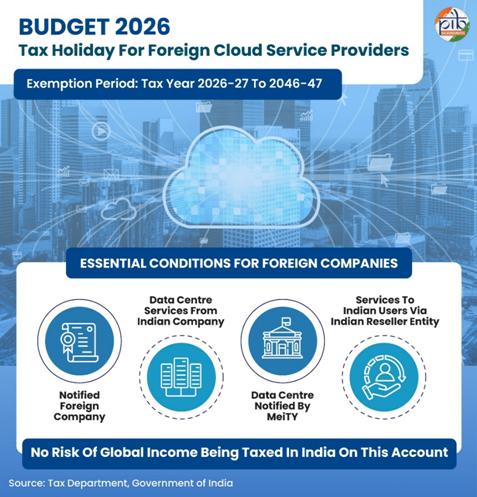
The services by the foreign company to Indian users are provided through an Indian reseller entity, being an Indian company.
This framework establishes regulatory oversight and ensures that the incentive operates within defined policy parameters.
Tax Treatment of Domestic Operations
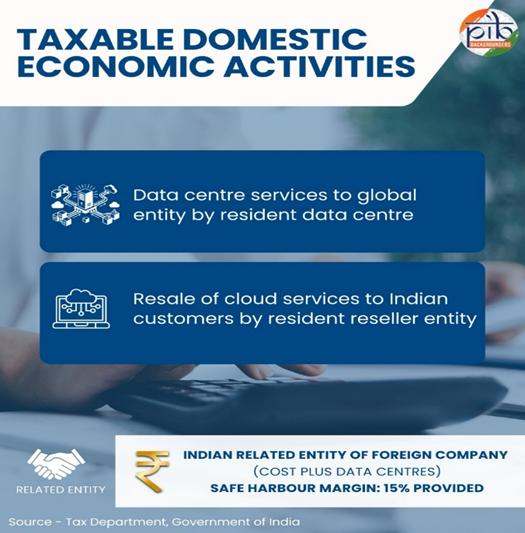
Under the proposed framework, profits arising from domestic economic activities will remain taxable as in the case of any other domestic company. These include:
Further, where the Indian data centre is a related entity of the foreign company (operating as a cost-plus centre), a safe harbour margin of 15 percent on cost has been proposed.
Safe Harbour Margin
A “Safe Harbour Margin” (under the Income Tax Act) refers to a specified profit margin declared by a taxpayer for certain international transactions, without detailed checking, if it meets prescribed conditions and provisions.
Linkage with Broader Technology Ecosystem Initiatives
The tax holiday is part of a broader set of Budget 2026–27 measures to strengthen India’s technology and digital manufacturing ecosystem. Together, these initiatives address different layers of the technology value chain, from semiconductor design and materials to electronics components, IT services and digital infrastructure.
India Semiconductor Mission (ISM) 2.0
The Budget announces the launch of India Semiconductor Mission 2.0, building on earlier efforts to establish semiconductor manufacturing capabilities in India. The programme focuses on:
A provision of ₹1,000 crore has been made for ISM 2.0 in FY 2026–27. The initiative supports the development of core electronics manufacturing capabilities that underpin digital infrastructure, including data centres and advanced computing systems.
Electronics Components Manufacturing Scheme (ECMS)
The allocation for the Electronics Components Manufacturing Scheme has been increased from about ₹22,000 crore to ₹40,000 crore in Budget 2026–27. The scheme has received 149 applications, exceeding earlier expectations and reflecting strong industry participation.
The enhanced allocation is intended to strengthen domestic production of electronics components under the scheme as part of the broader electronics manufacturing ecosystem.
IT Services Simplification and Safe Harbour Provisions
IT services remain one of India’s largest export sectors, with exports exceeding USD 220 billion. To provide tax certainty and support industry growth, the Budget proposes:
Unilateral Advance Pricing Agreement (APA)
Unilateral Advance Pricing Agreement (under the Income-tax Act) refers to an agreement entered into between a taxpayer and the Central Board of Direct Taxes (CBDT) to determine, in advance, the price charged, for specified international or domestic transactions, for a fixed period of time.
India’s Expanding Cloud and Digital Infrastructure Base
India’s cloud and data centre ecosystem is expanding in line with the country’s digital transformation and growing use of AI-enabled applications across sectors.
Under the Digital India initiative, the national cloud infrastructure GI Cloud (MeghRaj) has been established to meet government cloud requirements. MeghRaj provides secure, scalable, and elastic cloud facilities for delivery of e-Governance services through the National Informatics Centre (NIC). National Data Centres operate with layered security frameworks supported by empanelled providers meeting international security standards.
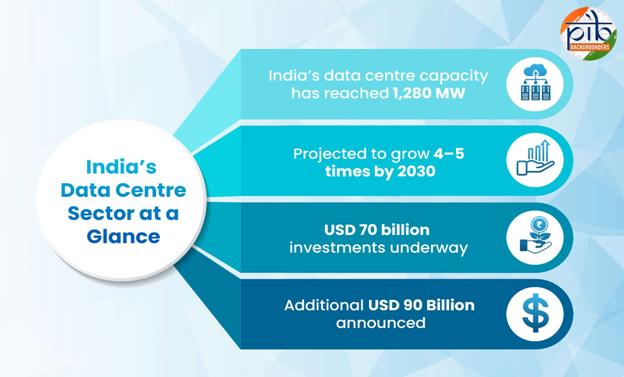
Industry estimates indicate that India’s cloud data centre capacity has reached around 1,280 MW and is projected to grow four to five times by 2030, reflecting rising demand for digital and AI infrastructure.
Expanding AI and Cloud Data Centre Infrastructure
Data centres, especially AI-focused facilities, form the backbone of modern digital infrastructure. Investments of nearly USD 70 billion are already underway in India’s data centre sector, with an additional USD 90 billion in announced projects, highlighting the scale of expansion.
The proposed tax framework extending to 2047 provides long-term policy visibility for such capital-intensive investments. The tax holiday for foreign cloud providers complements broader technology initiatives announced in Budget 2026–27, including India Semiconductor Mission 2.0 and enhanced allocation for the Electronics Components Manufacturing Scheme, complementing digital infrastructure expansion. Together, these measures strengthen both digital infrastructure and electronics manufacturing capacity.
Global Policy Momentum in AI Data Centre Infrastructure
Across major economies, AI data centres and related digital infrastructure are increasingly being supported through policies that enable large-scale deployment and long-term investment.
In the United States, a Presidential Executive Order titled “Accelerating Federal Permitting of Data Center Infrastructure” outlines steps to expedite the development of large AI data centre projects. The Order provides for:
The Order defines large-scale data centre projects as those requiring more than 100 megawatts of new load, indicating the scale at which AI infrastructure is being planned.
At the same time, Goldman Sachs Research notes that Chinese AI and cloud providers are entering a phase of accelerated infrastructure build-out. Chinese firms are projected to make substantial investments in data centres, alongside expansion in AI chips, hardware supply chains and overseas data centre capacity. The research indicates that infrastructure development is being treated as a foundational requirement for AI growth and digital services expansion.
These developments underscore the strategic centrality of AI and cloud data centre infrastructure within national technology and industrial strategies. In this context, India’s long-term tax framework for cloud services using India-based data centres provides policy clarity and investment visibility in a capital-intensive sector characterised by long project cycles and rapidly expanding demand.
Conclusion
The tax holiday announced in Budget 2026–27 provides long-term policy certainty till 2047 for global cloud and AI infrastructure investments in India. While offering investment visibility in a capital-intensive sector, the framework retains safeguards through clearly defined eligibility conditions and continued taxation of domestic operations.
Aligned with semiconductor, electronics manufacturing and IT sector reforms, the measure reflects a coordinated strategy to strengthen India’s digital ecosystem. In a period of intensifying global competition for AI infrastructure, the policy positions India as a credible and long-term destination for cloud and data centre investment.
References
Ministry of Finance
https://www.pib.gov.in/PressReleasePage.aspx?PRID=2221412&utm_source=chatgpt.com®=3&lang=2
Ministry of Electronics & IT
https://www.pib.gov.in/PressReleasePage.aspx?PRID=2221894&lang®=3&lang=2
https://www.pib.gov.in/PressReleasePage.aspx?PRID=2221894&lang=2®=3
Income Tax Department, Government of India
https://x.com/incometaxindia/status/2019046108673265855?s=48&t=CSE0glwGSDCXRHUtG7cLjw
https://x.com/IncomeTaxIndia/status/2018882843934650496?s=20
The White House
Goldman Sachs
UNCTAD
https://unctad.org/news/data-centres-are-reshaping-global-investment-landscape
Incometax.gov.in
https://incometaxindia.gov.in/Rules/Income-Tax%20Rules/103120000000009915.htm
https://incometaxindia.gov.in/Rules/Income-Tax%20Rules/103120000000007832.htm
https://www.indianembassyusa.gov.in/pdf/advance_pricing_agreement_guidance_with_faqs_(tpi-43).pdf