Artificial Intelligence (AI) Transforming Indian Agriculture
Artificial Intelligence (AI) Transforming Indian Agriculture

Key Takeaways
Introduction
India is emerging as a global leader in Artificial Intelligence, ranking third worldwide in AI competitiveness, according to Stanford University’s 2025 Global AI Vibrancy Tool. The rapid rise, measured across AI growth and innovation between 2017 and 2024, reflects India’s digital capabilities, data ecosystem, and strengths in AI talent, research, startup, investment, infrastructure, and governance. Artificial Intelligence (AI) is also increasingly emerging as a transformative force in agriculture, offering new pathways to enhance productivity, sustainability, and resilience across farming systems. By leveraging data from satellites, sensors, drones, weather stations, and farm machinery, AI-enabled tools support informed decision-making at every stage of the agricultural value chain.
What is Artificial Intelligence?
Artificial Intelligence (AI) is the ability of machines to perform tasks that normally require human intelligence. It enables systems to learn from experience, adapt to new situations, and solve complex problems independently. AI uses datasets, algorithms, and large language models to analyse information, recognise patterns, and generate responses. Over time, these systems improve their performance, allowing them to reason, make decisions, and communicate in ways similar to humans.
India-AI Impact Summit 2026: AI for Inclusive Development
The India-AI Impact Summit 2026, being convened, highlights India’s approach to Artificial Intelligence as a tool for inclusive development. The Summit emphasises the democratisation of technology by promoting more equitable and affordable access to AI capabilities, particularly for underserved communities. It emphasizes India’s approach to technology development, aligned with the vision of ‘Welfare for All, Happiness for All’. Reinforcing the principle of ‘AI for Humanity ‘- positioning AI as a human-centric and ethical enabler of improved governance, service delivery, and sustainable development across sectors. Within this broader context, Indian agriculture stands at a critical turning point, where AI is increasingly being harnessed to support farmers, strengthen decision-making, and enhance productivity.
Artificial Intelligence and Its Uses in Agriculture
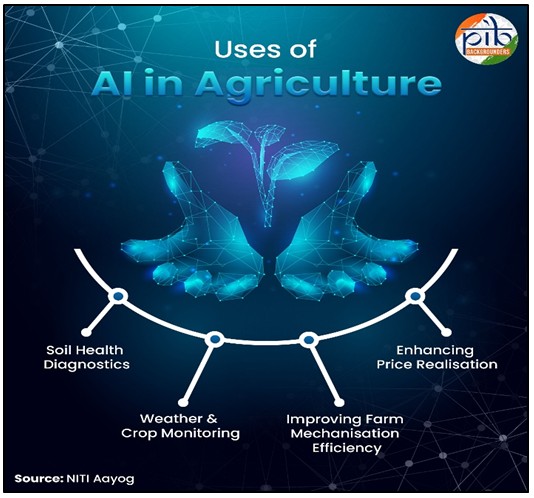
In agriculture, AI helps turn data into simple, actionable advice that farmers can implement in their day-to-day farming practices. By analysing satellite imagery, weather forecasts, soil data, and crop patterns, AI can help farmers decide what to sow, when to sow, how much input to use, and when to harvest. From early warnings about pests and diseases to better planning for irrigation and fertiliser use, AI is making farming more precise, efficient, and less risky. The uses of AI in agriculture can be categorised as:
AI uses deep learning and image recognition to monitor soil health by analysing signals from satellite imagery, drone-based observations, and farm-level images. This eliminates the need for laboratory testing infrastructure while detecting nutrient deficiencies and soil stress. Farmers can take timely action to restore soil fertility.
Indian agriculture is particularly susceptible to climate variability because it relies heavily on rainfall. AI analyses weather and climate data to predict changing rainfall patterns, temperature variations, and extreme events, while providing real-time advisories on sowing decisions, irrigation scheduling, pest management, and input application. In addition, AI-enabled monitoring using satellite imagery, drones, sensors, and image analytics facilitates early detection of pests and crop diseases, allowing timely interventions. Collectively, these applications support farmers, particularly in rainfed regions, in managing climate risks and reducing potential crop losses.
AI-powered image classification and machine learning tools, integrated with drones, remote sensing, and local sensor data, improve the utilisation and efficiency of farm machinery. Applications include precision weed removal, early disease detection, automated harvesting, and produce grading.
In horticulture, where crops require continuous monitoring across multiple growth stages, AI-based systems offer round-the-clock surveillance of high-value crops. This leads to reduced labour dependency, optimised input use, and improved quality control.
Farmers, particularly those engaged in fruit and vegetable production, often capture only a small share of the final consumer price due to inadequate price discovery, supply chain inefficiencies, and information asymmetries. Artificial intelligence (AI) offers a robust means of addressing these structural constraints by strengthening demand-supply forecasting, market intelligence, and coordination across agricultural value chains.
AI-driven predictive analytics leverage large datasets from platforms such as e-NAM, AGMARKET, the Agricultural Census, and the Soil Health Card programme to assess price movements, arrival trends, and regional demand patterns. By incorporating both domestic and global commodity signals, these tools support more informed decisions on crop selection, sales timing, and market choice, thereby enhancing price realisation and reducing distress-driven sales. The implementation of AI in agriculture highlights the breadth of bottom-up adoption across the sector. AI-enabled agricultural networks have improved market access, price discovery, and logistical efficiency for about 1.8 million farmers across 12 states.
AI as a Key Enabler of Precision Farming
AI enables precision farming by turning data from GPS, sensors, satellites, and drones into actionable farm-level insights. It enables the collection of data on soil properties, moisture levels, and crop health at a highly localised level, ensuring that inputs such as water, fertilisers, and pesticides are applied precisely where and when needed. This site-specific approach improves productivity, optimises resource use, reduces waste, and minimises environmental impact.
AI-Enabled Precision Farming: A Scalable Approach for Sustainable Agricultural Transformation
The experience of Rajaratnam Kanakarajan illustrates the practical and scalable application of artificial intelligence in Indian agriculture. By adopting an AI-enabled precision farming system developed by Farm Again, a Tamil Nadu-based startup, he leveraged solar-powered sensors to monitor soil moisture, irrigation, and fertilizer use in real time through a mobile platform. The system automated farm operations, reduced over-irrigation and input use, and optimised crop conditions, resulting in a doubling of coconut yields.
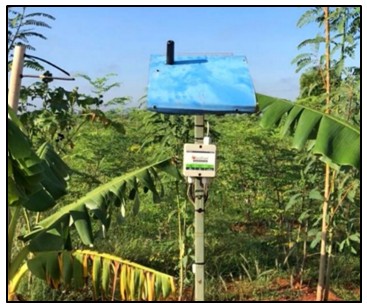
This approach has since benefited over 3,500 farmers across more than 4,000 acres in Tamil Nadu. Its adoption has been driven by affordability, with indigenous equipment costing (₹2.5 Lakh) significantly less than imported (₹25 Lakh) alternatives. In addition to productivity gains, the approach has delivered substantial environmental benefits, including annual savings of over 4,00,000 cubic metres of water and approximately 1,75,000 kWh of energy, as well as significant emissions reductions, avoiding an estimated 20,000 tonnes of CO₂-equivalent emissions. The solution’s scalability, demonstrated by its expansion to multiple countries, highlights how locally designed AI innovations can enhance farm productivity, conserve resources, and support sustainable agricultural transformation.
Government Initiatives in AI-Driven Agriculture
The government is actively harnessing the power of Artificial Intelligence to transform the agriculture sector through its various initiatives. The initiatives mentioned below reflect the government’s holistic approach to agricultural growth and development, as reflected in policy innovations.
Union Budget 2026-27: Bharat-VISTAAR for AI-Driven Agricultural Advisory
The Union Budget 2026-27 proposed Bharat-VISTAAR (Virtually Integrated System to Access Agricultural Resources)- a multilingual AI tool that shall integrate the AgriStack portals and the ICAR package on agricultural practices with AI systems. This will increase farm productivity, enable better decisions for farmers, and reduce risk by providing customized advisory support.
AI-Enabled Advisory and Decision Support Services for Farmers
Kisan e-Mitra:
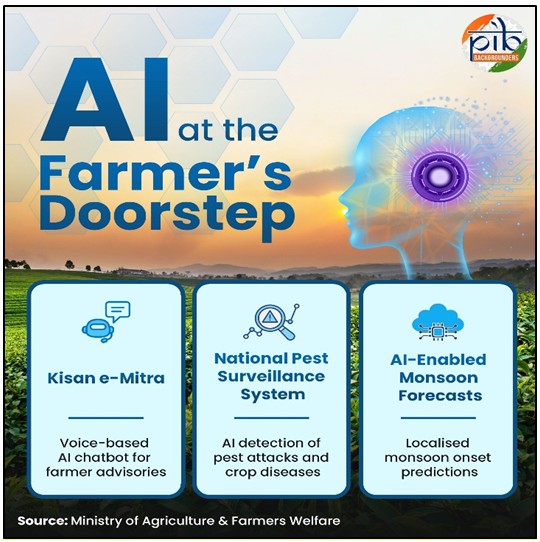
Kisan e-Mitra, launched in 2023, is a voice-enabled, AI-powered chatbot designed to support farmers by answering queries on key government schemes, including PM Kisan Samman Nidhi, the Kisan Credit Card, and the Pradhan Mantri Fasal Bima Yojana. The platform operates in 11 regional languages and currently addresses over 8,000 farmer queries each day. As of December 2025, it has successfully responded to more than 93 lakh queries, enhancing accessibility to scheme-related information for farmers across the country.
National Pest Surveillance System:
The National Pest Surveillance System (NPSS), launched in 2024, utilises Artificial Intelligence (AI) and Machine Learning (ML) to enable early detection of pest infestations and crop diseases. Accessible through a user-friendly mobile application and the online portal, the system allows farmers to upload images of affected crops or pests for rapid identification and diagnosis.
Using image analytics, NPSS provides real-time crop protection advisories, guiding farmers on appropriate pest and disease management practices and enabling timely interventions to reduce crop losses. As of December 2025, NPSS is being used by over 10,000 extension workers and supports 66 crops and more than 432 pest species.
AI-Enabled Local Monsoon Onset Forecasts for Informed Kharif Sowing Decisions:
An AI-based pilot was implemented during Kharif 2025 to generate location-specific monsoon onset forecasts across parts of 13 states. The initiative was carried out in collaboration with the India Meteorological Department (IMD) and the Development Innovation Lab-India. The pilot employed an open-source blended modelling approach, combining NeuralGCM, the European Centre for Medium-Range Weather Forecasts’ (ECMWF) Artificial Intelligence Forecasting System (AIFS), and 125 years of historical rainfall data from IMD. To guide optimal sowing decisions, focusing on local monsoon onset, probabilistic forecasts were disseminated via SMS through the mKisan portal to over 3.88 crore farmers in five regional languages across 13 states. Follow-up surveys in Madhya Pradesh and Bihar indicated that 31–52 percent of farmers modified their planting decisions based on the forecasts, primarily by adjusting land preparation, sowing timelines, and crop and input choices.
Data-Driven Governance through the Digital Agriculture Mission
The Digital Agriculture Mission, launched in 2024 with a total outlay of ₹2,817 crore and an allocation of ₹54.972 crore for FY 2025–26, aims to advance the delivery of innovative, farmer-centric digital solutions in the agriculture sector. The Mission seeks to ensure timely access to reliable crop-related information for all farmers by leveraging verified datasets on farmers, landholdings, and crops, alongside advanced digital technologies such as data analytics, artificial intelligence, and remote sensing.
By strengthening data-driven decision-making, the Mission is designed to enhance the efficiency, transparency, and responsiveness of agricultural services. It envisages developing a comprehensive Digital Public Infrastructure (DPI) for agriculture, including platforms such as AgriStack and the Krishi Decision Support System (KDSS), as well as an integrated Soil Fertility and Profile Map, thereby laying the foundation for a robust, scalable digital agriculture ecosystem in India.
AgriStack:
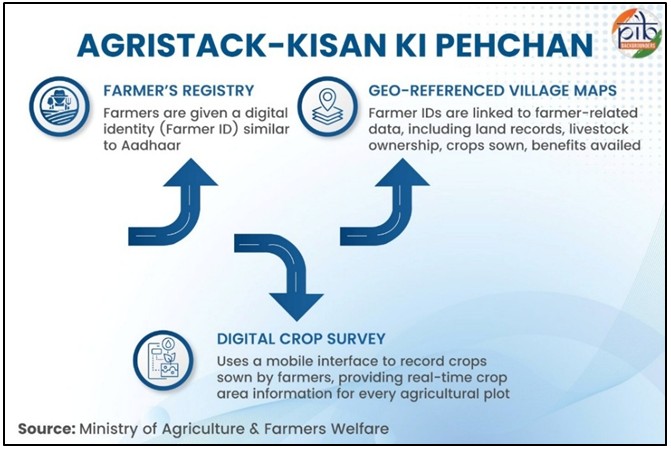
AgriStack is a core component of the Digital Agriculture Mission, providing farmers with a unique digital identity (Farmer ID) linked to land records, livestock ownership, crops cultivated, and benefits availed, enabling secure identification and access to agricultural services. Against a target of 11 crore Farmer IDs by 2026–27, over 7.63 crore IDs have been generated as of 27 November 2025, including 1.93 crore IDs for women farmers. To accelerate creation and verification, ₹10 per Farmer ID has been earmarked from PM-KISAN administrative funds. AgriStack also supports a mobile-based Digital Crop Survey that captures real-time, plot-level data on crop type and area under cultivation. The survey covered 492 districts and over 23.5 crore plots during Rabi 2024–25, with nationwide rollout planned across all districts in FY 2025–26 to strengthen planning, monitoring, and policy implementation.
Krishi Decision Support System:
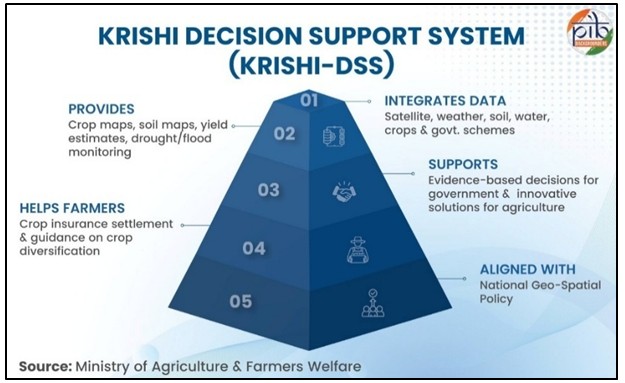
The Krishi Decision Support System (KDSS) integrates data from multiple sources, including satellite imagery, weather information, soil and water resources, crop data, and government scheme databases, to generate comprehensive analytical outputs such as digital crop maps, soil maps, yield estimates, and drought and flood monitoring assessments. The system supports informed decision-making by enabling crop diversification advisories and facilitating technology- and model-based yield assessments for crop insurance settlement. Simultaneously, KDSS strengthens evidence-based policymaking and programme implementation by providing government agencies with reliable, real-time insights.
Soil Profile Maps:
The Nationwide Soil Resource Mapping project, undertaken by the Soil and Land Use Survey of India (SLUSI), aims to generate a comprehensive village-level soil inventory at a high spatial resolution of 1:10,000 by integrating high-resolution satellite imagery with field-based observations. The resulting standardized soil maps provide a scientific basis for informed land-use planning, crop selection, and the promotion of sustainable agricultural practices. As of September 2024, approximately 29 million hectares have been mapped, against the mission target of 142 million hectares of agricultural land. For the implementation of the mission, ₹1,076 crore has been provided to six states– Uttar Pradesh, Madhya Pradesh, Rajasthan, Maharashtra, Tamil Nadu, and Andhra Pradesh. Also, the state has been encouraged to adopt the camp-mode approach to organise field-level camps and mobilise the local administration, with an allocation of ₹15,000 per camp.
AI-Enabled, Technology-Driven Crop Insurance for Resilient Agriculture
The Pradhan Mantri Fasal Bima Yojana (PMFBY) was launched to safeguard farmers against crop losses arising from unforeseen events by offering affordable crop insurance through low, fixed premium rates. Farmers contribute only 2 percent for Kharif food and oilseed crops, 1.5 percent for Rabi food and oilseed crops, and 5 percent for commercial and horticultural crops, with the remaining premium subsidised by the government. In the North-Eastern States, Jammu & Kashmir, and Himachal Pradesh, the full premium is borne by the government to ensure coverage for vulnerable farmers.
The scheme has progressively integrated AI-enabled technologies to enhance efficiency and transparency.
The YES-TECH (Yield Estimation System based on Technology) employs remote sensing and AI-driven analytics to generate accurate yield estimates. Introduced for paddy and wheat in Kharif 2023 and extended to soybean in Kharif 2024, YES-TECH assigns a minimum 30 percent weightage to technology-based assessments. As of January 2025, it has been adopted by nine states, with Madhya Pradesh fully transitioning to technology-based yield estimation, thereby enabling timely loss assessment and faster claim settlement.
CROPIC (Collection of Real-Time Observations and Photographs of Crops) is an AI-enabled tool used to monitor crop health and assess crop damage. Through a mobile application, farmers and field coordinators upload geotagged, time-stamped crop images from smartphones. These time-series photographs support crop validation against insured crops and enable accurate damage assessment during localised calamities. CROPIC provides a transparent, real-time, evidence-based system that strengthens crop insurance implementation, disaster response, and data-driven decision-making.
The PMFBY WhatsApp Chatbot is an AI-based chatbot accessible via WhatsApp to assist farmers with information on the PMFBY scheme.
WINDS (Weather Information and Network Data System), launched in 2023, is a national platform that integrates multiple weather systems to provide real-time, reliable weather data. It enables accurate weather monitoring, planning, and risk assessment in agriculture.
PMFBY has emerged as India’s most extensive crop insurance programme. Introduced alongside PMFBY, the Restructured Weather-Based Crop Insurance Scheme (RWBCIS) is a weather index-based insurance scheme that complements yield-based coverage. Between 2016–17 and 2024–25 (as of October 2025), the Pradhan Mantri Fasal Bima Yojana (PMFBY) and the Restructured Weather-Based Crop Insurance Scheme (RWBCIS) together covered over 78.51 crore farmer applications. During this period, farmers contributed ₹35,919 crore in premiums, while claims amounting to ₹1,90,374 crore were disbursed, benefiting more than 23 crore farmer applications. Focusing on the recent period from 2020–21 to 2024–25 alone (as of 31 October 2025), the schemes covered over 55.28 crore applications and paid ₹93,891 crore in claims, benefiting more than 14.97 crore farmer applications. These facts underscore the expanding reach, credibility, and impact of PMFBY in protecting farm livelihoods against production risks.
AI-Enabled Agri-Tech Startups and Emerging Agricultural Innovations
The Government of India has been promoting the rapid growth of agri-tech startups through the Innovation and Agri-Entrepreneurship Development programme under the Rashtriya Krishi Vikas Yojana (RKVY) since 2018–19. In parallel, the programme supports the adoption of emerging technologies, including Artificial Intelligence (AI), machine learning, precision farming, drones, and climate-smart agriculture. Agri-tech startups are ushering in a new era for Indian agriculture, integrating agricultural practices with artificial intelligence. These startups, dubbed a ‘ray of hope’, are driving innovation and transforming agrarian operations across the country.
Under the programme, Knowledge Partners (KPs) and RKVY Agribusiness Incubators (R-ABIs) provide structured technical and financial support to agri-startups at the idea or pre-seed stage (up to ₹5 lakh) and the seed stage (up to ₹25 lakh), enabling them to develop, pilot, and scale innovative products and services. As of January 2026, more than 6,000 agri-startups have received training, and between FY 2019–20 and FY 2025–26, a total of 2282 startups have been supported with financial and technical assistance, with cumulative grants amounting to ₹186.55 crore.
The supported startups operate across key domains, including precision agriculture, AI and IoT–based solutions, farm mechanisation, post-harvest and food technologies, supply chain management, waste-to-wealth initiatives, and organic farming, thereby driving innovation and enhancing efficiency across agriculture and allied sectors.
AI-Enabled Robotics Transforming Farm Operations
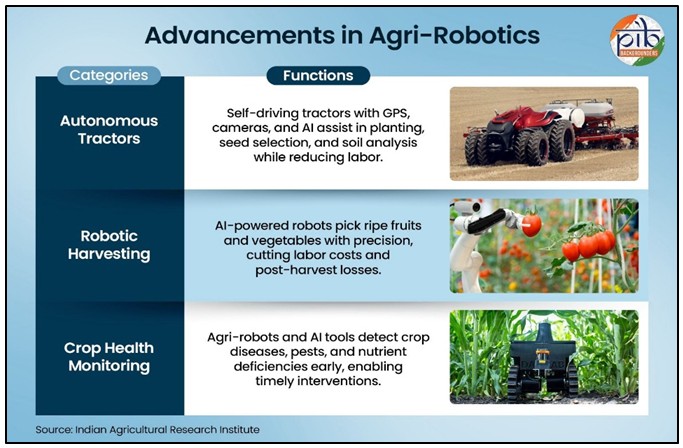
The Agricultural Engineering Division of ICAR–Indian Agricultural Research Institute (IARI) is actively engaged in developing agricultural robotics for a range of farm operations, including soil sampling, sowing, harvesting, and crop surveillance. Complementing these efforts, India’s agrarian robotics ecosystem has witnessed notable advances, including autonomous tractors, robotic harvesting systems, and AI-enabled tools for crop monitoring, reflecting the growing integration of automation and intelligent technologies into agricultural practices.
Future Farming in India: The IMPACT AI Framework
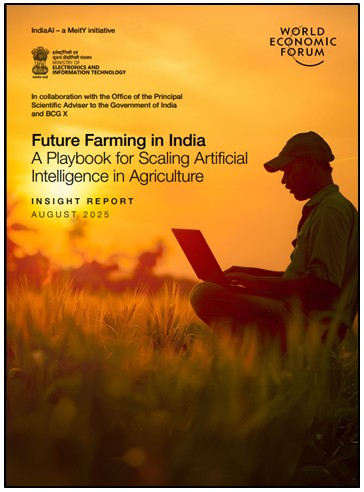
The Government of India released a publication titled “Future Farming in India: AI Playbook for Agriculture” on 22 October 2025. Developed as an insight report by the World Economic Forum in collaboration with the Office of the Principal Scientific Adviser to the Government of India, IndiaAI (MeitY), and BCG X, the playbook provides a policy-oriented roadmap for the responsible and scalable adoption of artificial intelligence (AI) in Indian agriculture, with a specific focus on small and marginal farmers.
The playbook aims to bridge the transition from pilot-stage AI applications to large-scale implementation by addressing critical constraints, including fragmented data ecosystems, limited digital infrastructure, affordability barriers, and last-mile delivery challenges. It positions artificial intelligence as an enabler of data-driven decision-making in routine farm operations, with the potential to enhance productivity, strengthen climate resilience, optimise resource use, and improve market access.
The report highlights priority AI use cases across the agricultural value chain, including AI-enabled crop planning, rapid soil-health analysis, pest prediction and control, and smart digital marketplaces. A central contribution of the playbook is the IMPACT AI framework, built on the following pillars, to guide ecosystem-wide action, clarify stakeholder roles, and support effective deployment of AI solutions:
Enable: The Enable pillar focuses on creating the basic systems needed to scale AI in agriculture. It emphasizes government-led actions such as developing clear AI strategies, supportive policies, data-sharing frameworks, and digital infrastructure to enable adoption.
Create: The Create pillar focuses on developing and testing AI solutions for agriculture. It highlights collaboration between start-ups, technology providers, and research institutions to design, validate, and refine AI applications.
Deliver: The Deliver pillar focuses on ensuring AI solutions reach farmers effectively. It strengthens extension systems, integrates AI into advisory services, and uses field feedback to improve outcomes.
Conclusion
India is undergoing a profound technological transformation in agriculture, leveraging Artificial Intelligence to move from traditional methods to a data-driven, precision-based ecosystem. This shift is anchored by the creation of a massive digital public infrastructure, including the Digital Agriculture Mission and AgriStack, which provides a verified foundation for delivering targeted services to millions of farmers. The integration of AI is delivering tangible benefits across the entire agricultural value chain.
Tools like Bharat-VISTAAR and Kisan e-Mitra provide multilingual, real-time advisory services, making expert knowledge accessible even in remote areas and further enhancing decision-making. AI-powered systems for monsoon forecasting and pest surveillance (NPSS) allow farmers to proactively manage climate and biological risks, significantly reducing potential losses and increasing resilience. Innovations in precision farming, agri-robotics, and AI-enabled crop insurance through YES-TECH and CROPIC are optimizing resource use and ensuring faster, more transparent claim settlements. Furthermore, AI-driven analytics seeks to address structural constraints in the supply chain, improving price discovery and market access for small and marginal farmers. Collectively, these initiatives reflect a human-centric approach to technology, aiming for sustainable agricultural growth that prioritizes inclusive development and the welfare of the farming community.
References
Lok Sabha
Rajya Sabha
Ministry of Agriculture & Farmers Welfare
Ministry of Finance
Ministry of Commerce and Industry
Ministry of Electronics and Information Technology
My Scheme
NITI Aayog
Office of Principal Scientific Advisor to GoI
PIB