AI Must Be Built on Trusted Data, Ethical Governance and Public Accountability for Scale, Says Shri Devendra Fadnavis, Chief Minister of Maharashtra
AI Must Be Built on Trusted Data, Ethical Governance and Public Accountability for Scale, Says Shri Devendra Fadnavis, Chief Minister of Maharashtra
As part of the India AI Impact Summit 2026, the session “AI Meets Agriculture: Building Food Security and Climate Resilience” convened policymakers, development institutions, researchers and digital innovators to explore how Artificial Intelligence can transform agricultural systems, strengthen food security, and enhance climate resilience at scale. The session featured a keynote address by Chief Minister of Maharashtra Devendra Fadnavis, followed by a high-level panel discussion with representatives from the Government of India, the World Bank Group, research foundations and innovation ecosystem.
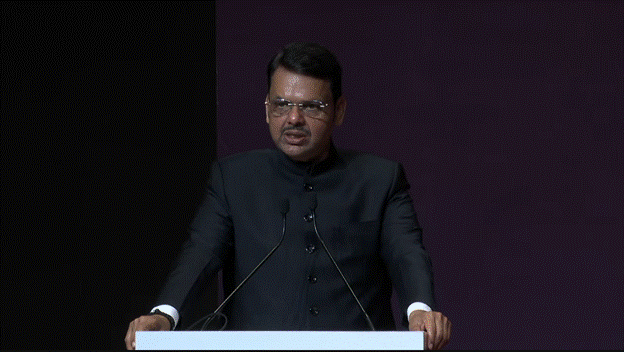
Delivering the keynote address, Chief Minister of Maharashtra, Devendra Fadnavis underscored that agriculture today sits at the intersection of climate volatility, economic stability and national security. “Across the world, food systems are under stress, climate volatility is intensifying, water tables are falling, soil health is deteriorating, supply chains are fragile, and global markets are unpredictable. For countries from the Global South, agriculture is not merely an economic sector, it is livelihood, social stability and national security. India understands this deeply, and has placed digital Public Infrastructure and Responsible AI at the centre-stage of national development,” he said.
The Chief Minister added that India’s AI mission is about using technology to deliver transparency, inclusion and scale. Agriculture must sit at the heart of this AI mission, for today at least half a billion Indians depend directly or indirectly on agriculture. For small farmers Agriculture can be challenging, AI changes this equation as it can provide hyper local weather predictions, early pest outbreak warnings, precise irrigation and fertilizer guidance, transparent supply-chain and real-time market advisories. “AI is not a magic, it must be built on trusted data, ethical governance and public accountability, otherwise scale will not happen, ” he noted.
Watch Shri Devendra Fadnavis, Hon’ble Chief Minister of Maharashtra, share how his state is using AI to enable a more resilient agriculture sector.
Speaking at the #IndiaAIImpactSummit2026, he applauded the international cooperation in advancing the good of everyone with AI.… pic.twitter.com/UlkjRSKAHr
Ministry of Agriculture and Farmers Welfare, Govt of India, Secretary, Devesh Chaturvedi outlined the Centre’s efforts to build inter-operable digital public infrastructure for agriculture. Explaining the rationale behind unified AI-driven platforms, he noted, “The whole idea was that once we have this AI-based system, we have a single platform for different applications and different advisories at the click of a button or maybe just through voice.” Emphasising on tailored advisories powered by farmer IDs and integrated datasets the Secretary added “Instead of pushing generic data which may not be useful for farmers, very specific tailored data for that farmer will be available based on integration of this digital public infrastructure with platforms like MahaVistar.”
Offering a global development perspective, World Bank Group, South Asia Region, Vice President, Johannes Zutt described AI in agriculture as a transformative moment for small-holders worldwide. “We are on the cusp of a major revolution happening in how to support farmers in agriculture,” he remarked. Stressing the foundational role of governments, he noted that Government’s responsibilities are principally on the foundations—things like governance of AI, interoperability, ensuring that education systems include appropriate skilling in the use of digital services. Highlighting India’s leadership potential, he added, “If AI can be made to work effectively at the farm level in India, there will automatically be large spillover learnings for other countries around the world.”
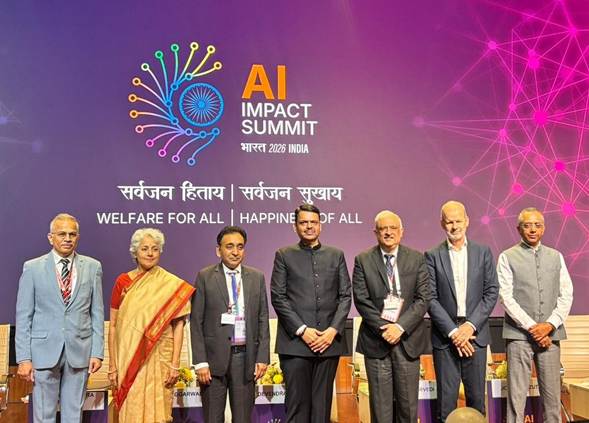
Chairperson of M. S. Swaminathan Research Foundation, Dr. Soumya Swaminathan emphasised inclusive design and gender equity as central to AI’s success in agriculture. “No technology is pro-poor or pro-rich or pro-women by itself, it is how we use that technology,” she stated. Cautioning against exclusion, she noted that algorithms are only as good as the data that feeds them, underscoring the need to ensure women farmers and marginalised groups are not left behind.
Shri Shankar Maruwada, Co-founder and CEO, EkStep Foundation which promotes use of technology in learning, highlighted the importance of open digital ecosystems and collaborative innovation. Drawing parallels with past agricultural revolutions, he noted, “The equivalent of ‘pulling bread out of air’ is now about pulling intelligence from data and providing it to farmers.” Emphasising interoperability, he added that what worked for Digital Public Infrastructure must now be applied to AI- open, interoperable systems that function like networks and not as siloed platforms.
The panel discussion also featured Govt of Maharashtra’s Agriculture Dept. Additional Chief Secretary Vikas Chandra Rastogi, who noted the importance of credible datasets, multilingual accessibility, strong governance frameworks and development partnerships to ensure AI tools are practical and trustworthy for smallholders across diverse agro-climatic regions.
Collectively, the session underscored a shared imperative: AI in agriculture must move beyond demonstration or pilot projects to become inclusive, public infrastructure that empowers farmers with hyper-local advisories, predictive climate insights and improved market and supply chain intelligence. The speakers affirmed that food security, climate resilience and AI governance are interconnected, and responsible, population-scale AI deployment will define the future of technology-led agricultural transformation in India.