AI and Climate Action in India
AI and Climate Action in India

Key Takeaways
Introduction
Climate change is a pressing reality today, that affects practically every aspect of life and livelihood. As climate risks grow, proactive solutions are needed for adaptation and mitigation. India has made significant progress in this regard, increasing green cover, harnessing renewable energy, reducing emissions, addressing the challenge of extreme weather. In recent years Artificial Intelligence (AI) has emerged as a powerful tool that helps in this fight against climate change. Artificial Intelligence (AI) enables computers to learn from data and make decisions or predictions, much like humans do. Deep learning is a method within AI that helps computers learn better by analysing large amounts of information. When applied to climate studies, AI systems analyse climate related data and provide solutions for improved climate modeling, optimized renewable energy generation, solutions for sustainable agriculture, and enhanced disaster resilience.
Recognizing AI’s critical role in driving inclusive development, the India-AI Impact Summit 2026 is being held from February 16–20 at Bharat Mandapam, New Delhi. It is the first global AI summit hosted in the Global South. Built on three foundational pillars-People, Planet, and Progress– the summit focuses on AI’s transformative potential across governance, innovation, and sustainable development.
AI-Enabled Early Warning and Disaster Risk Reduction
Advanced technology is reshaping how we predict weather patterns and prepare for natural disasters.
Forecasting System: Cyclone and Extreme Weather Modelling
India significantly enhanced its cyclone forecasting capacity through AI-assisted tools:
Cyclone Monitoring
IMD uses satellite-based AI tools to monitor tropical cyclones. The Advanced Dvorak Technique helps estimate intensity of cyclones. IMD also uses AI-based guidance from the European Centre for Medium-Range Weather Forecasting. These tools help predict when cyclones will form, where they will go, and how strong they will become.
Under Research & Development
Landslide, Flood and Glacial Monitoring
AI-driven early warning systems are also operational in vulnerable regions:
Together, these AI-enabled systems enhance early warning lead times, strengthen evacuation planning, reduce infrastructure losses, and safeguard vulnerable communities across climate-sensitive regions
Last-Mile Climate Intelligence: Reaching Communities
Emerging AI tools for Climate and Weather
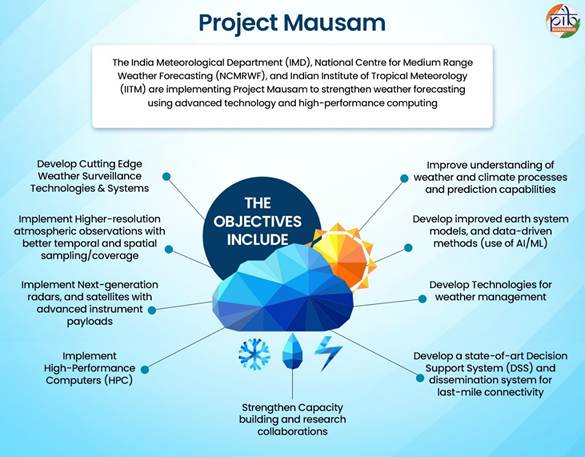
By democratizing access to high-resolution climate information, India is embedding resilience at the community level.
AI-Powered Forest Surveillance and Conservation
Integrated satellite, drone, and ground-sensor networks are strengthening conservation governance and safeguarding natural carbon sinks.
AI Innovations in Air and Water Risk Management
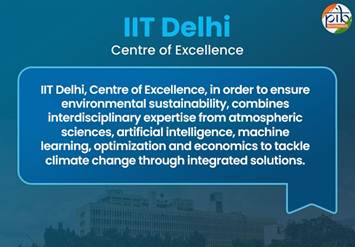
AIRAWAT Research Foundation of IIT Kanpur has signed an MoU with IIT Delhi to advance AI-driven research and solutions for sustainable cities. This collaboration focuses on critical urban challenges including air quality, energy, mobility, infrastructure, waste management, and digital governance. Key initiatives include developing AI-enabled sensor systems for real-time air and bioaerosol monitoring, aiming to build smarter, healthier, and more resilient cities through technology-driven innovations. By integrating multi-source urban data, AI contributes to building climate-resilient and environmentally sustainable cities.
IIT Kharagpur researchers developed an AI-based prediction model to detect arsenic pollution in India’s drinking water, addressing a crisis affecting millions along the Ganga banks. Using AI algorithms on environmental, geological, and human usage data, the team predicted groundwater arsenic distribution and health risks. They identified high and low arsenic zones across the delta region. The model shows a strong association of ‘surficial aquitard thickness’ and ‘groundwater-fed irrigation’ to regional-scale as-hazard. This framework helps identify safe drinking water sources in arsenic-affected areas like West Bengal and supports the government’s Jal Jeevan Mission by enabling smarter groundwater source selection.
AI is transforming India’s approach to environmental protection, paving the way for sustainable development and healthier communities.
Conclusion
India is advancing as a global leader in AI-driven climate solutions. The country has made institutional innovations and strong multilateral partnerships. India now provides village-level weather forecasts. These forecasts reach nearly every panchayat. The indigenous Bharat Forecasting System offers 6km resolution predictions. This democratizes climate information access across the country.The country has invested substantially in AI infrastructure. This includes 22 PetaFLOPS computing capacity. These investments show India’s commitment to innovation and international cooperation. India is working towards its net-zero emissions goal by 2070. AI-powered solutions help in many areas. These include renewable energy optimization, sustainable agriculture, and disaster prediction. These are not just technological achievements. They are essential tools for building climate resilience. India is proving that AI can be a powerful tool in fighting climate change. This is especially important for vulnerable communities in the Global South.
References:
India AI
https://indiaai.gov.in/article/ai-and-climate-action-in-india-a-strategic-perspective-in-2025
Press Information Bureau
https://www.pib.gov.in/PressReleasePage.aspx?PRID=2216805 &r
https://www.pib.gov.in/PressReleasePage.aspx?PRID=2158416®=3&lang=2
Indian Institute of Technology
https://iitk.ac.in/kss/index.php/mou/34-sign-mou-with-iit-delhi
https://hydrosense.iitd.ac.in/research/
Department of Science and Technology
Ministry of Earth Sciences
https://www.moes.gov.in/schemes/mission-mausam
https://mausam.imd.gov.in/event/mission_mausam.pdf
Niti Aayog
Other
https://www.digitalindia.gov.in/initiative/global-partnership-on-artificial-intelligence/
- Advanced Dvorak Technique is being used by the India Meteorological Department (IMD) and other government institutions to estimate cyclone intensity.