Agricultural Education & Training in India
Agricultural Education & Training in India
Agriculture provides the primary livelihood for nearly half of India’s population and contributes about 18 percent of GDP. Building human capacity, through higher education, research, and hands-on training, is vital for raising productivity, reducing costs, and achieving national goals. Agricultural education, research, and extension are recognised as the key pillars of the sector, forming the institutional and scientific base essential for sustaining the targeted 5 percent agricultural growth rate and achieving the national vision of “Viksit Krishi aur Samruddh Kisan” (Developed Agriculture and Prosperous Farmer)-the core philosophy of “Viksit Bharat”. To achieve this vision, these three pillars must work in synergy under the guiding principle of “One Nation – One Agriculture – One Team.”
Indian Council of Agricultural Research (ICAR)
Public and Private Institutions
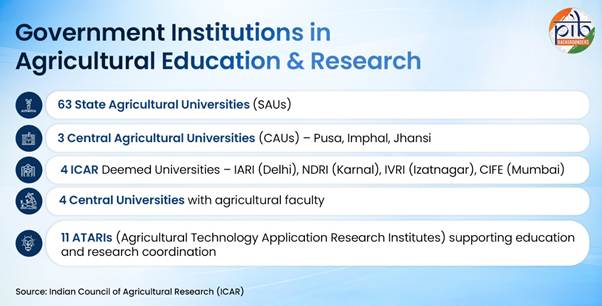
Government universities and institutes: India has 63 State Agricultural Universities (SAUs), 3 Central Agricultural Universities (CAUs) (Pusa, Imphal, Jhansi), 4 “Deemed” universities (IARI-Delhi, NDRI-Karnal, IVRI-Izatnagar, CIFE-Mumbai), and 4 Central Universities with agriculture faculty. The ICAR network also includes 11 ATARI (Agricultural Technology Application Research Institutes) centres.
Private sector: Agricultural education falls under the purview of State Governments, which have their own policies for establishing and promoting private institutions. ICAR’s role is limited to granting accreditation upon request. Over the past five years, the number of ICAR-accredited private agricultural colleges has risen from 5 in 2020–21 to 22 by 2024–25.
Central Agricultural Universities
Currently, three Central Agricultural Universities (CAUs) operate in India. Each was created by an Act of Parliament to serve regional needs:
RPCAU offers undergraduate programs in 8 disciplines (Agriculture, Horticulture, Agricultural Engineering, Community Science, Fisheries, Biotechnology, Forestry & Food Technology). Additionally, the university also offers a wide range of Master’s Programmes, and Ph.D. The university operates through multiple campuses, at Pusa in Samastipur District, Dholi in Muzaffarpur District, and Piprakothi in East Champaran District of Bihar, and manages 18 KVKs, linking research with farmers in Bihar. Aligned with the National Education Policy, the university has launched several short-term certificate and diploma programmes aimed at developing industry-ready talent at grassroots and mid-management levels.
Internet of Things (IoT) and ArtificialI intelligence (AI) in Agriculture
Start-up Ecosystem: Since 2018–19, the “Innovation and Agri-Entrepreneurship Development” programme under the Rashtriya Krishi Vikas Yojana (RKVY) has been fostering innovation and agripreneurship by offering financial assistance and strengthening the agri-incubation ecosystem. The initiative supports start-ups in agriculture and allied sectors, with the dual aim of boosting farmers’ incomes through new opportunities and generating employment for rural youth. Start-ups supported under the programme are engaged across diverse areas of agriculture and allied sectors, including agro-processing, food technology and value addition, artificial intelligence (AI), the Internet of Things (IoT), information and communication technology (ICT), precision farming, digital agriculture, blockchain technology.
Skilling and Training of Farmers
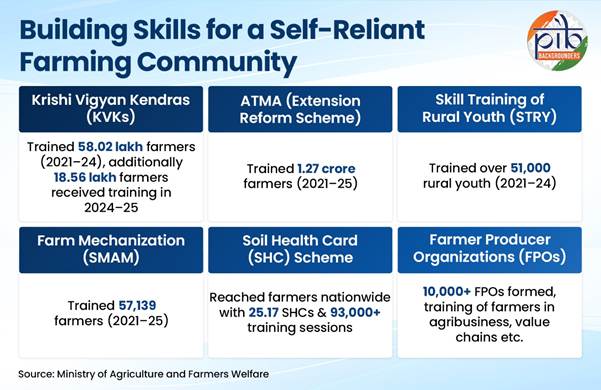
Skilling and training of farmers have become central to India’s agricultural transformation. Recognising that modern farming requirements, the Government has prioritised capacity building to help farmers adapt to technological innovations, climatic and market transformations. Programmes such as the Skill Training of Rural Youth (STRY), Sub-Mission on Agricultural Mechanization (SMAM), Pradhan Mantri Kaushal Vikas Yojana (PMKVY), and initiatives through Krishi Vigyan Kendras (KVKs) and Agricultural Technology Management Agency (ATMA) are equipping farmers with practical knowledge and vocational expertise for sustainable agriculture practices.
Conclusion
India’s agricultural education and training system today reflects a well-integrated approach linking education, research, technology, and field-level skill development. Guided by the vision of “One Nation – One Agriculture – One Team,” institutions such as ICAR, Central and State Agricultural Universities, and Krishi Vigyan Kendras have created a strong foundation to make farming more productive, sustainable, and knowledge-driven. The continuous emphasis on quality education, accreditation reforms, and farmer-centric training is helping bridge the gap between scientific research and practical application.
The inclusion of technologies like the Internet of Things (IoT), Artificial Intelligence (AI), and precision farming tools marks a significant shift toward modern and data-based agriculture. Through initiatives like ATMA, STRY, and SMAM, farmers and rural youth are being equipped with essential technical and entrepreneurial skills, fostering employment and self-reliance in villages. Together, these efforts are contributing to higher productivity, better incomes, and sustainable use of resources. As India aims for self-reliance in food production and a resilient rural economy, strengthening this synergy between education, innovation, and skilling will remain central to the nation’s agricultural progress.
References:
PIB:
ICAR:
CAU
***
- Tirhut College of Agriculture
- Post Graduate College of Agriculture
- College of Agricultural Engineering and Technology
- College of Community Science
- College of Basic Sciences and Humanities
- College of Fisheries
- Pt. Deen Dayal Upadhyay College of Horticulture and Forestry
- School of AgriBusiness & Rural Management