Advancing India’s Mental Healthcare and Well-Being
Advancing India’s Mental Healthcare and Well-Being
Key Takeaways
Introduction
The Union Budget 2026-27 marks a decisive shift in India’s mental health policy by placing institutional expansion and regional equity at the centre of public health planning. By strengthening mental health and trauma care infrastructure, the budget advances the Government of India’s vision of inclusive development, under “Sabka Sath, Sabka Vikas” and the vision of a Viksit Bharat.
Addressing the long-standing absence of national-level mental health institutions in North India and the growing demand for specialised services, the Budget elevates mental health to a core public health priority. Its focus on targeted interventions, workforce capacity-building, and trauma care support is aimed at reducing the disproportionate burden borne by vulnerable families. This signals a clear and sustained commitment to equitable access to mental health and trauma care.
What is Mental Health?
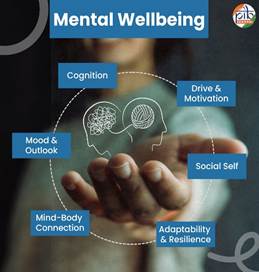
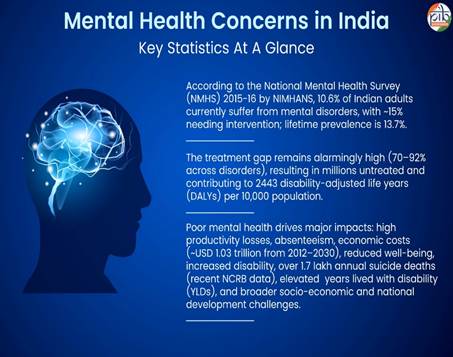
Mental health is the state of well-being in which a person can cope with normal stresses of life. It allows one to learn, work well and contribute to community. Good mental health includes emotional, psychological, and social well-being. Poor mental health can lead to disorders like anxiety, depression, and other severe disorders, with far-reaching consequences for physical health, relationships, and overall functioning. In India, rising stress levels, rapid urbanisation, and post-pandemic challenges have increased the demand for mental health care. Timely access to support and treatment helps prevent crises and improves quality of life. Recognising this, the government increasingly views mental health as central to inclusive development, social stability and productivity.
Union Budget 2026-2027: Strengthening Commitment to Mental Healthcare
In the Union Budget 2026-27, the government further reaffirmed its commitment to mental health and trauma care. This is part of ensuring access for the vulnerable under the third Kartavya (duty) – making sure every family, community, region, and sector has resources.
NIMHANS expansion
Upgradation of existing institutes
Establishment of emergency and trauma care centres
These steps aim to reduce regional disparities, improve access for the poor and vulnerable, and address the burden of rising mental health disorders across age groups, genders and regions.
Striding Toward Mental Well-Being: India’s Journey Thus Far
India has built a strong base for mental health care, with NIMHANS, Bengaluru being the apex body for research, training, and care. It received the Nelson Mandela Award for Health Promotion by WHO in 2024[4]. Building on this leadership, India’s mental health sector emphasises reducing stigma, expanding access to services, and integrating digital tools. Key progress includes the establishment of rehabilitation homes, stronger community linkages, and efforts to deliver equitable, affordable, and high-quality mental health care across the country.
National Mental Healthcare Act, 2017[5]
National Health Policy, 2017[6] [7]
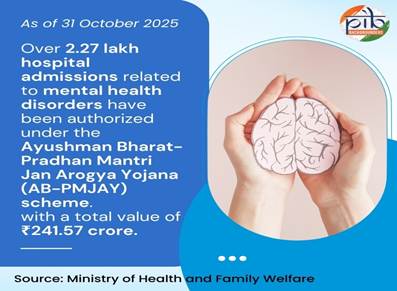
Integration through Ayushman Bharat and Primary Care
National Mental Health Programme (NMHP), 1982
District Mental Health Programme (DMHP)[10]
National Suicide Prevention Strategy (NSPS)[11]
National Tele Mental Health Programme (Tele-MANAS)[12]
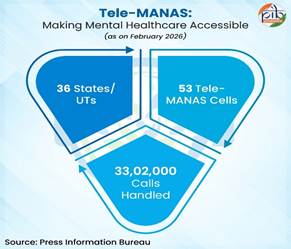
As of February 5, 2026, a total of 2,065 video calls have been handled through this feature.
Infrastructure for Mental Health Care
India has 47 government-run mental hospitals, including 3 central institutions (NIMHANS Bengaluru, LGBRIMH Tezpur[13], and CIP Ranchi[14]) and 44 state-run hospitals[15]. Mental health services are available across all AIIMS facilities to provide advanced and specialised care.
A total of 25 Centers of Excellence have been sanctioned to strengthen training in psychiatry, clinical psychology, psychiatric social work, and psychiatric nursing[16]. These include 11 CoEs during the 11th Plan (2007–2012), 10 during the 12th Plan (2012–2017), and 4 beyond the 12th Plan (2017–2018). Grants support upgradations in civil work, equipment procurement, books and journals procurement for library., capital works, equipment, faculty retention, tertiary-level care, creation of PG seats, research, and implementation of the District Mental Health Programme (DMHP)[17].
A total of 47 Postgraduate Departments in 19 government institutions have been sanctioned for upgradation. This includes 27 departments in 11 institutions during the 11th Plan (2009–2011), 13 during the 12th Plan (2015–2016) in 5 institutions, and 7 beyond the 12th Plan in 3 institutions (2017–2018)[18]. Upgrades focus on improving training capacity for mental health specialists.
Digital Academies established at NIMHANS, LGBRIMH, and CIP Ranchi since 2018 have trained 1,76,454 healthcare professionals. The iGOT-Diksha Platform (launched 2020) has provided training to healthcare workers, frontline staff, and community volunteers to build grassroots-level mental health capacity[19].
Conclusion
The Union Budget 2026-27 represents a meaningful advancement in India’s mental health landscape. It reinforces the government’s long-standing efforts to build an inclusive, accessible, and equitable system of care. By announcing the establishment of NIMHANS-2 in North India and upgrading key institutes in Ranchi and Tezpur, the Budget directly addresses critical regional gaps, strengthens specialised infrastructure, workforce training, and trauma care support.
These targeted measures build on a solid foundation laid over decades. Collectively, these initiatives signal a sustained commitment to reducing stigma, bridging treatment gaps, and prioritising mental well-being as essential to national productivity, youth empowerment, and inclusive growth. Continued implementation and monitoring will be key to translating this momentum into tangible improvements for millions across the country.
References
Press Information Bureau:
https://www.pib.gov.in/PressReleasePage.aspx?PRID=2221455
https://www.pib.gov.in/PressReleasePage.aspx?PRID=2221458
https://www.pib.gov.in/PressReleasePage.aspx?PRID=2221410
https://static.pib.gov.in/WriteReadData/specificdocs/documents/2026/feb/doc202621775901.pdf
https://www.pib.gov.in/PressReleaseIframePage.aspx?PRID=2022303®=3&lang=2
https://www.pib.gov.in/PressReleaseIframePage.aspx?PRID=2100706®=3&lang=2
https://www.pib.gov.in/PressReleaseIframePage.aspx?PRID=2100706®=3&lang=2
https://www.pib.gov.in/PressNoteDetails.aspx?ModuleId=3&NoteId=153277&lang=1®=3
https://www.pib.gov.in/PressReleasePage.aspx?PRID=2188003®=3&lang=2
https://www.pib.gov.in/PressReleseDetail.aspx?PRID=2221458®=3&lang=1
Ministry of Health and Family Welfare:
https://www.mohfw.gov.in/?q=en/pressrelease-206
https://indianmhs.nimhans.ac.in/phase1/Docs/Summary.pdf
https://dghs.mohfw.gov.in/national-mental-health-programme.php
https://mohfw.gov.in/sites/default/files/9147562941489753121.pdf
Ministry of Finance:
https://www.indiabudget.gov.in/doc/bh1.pdf
Advancing India’s Mental Healthcare and Well-Being