Infrastructure Financing in India: Trends, Institutions, and Innovations
Infrastructure Financing in India: Trends, Institutions, and Innovations
Key Takeaways
Introduction
Infrastructure is the backbone of India’s economic growth and social development, shaping opportunities for industry, employment, and improved quality of life. Infrastructure financing is vital because it ensures a steady flow of funds for large projects, reducing dependence on government budgets alone. It helps attract private investment, spread risks, and accelerate project delivery, while aligning infrastructure growth with long-term national goals of sustainability, competitiveness, and inclusive development. Over the past decade, India has consistently prioritized large-scale investment in infrastructure as a driver of inclusive progress and competitiveness, with the World Bank ranking it among the top five countries worldwide for Job creation in infrastructure among low and middle-income economies.
The Union Budget 2026–27 continues this momentum, announcing new measures to strengthen financing instruments, expand public capital expenditure, and support risk mitigation and asset monetisation. These initiatives reflect the vision of Viksit Bharat, where modern infrastructure serves as its foundation.
Rising Public Capex, Stronger Infrastructure Push
Public Capital expenditure refers to government spending on the creation of assets such as roads, buildings, machinery, and equipment, with a high multiplier effect on economic growth.
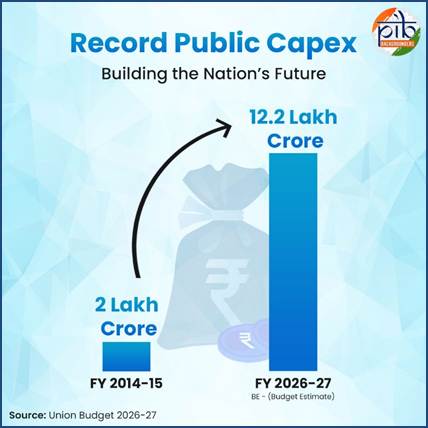
Over the past decade, public capital expenditure has been the driving force of India’s infrastructure push. The Government has steadily raised allocations, using higher spending as a tool to attract private investment, generate employment, and boost the economy.
v Why Higher Capex Matters
Further to amplify the potential of urban centres, the Union Budget 2026-27 introduces the concept of City Economic Regions (CERs), mapped according to their specific growth drivers. An allocation of ₹5,000 crore per CER over five years has been proposed, to be implemented through a challenge mode with a reform-and-results-based financing mechanism.
Debt Market Reforms Driving Long-Term Financing
The debt market plays a crucial role in infrastructure financing by enabling governments, companies, and institutions to raise long-term funds through bonds and similar instruments. Investors buy these bonds, providing capital for projects and earning fixed interest in return. Unlike other financing channels that mobilize equity, blended finance, or institutional capital, debt market financing is purely borrowing-based and relies on repayment obligations. The Government has been working to make India’s debt markets stronger and more effective for long-term infrastructure financing through the following measures:
India’s Infrastructure Financing Ecosystem
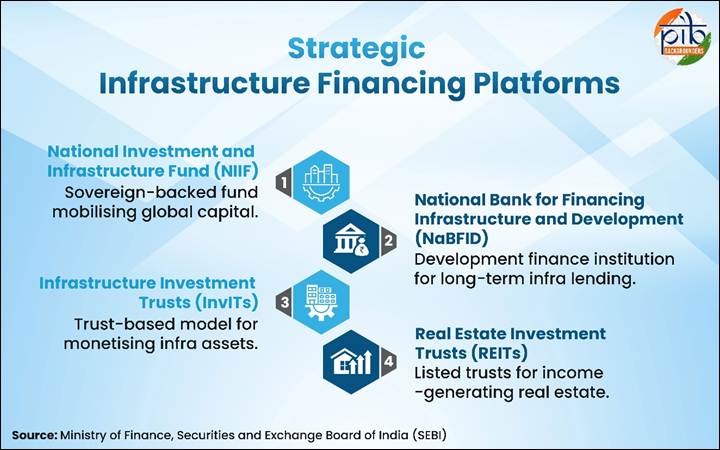
India’s infrastructure financing has undergone a major transformation over the past decade, shifting from reliance on budgetary support to a blended model of public and private capital. According to the World Bank, India has emerged as the largest recipient of Private Participation in Infrastructure (PPI) investment in South Asia, accounting for over 90% of the region’s total. Institutions like the National Investment and Infrastructure Fund (NIIF) and the National Bank for Financing Infrastructure and Development (NaBFID) have emerged as pivotal anchors, mobilising global and domestic capital and providing long-term development finance to strengthen India’s infrastructure ecosystem. Alongside these institutions, instruments such as Infrastructure Investment Trusts (InvITs) and Real Estate Investment Trusts (REITs) have enabled monetisation of completed assets and recycling of funds into new projects.
Both the Master Fund and Private Markets Fund are fully committed, with Master Fund investments contributing to greenfield assets in ports, logistics, airports, and data centres.
Strengthening Rail Infrastructure through IRFC
Railways form the backbone of India’s infrastructure, driving connectivity, trade, and economic growth. To support this vast network, the Indian Railway Finance Corporation (IRFC) serves as the dedicated financing arm, mobilising resources and strengthening the financial foundation of Indian Railways.
InvITs have thus emerged as a trusted instrument for utilising long-term capital, attracting global investors, and strengthening India’s infrastructure financing ecosystem.
2. Real Estate Investment Trusts (REITs): Real Estate Investment Trusts (REITs), regulated by the Securities and Exchange Board of India (SEBI), allow investors to participate in income-generating real estate through small investments. Their units are listed on stock exchanges, offering transparency, liquidity, and diversification. Further, the Union Budget 2026-27 has announced the creation of dedicated REITs for Central Public Sector Enterprises (CPSEs) to accelerate monetisation of government-owned real estate assets.
ü Transparency: Regular disclosure of Net Asset Value (NAV) ensures clarity on investments.
Infrastructure Risk Guarantee Fund – Securing Finance, Delivering Projects
Infrastructure projects often face challenges such as early-stage project construction & development risks, , delays, and uncertainty in execution. To address these issues, the Government introduced the Infrastructure Risk Guarantee Fund in the Union Budget 2026-27 to strengthen investor confidence and ensure the timely delivery of projects. This fund will provide wide of partial guarantees to lenders, reducing default risks for private developers and making financing more secure.
Conclusion
India’s infrastructure financing journey reflects a decisive shift towards scale, innovation, and resilience. By blending public investment with institutional strength and modern instruments, the country is building a robust foundation for inclusive growth. The strategy not only secures capital flows but also ensures sustainability, competitiveness, and confidence in India’s long-term development trajectory.
References:
Ministry of Finance:
https://www.indiabudget.gov.in/
https://www.indiabudget.gov.in/economicsurvey/
https://www.pib.gov.in/PressReleasePage.aspx?PRID=2219991®=3&lang=2
https://sansad.in/getFile/loksabhaquestions/annex/187/AU413_G5UG75.pdf?source=pqals
https://financialservices.gov.in/beta/sites/default/files/2025-02/Budget.pdf
Ministry of Railways:
Ministry of Road, Transport & Highways:
https://www.pib.gov.in/PressReleasePage.aspx?PRID=2210839®=3&lang=1
Cabinet Committee on Economic Affairs (CCEA):
https://www.pib.gov.in/PressReleaseIframePage.aspx?PRID=1652428®=3&lang=2
Indian Railway Finance Corporation:
National Investment & Infrastructure Fund (NIIF):
National Bank for Financing Infrastructure and Development (NaBFID):
Securities and Exchange Board of India:
https://www.sebi.gov.in/sebi_data/faqfiles/jan-2023/1674793029919.pdf?utm_source=copilot.com
https://www.sebi.gov.in/sebi_data/meetingfiles/nov-2017/1509521834318_1.pdf
National Institute of Securities Markets (NISM):
https://www.nism.ac.in/understanding-reits/
India Infrastructure Finance Company Limited (IIFCL):
- Rising Capex Levels: Public investment has seen a sharp rise, growing from ₹2 lakh crore in FY2014–15 to a Budget Estimate of ₹12.2 lakh crore in 2026–27, continuing its upward trajectory and underscoring the Government’s commitment to infrastructure-led growth.