SUDDEN COOLING IN GREENLAND REDUCED SUMMER MONSOONS IN INDIA 8,200 YEARS AGO
SUDDEN COOLING IN GREENLAND REDUCED SUMMER MONSOONS IN INDIA 8,200 YEARS AGO
Around 8,200 years ago, a drop in temperature in Canada at one end of the globe triggered a decline in the intensity of the Indian Summer Monsoons, scientists have found.
The “8.2 ka cooling event” is the largest climatic excursion of the Holocene from the perspective of Greenland temperature change. Greenland temperature dropped by 3 ºC, and methane declined by 80 ppbv, which suggest an important change in the hydrologic cycle.
During ca. 8220 to 7600 cal yr BP also called the “8.2 ka cooling event” Greenland temperature dropped by 3 ºC, and methane declined by 80 ppbv due to glacial outburst flood of freshwater from Lake Agassiz thorough the Hudson Bay into the North Atlantic.
It is one of the largest climatic excursions of the Holocene and an important change in the hydrologic cycle.
Scientists from Birbal Sahni Institute of Palaeosciences (BSIP), an autonomous institute of the Department of Science and Technology (DST) have found signature of this Abrupt Climate Change (ACC) or Rapid Climate Change (RCC) event of the North Atlantic, in the Core Monsoon Zone (CMZ), India (Figs. 1 & 2).
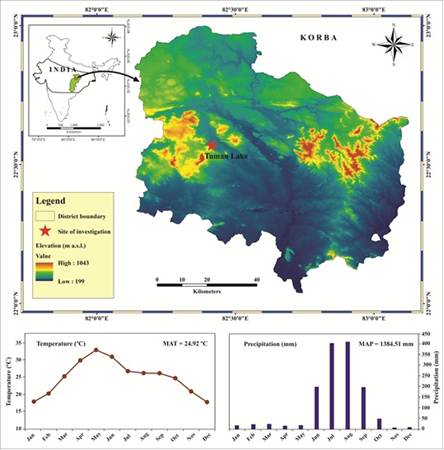
Fig. 1. Shuttle Radar Topographic Mission (SRTM) Digital Elevation Model (DEM) of the Korba District, Chhattisgarh State, central India, showing the location of the study area (the red star shows the site of investigation). Geographic map of India showing Korba District in Chhattisgarh State, and the Core Monsoon Zone (CMZ) of India (dark black and bold lines) (left upper panel). This figure was created using ArcGIS 10.8.2. Nearest Climate research Unit Time Series (CRU TS) 4.07, 0.5 × 0.5 gridded climate data point, 1901–2022, showing mean monthly precipitation and temperature around the study area (inserted down panel). MAP = Mean Annual Precipitation; MAT = Mean Annual Temperature.
The team extracted a 1.2-meter-long sediment profile from Tuman Lake in Korba District, Chhattisgarh, located within the CMZ and analyzed fossil pollen preserved in lake sediments.
Each type of plant produces distinctive pollen grains. By identifying and counting 300 terrestrial pollen grains per sample, the researchers reconstructed past vegetation patterns and, in turn, inferred past climate conditions and constructed a high-resolution climate archive written in microscopic grains of pollen.
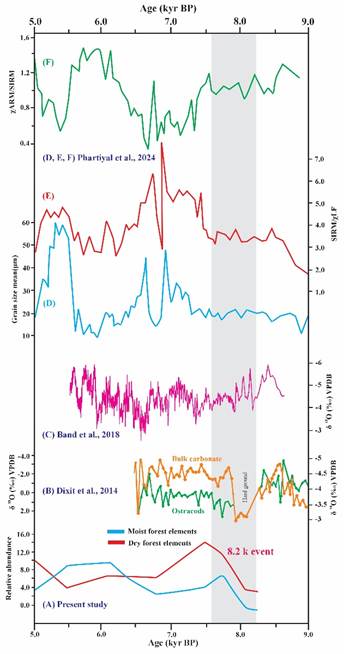
Fig. 2. The weakening of the monsoon at global 8.2 kyr BP and its correlation with the present study (8220 cal yr BP) (A). Present study, and correlation with other studies. (B). δ18O of ostracod calcite (green) and bulk carbonate (orange) record from Riwasa Lake, NW India (Dixit et al. 2014). (C). Speleothem δ18O records from Kotumsar Cave (Kanger Valley National Park, Jagdalpur of the Bastar District, Chhattisgarh), CMZ, India (Band et al. (2018). (D, E, and F). Record from the Kanwar wetland (mean grain size, SIRM/χlf and χARM/SIRM) (Phartiyal et al., 2024). (For interpretation of the references to color in this figure legend, the reader is referred to the web version of this article).
In a study published in the journal Quaternary International, the researchers interpretated that more tropical moist deciduous forest pollen indicated stronger monsoon rainfall and drier deciduous or herbaceous pollen indicated weaker monsoon conditions and identified weakened monsoon during the 8.2 ka interval.
Also, using radiocarbon dating and statistical age-depth modelling, the team built a timeline stretching back over 8,200 years.
The weakened monsoon during the 8.2 ka interval suggests a powerful teleconnection or an atmospheric and oceanic link between the North Atlantic and the Indian Summer Monsoon. It indicated that cooling in Greenland caused disruptions in Atlantic circulation that may have shifted global wind belts and weakened monsoons in the Northern Hemisphere, thereby reducing rainfall over India.
The findings show that even in the Middle Holocene, India’s monsoon was sensitive to both high-latitude ocean changes and tropical Pacific variability.
Publication link: https://doi.org/10.1016/j.quaint.2025.110103