Painted Worlds
Painted Worlds
Tribal Arts in Conversation
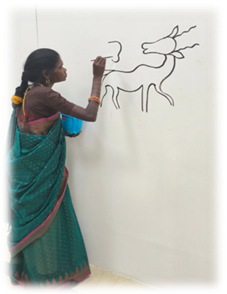
Between 3rd and 13th March 2026, the grounds of Travancore Palace in New Delhi came alive with creative energy filled with artists at work, visitors discovering tribal traditions, and the subtle scent of natural pigments in use. This was the Tribes Art Fest 2026, a national cultural event organised by the Ministry of Tribal Affairs, Government of India, that brought more than 75 tribal artists and over 1,000 artworks under one roof, representing more than 30 distinct tribal art traditions from across the country. Organised in collaboration with the National Gallery of Modern Art (NGMA) and FICCI, the festival was far more than an exhibition. The artworks illustrated tribal stories, mythology, nature, and community life, demonstrating the diversity of India’s indigenous cultural heritage. It was a platform where traditional knowledge systems meet new audiences, where artworks find buyers, and where living heritage is given the recognition it deserves.
Beyond exhibition, Tribes Art Fest included panel discussions on themes such as Tribal Art Revival & Sustainable Futures, Tribal Art in Contemporary Spaces, and Livelihoods & Market Linkages. The programme also involved participatory workshops, storytelling through tribal arts, illustrated talks and live demonstrations. Over 100 tribal students pursuing art from across India were provided curated walkthroughs, mentorship sessions with senior tribal artists, and exposure to live creative processes.

Warli Painting: A Living Link to Ancient Traditions
Madhukar Rambhau Vadu began practicing Warli painting at the age of eight and has been devoted to the art for nearly five decades. Now 56, he is not simply an artist but also a writer, a researcher, and a devoted custodian of a tradition he has spent his life decoding. His passion is exploring and researching the invisible thread that connects prehistoric cave paintings and ancient petroglyphs to Warli art.
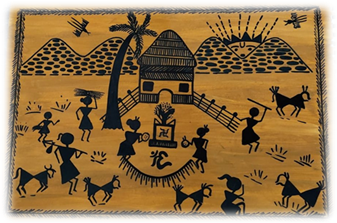
Warli painting, a folk art tradition from Maharashtra, is practised by the Warli tribe. With possible roots in the 10th century AD or even the Neolithic era (2,500–3,000 BC), it reflects a deep connection to nature. Farming sustains the tribe, making natural elements central to their art. Traditionally, the artists use clay hut walls as canvases, much like ancient cave paintings, to depict their culture and reverence for nature.[1] Using white pigment made from rice paste, they distil the complexity of everyday existence into elemental geometric forms—circles, triangles, and squares—depicting scenes of farming and hunting, village rituals, and the spirited Tarpa dance. Each painting is, in essence, a conversation between the community and the natural world it inhabits.
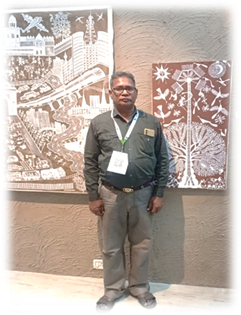
For Madhukar, events like the Tribes Art Fest are not simply exhibitions—they are acts of cultural advocacy. He believes such festivals need to happen more frequently, and in more parts of the country, if tribal art traditions are to truly reach the audiences they deserve.
“This is a very important platform provided by the Government of India,” he says. “It helps people learn about tribal art and encourages young artists who want to pursue it.” His own work has found a warm reception at the festival, with several of his paintings selling to visitors who encountered Warli art for the very first time.
Masks that Tell Stories: Rabha and Tamang Traditions
A few stalls away, the faces staring back at visitors are not of living people but of gods, spirits and mythological creatures. They are Rabha and Tamang masks crafted by Shanti Ram Rabha, a 64-year-old artist from Alipurduar in West Bengal.
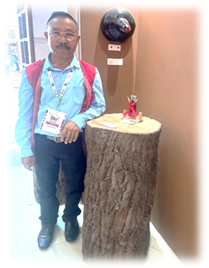
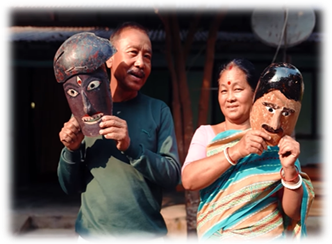
Among the Rabha tribe, which is found mainly in Assam and parts of North Bengal, mask-making is an ancient craft inseparable from folk theatre and ritual dance. Carved from wood, bamboo, gourd, or clay and painted in vivid colours, each mask depicts mythological figures, animals, or spirits summoned during ceremony. The Tamang traditions of the Himalayan region share a similar spiritual grammar: performers wear the masks to embody deities and mythical beings, collapsing the boundary between the human and the divine.
What makes Rabha’s story particularly striking is that he came to this art not in his youth, but after decades of military service. He retired from the army before picking up the tools of a mask-maker and what began as personal curiosity quickly became a calling. At the Tribes Art Fest, the market confirmed what he already sensed: many of his masks sold on the very first day of the festival.
For him, selling a mask is secondary to what the exchange represents: a chance to bring these storytelling traditions in front of new eyes, and to ensure they are not forgotten when the craftspeople who carry them are gone.
Gond Art: Stories Through Pattern and Colour
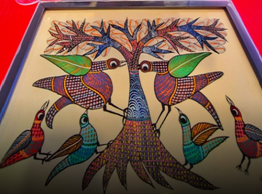
Gond painting has its roots in the walls and floors of homes across central India, particularly in Madhya Pradesh, where artists of the Gond community once mixed their pigments from clay, stones, flowers, and herbs to paint animals, birds, and trees onto the surfaces of everyday life. The art form is famous for its signature technique of using intricate patterns of dots and lines that fill every shape, giving compositions a rhythmic, almost musical quality. The paintings are not decorative exercises but narratives grounded in folklore, community memory, and the deep ecology of forest life.
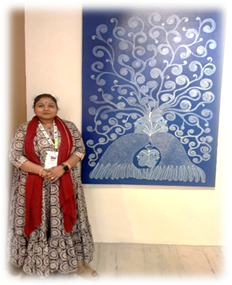
To look at the painting by Japani Shyam Hurley is to enter a world that vibrates with colour and pattern—a world teeming with animals, birds, and trees that seem almost to breathe. A young artist from Bhopal, who belongs to the Gond Pradhan community, carries in her brushwork both a legacy and a living tradition.
She was inspired by her father, Janghar Singh Shyam to become a Gond art artist. One of her canvases at the festival told the story of two friends with sharply different natures—one gentle and compassionate, the other shaped by darker influences. It is a moral fable rendered in colour and pattern. The painting carries a quiet philosophical argument: that the company we keep shapes who we become. In Japani’s telling, a truly good friend is like the Ganga—capable of cleansing and remaking us, one interaction at a time.
Platforms like the Tribes Arts Fest, she says, do something beyond just promoting art—they embolden people. “Such platforms encourage more people from our community to come forward and pursue art,” she observes. The encouragement, she believes, matters as much as the commerce.
Bhil Painting: Stories in Dots and Colours
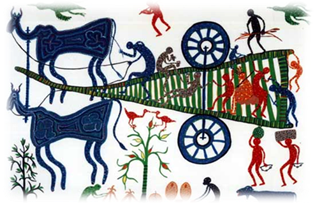
The Bhil paintings are practiced by the Bhil community which is one of the largest indigenous groups in India. The paintings also carry the honour of being among the oldest art traditions on the subcontinent. Its most distinctive feature is immediately arresting: every composition is built from more than thousand tiny dots, each one representing a seed, a grain, or a pulse of nature’s rhythm. Animals, deities, forests, and scenes from daily life emerge from this pointillist universe, anchoring the art in a cosmology shaped by centuries of living close to the land.
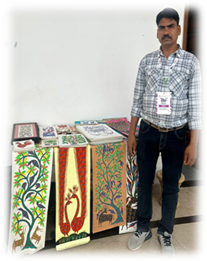
Ram Singh Bhavor, an artist from Jhabua district in Madhya Pradesh, remembers exactly when he first noticed Bhil painting: it was on the walls of homes in his village, where the art had always been present, like something that had grown there naturally. It would take time before he realised that what he had grown up seeing was part of one of India’s oldest and most vital tribal art traditions.
The turning point came when Ram Singh saw senior tribal artists carrying works like his village’s wall paintings onto national stages. Something shifted. The art he had always lived alongside suddenly revealed itself as something the wider world wanted to see—and he decided to be part of that story.
He took up painting with seriousness and intention, hoping that in doing so he might also light a path for younger artists from his community. At the Tribes Art Fest, he found buyers for his work—but more unexpectedly, he found conversations. Artists from traditions he had never met before were working just a few stalls away, and the exchange of stories across regional and cultural lines became, for him, one of the festival’s greatest rewards.
In a festival this diverse, he says, every interaction is also an education—a chance to understand not just other art forms, but the lives and landscapes that gave birth to them.
A Festival Celebrating Living Traditions
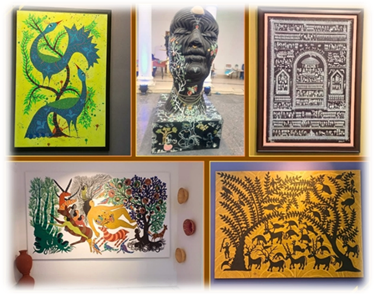
The Tribes Art Fest 2026 brought together master artists from across India, each carrying forward traditions that predate modern India by centuries.
Every artwork on display carried more than aesthetic value—it carried a community’s way of seeing the world, its relationship with nature, its moral stories, and its memory. These are not relics. They are living, evolving traditions, and the artists who practice them have made clear that they do not intend to let them fade.
References:
Press Information Bureau:
https://www.pib.gov.in/PressReleasePage.aspx?PRID=2234758
Ministry of Textiles, Government of India
Economic Advisory Council to the Prime Minister (EAC-PM)
https://tribal.nic.in/downloads/Livelihood/Resource%20and%20Publications/tribalFaces.pdf
Government of Tamil Nadu
https://govtmuseumchennai.org/uploads/topics/16527874636788.pdf
Pictures