Government Taking Multiple Steps to Increase Domestic Fertilizer Production and Reduce Import Dependence
Government Taking Multiple Steps to Increase Domestic Fertilizer Production and Reduce Import Dependence
The Government of India has undertaken several initiatives to strengthen domestic fertilizer production and reduce dependence on imports.
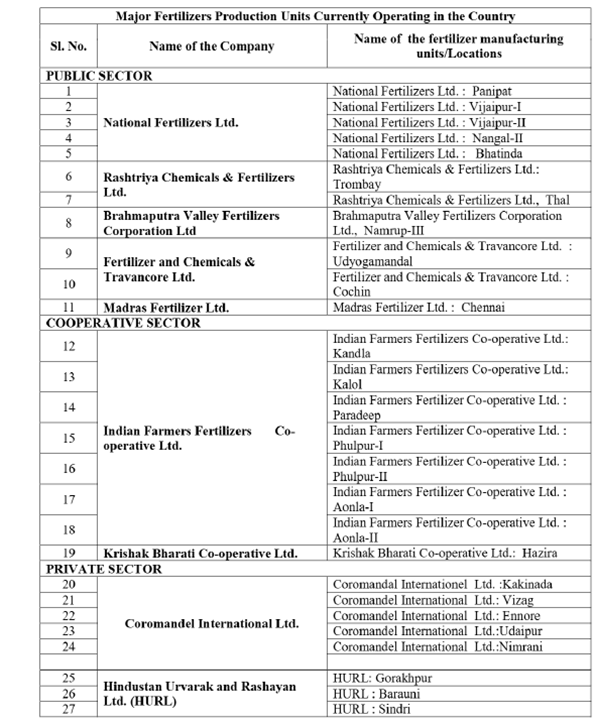
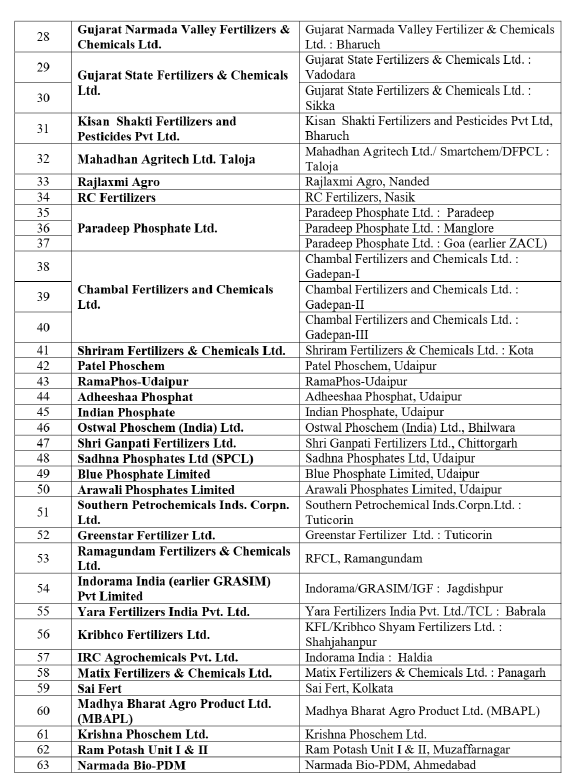
In a written reply in the Lok Sabha, the Minister of State for Chemicals and Fertilizers Smt. Anupriya Patel informed that a number of fertilizer production units are currently operational in the country across the public, cooperative and private sectors. The detailed list of fertilizer manufacturing units operating in the country is provided in the Annexure.
To promote self-sufficiency in urea production, With regard to urea, the Government had announced New Investment Policy (NIP) – 2012 on 2nd January, 2013 and its amendment on 7th October, 2014 to facilitate fresh investment in the urea sector and to make India self-sufficient in the urea sector. Total 6 new urea units have been set up under NIP-2012 which includes 4 urea units set up through Joint Venture Companies (JVC) of nominated PSUs and 2 urea units set up by the private companies. The units set up through JVC are Ramagundam urea unit of Ramagundam Fertilizers and Chemicals Ltd (RFCL) in Telangana and 3 urea units namely Gorakhpur, Sindri and Barauni of Hindustan Urvarak & Rasayan Limited (HURL) at Gorakhpur in Uttar Pradesh, Sindri in Jharkhand and Barauni in Bihar, respectively. The units set up by private companies are Panagarh urea unit of Matix Fertilizers and Chemicals Ltd. (Matix) in West Bengal; and Gadepan-III urea unit of Chambal Fertilizers and Chemicals Ltd. (CFCL) in Rajasthan. Each of these units has installed capacity of 12.7 Lakh Metric Tonne per annum (LMTPA). These units are highly energy efficient as they are based on latest technology.
The Government has implemented Nutrient Based Subsidy (NBS) Scheme w.e.f. 01.04.2010 for Phosphatic and Potassic (P&K) Fertilizers. Under the Scheme, P&K fertilizers are covered under Open General License (OGL) and companies are free to import/manufacture these fertilizers as per their business dynamics. To increase domestic fertilizer production and make country self-reliant the following measures have been taken by the Government:
ANNEXURE
Annexure referred to in reply to part (a) of Lok Sabha Unstarred Q.No.2436 for answering on 13.02.2026
******
- Department of Fertilizers has issued guidelines dated 18.01.2024 to ensure reasonableness of Maximum Retail Price and encourage domestic production.
- Based on the requests, the new manufacturing units or increase in manufacturing capacity of existing units have been recognized / taken on record under the NBS Scheme.
- The number of P&K fertilizers covered under NBS policy has increased from 22 grades in 2021 to 28 grades.
- Freight Subsidy on SSP, which is an indigenously manufactured fertilizer, has been approved since Kharif, 2022 to promote SSP usage for providing Phosphatic or ‘P’ nutrient to the soil.
- To reduce import dependence on imported Potassic fertilizers, Potash Derived from Molasses (PDM), which is a domestically produced Potassic fertilizer, has been inducted under NBS scheme since Rabi, 2021.