No Shortage of Chemical Fertilizers; Adequate Availability Ensured During Kharif 2025 and Rabi 2025–26
No Shortage of Chemical Fertilizers; Adequate Availability Ensured During Kharif 2025 and Rabi 2025–26
Union Minister for Chemicals and Fertilizers Shri Jagat Prakash Nadda, while replying to Lok Sabha Starred Question No. *218, informed that no shortage of chemical fertilizers has been reported across States, including Uttar Pradesh, during the Kharif 2025 and the ongoing Rabi 2025–26 seasons.
The Minister stated that the availability of major fertilizers such as Urea, DAP, MOP and NPKS has remained adequate across the country. State-wise details regarding requirement, availability and sales of these fertilizers during the said seasons have been placed at Annexure.
The details of the quantity of fertilizers produced by the different plants of IFFCO during the last two years are as under:
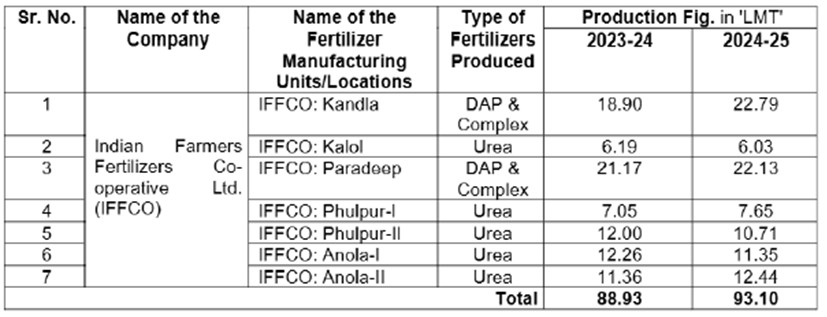
Further, 41,24,000 Metric Tonnes of Urea was produced by IFFCO units during April–January of FY 2025–26, compared to 40,66,000 Metric Tonnes during the corresponding period of FY 2024–25, indicating steady production levels.
With regard to urea, the Government had announced the New Investment Policy (NIP) – 2012 on 2 January 2013 and its amendment on 7 October 2014 to facilitate fresh investment in the urea sector and to make India self-sufficient in urea production. Under NIP-2012, a total of six new urea units have been commissioned, including four units set up through Joint Venture Companies (JVCs) of nominated PSUs and two units established by private companies.
The units set up through JVCs include the Ramagundam urea unit of Ramagundam Fertilizers and Chemicals Ltd. (RFCL) in Telangana, and three units of HURL located at Gorakhpur (Uttar Pradesh), Sindri (Jharkhand), and Barauni (Bihar). The private sector units include the Panagarh urea unit of Matix Fertilizers and Chemicals Ltd. (Matix) in West Bengal and the Gadepan-III urea unit of Chambal Fertilizers and Chemicals Ltd. (CFCL) in Rajasthan. Each of these units has an installed capacity of 12.7 Lakh Metric Tonne per annum (LMTPA) and is based on the latest energy-efficient technology. Together, they have added 76.2 LMTPA of urea production capacity.
As a result, the indigenous urea production capacity (Reassessed Capacity, RAC) has increased from 207.54 LMTPA (2014–15) to 283.74 LMTPA (2023–24). Further, an exclusive policy has been approved for the revival of the Talcher unit of FCIL through a JVC of nominated PSUs, namely Talcher Fertilizers Limited (TFL), by setting up a new Greenfield urea plant of 12.7 LMTPA using the coal gasification route. Additionally, the Union Cabinet has approved the setting up of a new Brownfield Ammonia–Urea Complex of 12.7 Lakh Metric Tonnes (LMT) annual capacity at the existing premises of Brahmaputra Valley Fertilizer Corporation Limited (BVFCL), Namrup, Assam, namely Assam Valley Fertilizer and Chemical Company Ltd. (AVFCCL).
As a result, the country’s indigenous urea production capacity has increased from 207.54 LMTPA in 2014–15 to 283.74 LMTPA in 2023–24. India also achieved a record urea production of 314.07 LMT in 2023–24, while 306.67 LMT was produced during 2024–25.
The Government has also implemented the New Urea Policy (NUP) – 2015, which has helped increase domestic urea production by 20–25 LMT annually compared to production levels in 2014–15.
For Phosphatic and Potassic fertilizers, the Nutrient Based Subsidy (NBS) Scheme, implemented since April 2010, allows companies to manufacture or import fertilizers based on market dynamics. The number of fertilizer grades covered under the NBS scheme has increased from 22 in 2021 to 28 grades, and freight subsidy on Single Super Phosphate (SSP) has been provided since Kharif 2022 to promote its usage.
The Minister further informed that the Government undertakes several measures each cropping season to ensure timely availability of fertilizers. These include assessment of State-wise fertilizer requirements in consultation with State Governments, monthly allocation of fertilizers, monitoring fertilizer movement through the Integrated Fertilizer Management System (iFMS), coordination with manufacturers and importers, and distribution management by State Governments.
Through these coordinated efforts, adequate availability of fertilizers has been ensured across the country, including in Uttar Pradesh, during the Kharif 2025 and the ongoing Rabi 2025–26 seasons.
******