Solving mystery of heat transport in magnetic semiconductors unveils possibilities in high-performance electronics
Solving mystery of heat transport in magnetic semiconductors unveils possibilities in high-performance electronics
Scientists have decoded how heat flows in magnetic semiconductors, materials that are critical to emerging technologies such as spintronics, magnetic memory, and quantum devices.
The discovery resolves a decade-old puzzle in condensed matter physics and opens up new possibilities for advanced thermal management in high-performance electronic and magnetic systems.
In conventional semiconductors, thermal conductivity decreases as temperature increases, primarily due to enhanced scattering of heat-carrying lattice vibrations, known as phonons. However, several magnetic semiconductors defy this rule by exhibiting an unusual increase in thermal conductivity above their magnetic transition temperature. Chromium nitride (CrN), a magnetic semiconductor used in coatings and electronic applications, is one such material. Until now, the microscopic origin of this anomalous thermal behaviour had remained unclear.
A research team led by Prof. Bivas Saha at the Jawaharlal Nehru Centre for Advanced Scientific Research (JNCASR), Bengaluru, an autonomous institution of the Department of Science and Technology (DST) has now provided direct experimental evidence identifying the underlying mechanism responsible for this phenomenon. The study demonstrates that strong coupling between phonons and magnetic spin fluctuations plays an important role in governing heat transport in magnetic semiconductors.
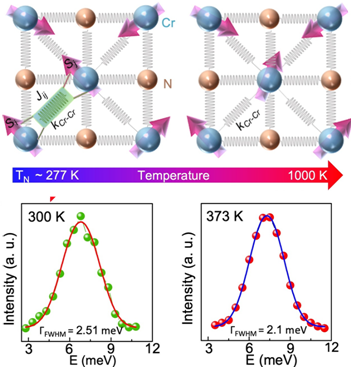
Fig: (Upper Panel) Evolution of dynamic spin-phonon coupling with temperature and its influence on acoustic phonon lifetime. (A) Schematic of coupled spin and phonon fluctuations near TN in paramagnetic CrN. At higher temperatures (T >> TN), spin fluctuations and spin-phonon coupling strength diminish. (Lower Panel) Temperature-dependent inelastic X-ray scattering spectrum at q = (0 0 0.18) of CrN highlighting the transverse acoustic (TA) phonon mode. Voigt function–fitted TA phonon mode of CrN at 300K and 373K are presented.
The researchers employed state-of-the-art temperature-dependent inelastic X-ray scattering techniques to directly measure phonon lifetimes in high-quality epitaxial CrN thin films across the magnetic phase transition. These measurements allowed the team to track how lattice vibrations interact with magnetic excitations as the material evolves from an ordered magnetic state to a disordered one.
The experiments revealed that acoustic phonons, which are the primary carriers of heat, experience strong damping near the Néel temperature due to intense interactions with magnetic spin fluctuations. Surprisingly, as the temperature increases further and long-range magnetic order weakens, phonon lifetimes increase anomalously. This leads to enhanced thermal conductivity at raised temperatures, contrary to conventional expectations. In contrast, optical phonons were found to follow standard temperature-dependent behaviour, clearly isolating the role of spin fluctuations in controlling heat transport.
These experimental observations are strongly supported by advanced atomistic spin-dynamics simulations and first-principles calculations, which together establish a clear microscopic mechanism linking magnetic fluctuations to anomalous heat conduction. The combined experimental and theoretical approach provides a comprehensive framework for understanding thermal transport in magnetically ordered materials.
“This work provides the first direct experimental evidence connecting spin fluctuations with enhanced thermal conductivity in magnetic semiconductors,” said Prof. Bivas Saha, who led the study. “By understanding how spin–lattice interactions influence heat flow, we can explore new strategies for thermal management in magnetic, spintronic, and quantum devices, where heat dissipation is a critical challenge.”
The findings have broad technological implications. Efficient heat management is essential for the reliable operation of high-power spintronic devices, magnetic memory elements, and future quantum technologies. The ability to tune thermal transport through magnetic degrees of freedom offers a fundamentally new approach to designing materials with controllable heat flow, potentially enabling devices that are both faster and more energy efficient.
The research was conducted through a collaborative effort involving JNCASR, IISER Thiruvananthapuram, Linköping University (Sweden), and major international synchrotron facilities, including SPring-8 (Japan) and DESY (Germany).
The study was recently published in the journal Science Advances, underscoring India’s growing leadership in cutting-edge materials research.
Publication link: 10.1126/sciadv.adw7332