Post budget webinar discusses ways to use budget announcements to strengthen India’s telescope ecosystem
Post budget webinar discusses ways to use budget announcements to strengthen India’s telescope ecosystem
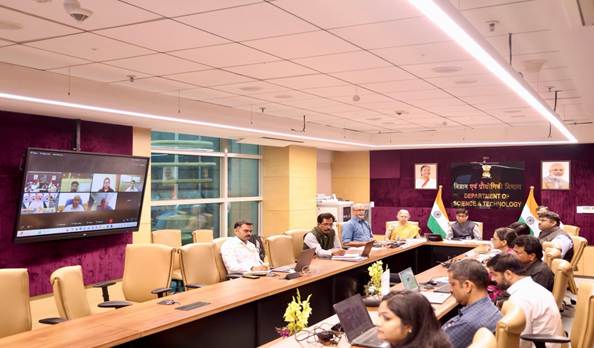
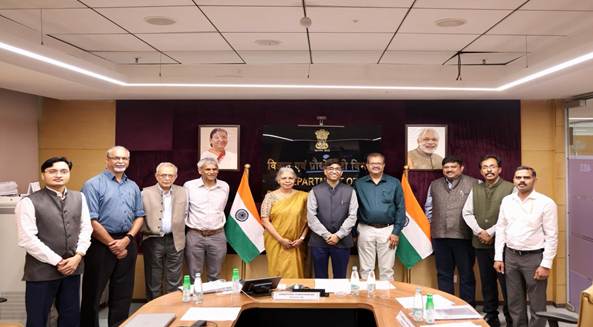
Experts discussed ways of strengthening telescope infrastructure and overcoming geographical, gender, and generational gaps in firming up capacity in astronomy and futuristic technologies at a breakout session on Telescope Infrastructure Facilities of the post budget webinar “Sabka Saath Sabka Vikas – Fulfilling Aspirations of People.”
Hon’ble Prime Minister Shri Narendra Modi addressed the inaugural session of the Post Budget Webinar 2026–27 underscoring expanding STEM opportunities for youth and women and stressed on the need to reach the remotest regions to build capacity for an innovation-driven India.
In line with this, astronomy experts from institutes across the country, deliberated on using the support in budget 2026-27 for telescope infrastructure facilities to reach out to institutes and universities in different regions to advance the next generation capacity in astronomy and futuristic technologies, at the session coordinated by the Ministry of Science & Technology.
In a major boost to mega-science facilities in the country, the budget of 2026-27 has announced four telescope infrastructure facilities to be set up or upgraded. These include the National Large Solar Telescope (NLST), the National Large Optical-Infrared Telescope (NLOT), the upgraded Himalayan Chandra Telescope (uHCT) and the COSMOS-2 Planetarium. The NLST will be built at Merak, Ladakh, while the NLOT and uHCT will be built at Hanle, Ladakh. COSMOS-2, the 2nd LED Dome planetarium to be built in India, will be constructed at Amaravathi.
Union Minister of State (Independent Charge) for Science & Technology, Earth Sciences, MoS PMO, Personnel, Public Grievances, Pensions, Atomic Energy and Space, Dr. Jitendra Singh, who addressed the concluding session highlighted the creation of advanced instrumentation and sophisticated research infrastructure facilities across the country under the leadership of Prime Minister Shri Narendra Modi and expressed confidence that the coming decades would be driven by transformative discoveries in astronomy and astrophysics enabled by large aperture telescopes.
DST Secretary Professor Abhay Karandikar in his introduction to the breakout session stressed that the discussions at the session could set the framework for effective and timely utilisation of the budget support to catapult the astronomy infrastructure and capacity of the country to the global level.
The session moderated by Prof. Annapurni Subramaniam Director, Indian Institute of Astrophysics (IIA), an autonomous Institution of the Department of Science and Technology (DST) also discussed consolidating the astronomy and mega-science ecosystem of the country, advancing indigenous technologies, and fostering collaboration between academia, industry, and research institutions.
Panelists included Prof. Jayaram Chengalur, director TIFR, Prof. A. N. Ramaprakash, scientist IUCAA, Dr. K. Sankarasubramanian, scientist ISRO, Mr. B. M. Raghavendra from Larsen & Toubro and Prof. Ajit Kembhavi, former director of IUCAA.
Discussions highlighted the importance of the budget announcements in strengthening India’s leadership in astronomy and astrophysics through mega-science projects, while also inspiring the next generation of astronomers and space scientists.