The Digital Blueprint for Ease of Doing Business
The Digital Blueprint for Ease of Doing Business
Key Takeaways
Introduction
India has fundamentally reimagined its economic landscape by positioning digital transformation as a vital engine for business growth. As part of its sustained commitment to improving Ease of Doing Business (EoDB), the Government has undertaken extensive reforms and initiatives to simplify regulations, enhance transparency, and strengthen institutional efficiency across sectors. From seamless business registration to a real-time payment system, India’s digital ecosystem ensures that organizations can navigate the entire business lifecycle, from entry to expansion, with unprecedented speed and ease. By harmonizing central and state-level reforms through integrated platforms, India offers a world-class gateway where data flows effortlessly across departments, reducing both time and cost of doing business.
The impact of these reforms is clearly reflected in India’s growing investment inflows and enterprise expansion. As the nation continues to strengthen its digital trade and logistics frameworks, it reinforces its status as a secure, efficient, and highly lucrative destination for industries.
Business Registration & Regulatory Framework
India’s advanced digital infrastructure makes business registration easy, fostering an environment that promotes ease of entry. By harmonizing central platforms with state-led reforms, India provides entrepreneurs and businessmen with an efficient, transparent, and reliable gateway to growth.
MCA21 Version 3
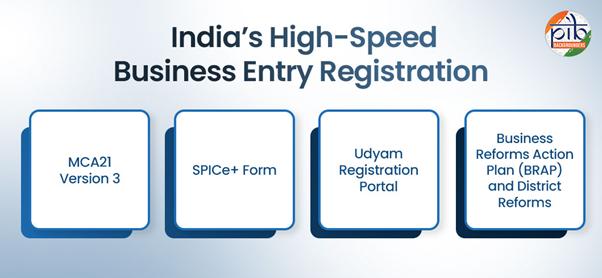
India’s corporate landscape is being revolutionized by the MCA21 Project, a forward-looking, AI-driven initiative that significantly enhances transparency and Ease of Doing Business. The platform is used for end-to-end registry and incorporation related services of Companies & LLPs since 2006. MCA21 Version 3 integrates advanced features like e-Scrutiny, e-adjudication and e-consultation, Compliance Management System and MCA Lab. Additionally, MCA21 V3 have a cognitive chat bot enabled helpdesk, mobile apps, interactive user dashboards, enhanced user experience using UI/UX technologies, and effortless data dissemination through APIs.
Application Programming Interface
API acts like a bridge that enables different systems to talk to each other and work together. It allows softwares to connect, access data or use functions such as searching information, retrieving details, submitting data, updating records, or triggering actions.
In the last five years (2021-2025), a total of approximately 3.84 crore filings have been made. And, the security and confidentiality of information submitted is ensured by adhering to ISO 27001 standards and multi-factor authentication to verify the identity of users accessing the system.
ISO 27001 standards
ISO 27001 provides organizations of all sizes and sectors with a framework to establish, implement, maintain, and continually improve an Information Security Management System (ISMS). Compliance with ISO 27001 demonstrates that an organization has implemented a robust system to manage data security risks in line with internationally recognized best practices and standards.
Additionally, a helpdesk mechanism to address grievances related to the MCA21 portal has been established. During the FY 2025-26 (up to 31st Jan 2026) 3,16,877 helpdesk tickets were raised on the portal of which about 98%, were successfully resolved.
Udyam Registration Portal
As of 12th February 2026, Udyam Portal has facilitated over 7.71 crore registrations and supported 33.97 crore jobs.
India’s Udyam Registration Portal epitomizes the Ease of Doing Business by offering a free, paperless, and self-declaration-based system for MSMEs (Micro, Small and Medium Enterprises). By efficiently integrating with CBDT (Central Board of Direct Taxes) and GSTN (GST Network) databases, it provides a fully digital, documentation-free experience that eliminates administrative hurdles.
Business Reforms Action Plan (BRAP) and District Reforms
Backed by a strong digital infrastructure, the Government has further strengthened EoDB reforms through the Business Reforms Action Plan (BRAP). BRAP was designed to compare regulatory requirements across States and encourage them to reduce compliance burdens and create a more business-friendly environment .
Since 2015, the Government has been implementing the BRAP to promote transparency, simplify regulatory procedures, and enhance service delivery across States and Union Territories. Till date, 7 editions of BRAP have been completed, and the eighth edition, BRAP 2026, was formally rolled out on 11 November 2025. To further deepen reforms at the grassroots, DPIIT has also launched the District Business Reform Action Plan (D-BRAP) to strengthen EoDB at the District Level. Following are some of the state specific achievements under BRAP:
Achievements of States under BRAP
Kerala
Uttar Pradesh
Tamil Nadu
Andhra Pradesh
Madhya Pradesh
SPICe+ Form
SPICe+ Form, an integrated web form, offers 11 services by 3 Central Govt Ministries & Departments and 3 State Governments (Maharashtra, Karnataka, West Bengal) and NCT – Delhi. The form saves many procedures, time and cost for starting a business in India. It has consolidated 10 essential procedures – including
This efficient system, featuring real-time data validation facilitates on-screen filing also for smooth incorporation of companies .
Integrated Clearance & Environmental Approvals
India has transformed its administrative framework by digitizing approvals at both central and state levels. Through unified single-window portals, businesses can navigate the regulatory journey electronically, ensuring unmatched transparency and operational speed.
National Single Window System (NSWS)
The NSWS is a digital platform which guides in identifying and applying for approvals according to the business requirements. It has emerged as a key reform initiative to streamline business approvals by reducing approval timelines, securing document repository and fast query management through a single digital gateway. It integrates approval processes across 32 Central Departments and 32 State Governments, and has access over 698 central and 7435 state approvals. NSWS has granted over 8,29,750 approvals, since its launch.
The Government has also launched other single-window digital platforms that increase transparency, reduces cost and simplify compliance.
Other Single Window Digital Platforms
PARIVESH (Pro-Active and Responsive facilitation by Interactive, Virtuous, and Environmental Single Window Hub) 3.0
For environmental clearances and post-approval compliance monitoring.
It integrates baseline data, afforestation land banks, inter-ministerial dashboards, and AI-enabled support to enhance transparency, predictability, and efficiency.
e-Gram SWARAJ portal
Provides a single window with the complete Profile of the GP, including details of Sarpanch/Secretary, demography, finances, assets along with activities taken up through the Gram Panchayat Development Plan (GPDP).
Serving as a unified reporting and tracking platform, it strengthens decentralised planning and improves the effectiveness of development fund utilisation.
Taxation, Customs & Trade Facilitation
India’s digitized fiscal and trade infrastructure boosts business competitiveness by facilitating smoother goods movement and more efficient tax compliance. By transitioning approvals and tracking systems to high-speed digital gateways, the traditional bottlenecks have been removed leading to a transparent trade environment.
GST Network (GSTN)
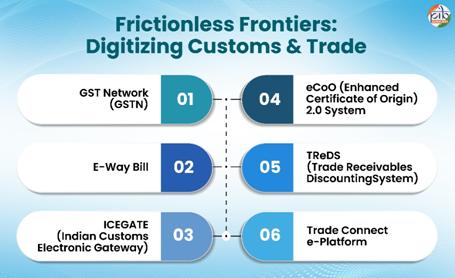
GST (Goods and Service Tax) is the nation’s largest ever indirect tax reform, which unified a diverse tax landscape into a single, streamlined system. Supported by its digital backbone, GSTN platform provides a synchronised interface for over a crore of taxpayers, ensuring effortless B2B electronic invoicing. It handled the processing of over ₹102.91 lakh crore payments through the portal as of January 2026. This automated ecosystem fosters a transparent and efficient fiscal framework.
E-Way Bill
The E-Way Bill system has revolutionized logistics in India by replacing multiple state-level permits with a single, electronic document for the movement of goods. This reform has facilitated the removal of static border check posts, significantly reduced transport time and improved tax compliance,. E-way bill volumes grew by 21% year-on-year during April- December 2025 which indicates robust transaction momentum under GST.
ICEGATE (Indian Customs Electronic Gateway)
ICEGATE serves as a centralized hub for all electronic interactions between Indian customs and the trading community. It offers a range of services including e-filing, online amendment submission, online duty payment, query resolution, and Integrated Goods and Services Tax (IGST) refund processing for traders. The gateway significantly enhances the ease of doing business by streamlining customs procedures and promoting transparency in cross-border trade.
eCoO (Enhanced Certificate of Origin) 2.0 System
The eCoO 2.0 System is a digital upgrade that significantly enhances the Ease of Doing Business by simplifying the certification process for exporters and trade efficiency. With user-friendly features like multi-user access under a single IEC, Aadhaar-based e-signing, and an integrated dashboard for Free Trade Agreement (FTA) resources, the platform ensures continuous trade efficiency. By allowing easy online applications for “in-lieu” Certificate of Origin, the system provides a highly flexible and transparent environment.
TReDS (Trade Receivables Discounting System)
TReDS is an electronic platform that facilitates financing / discounting of trade receivables of MSMEs through multiple financiers. These receivables can be due from corporates and other buyers, including Government Departments and Public Sector Undertakings (PSUs).
TReDS in Union Budget 2026-27
To enhance MSME liquidity, the Union Budget 2026-27 proposed mandating TReDS for Central Public Sector Enterprises’s transaction settlements and introducing a credit guarantee mechanism for invoice discounting. Furthermore, linking GeM with TReDS facilitates quicker financing, while introducing TReDS receivables as asset-backed securities which will help develop a secondary market for enhanced transaction settlement.
Trade Connect e-Platform
Trade Connect e-Platform provides comprehensive international trade information and services to all exporters, including MSMEs, enabling them easy access to global markets. It enables directs connections between global buyers and Indian exporters with the help of Indian missions abroad. It is a single engagement channel for exporters to engage with government agencies and demystifies international trade through digital learning, information and trade intelligence on an integrated platform. Currently, it has over 19.25 lakhs registered users with more than 28 lakhs certificate of origin issued (as on 12 February, 2026).
Logistics & Market Access
India’s advanced digital infrastructure strengthens the business environment through integrated logistics coordination and expansive electronic market access. These centralized platforms ensure transparent end-to-end solutions and efficient supply chains, reinforcing the nation’s commitment to superior Ease of Doing Business.
PM GatiShakti National Master Plan
Launched in October 2021, the PM GatiShakti National Master Plan is a transformative initiative for integrated infrastructure planning and multimodal connectivity. It brings together 57 Central Ministries and all States and Union Territories on a unified digital platform with over 1,700 data layers to enable coordinated, data-driven project planning and execution of infrastructure projects.
The PM GatiShakti Public and Unified Geospatial Interface provides 230 curated datasets to private stakeholders, supporting more informed investment decisions and logistics planning strategies. So far, 27 States have notified State Logistics Policies, and 28 Aspirational Districts are using the District Master Plan Module, with expansion to all 112 Aspirational Districts in the near future.
PM GatiShakti institutionalises coordinated planning through the Network Planning Group (NPG), ensuring multimodal integration and last-mile connectivity at the project stage. As of February 2026, the NPG has evaluated 352 projects worth ₹16.10 lakh crore; 201 have been sanctioned, out of which 167 are under implementation.
By enabling a holistic assessment of transport corridors, logistics nodes, and economic zones, the Plan reduces project delays, prevents duplication of assets, strengthens multimodal freight movement across the country, and enhances Ease of Doing Business.[46]
National Logistics Portal (Marine)
The National Logistics Portal (Marine) is a maritime single-window platform that significantly bolsters the ease of doing business by providing end-to-end logistics solutions for exporters, importers, and service providers. This “open platform” aligns with global standards, integrating G2G, G2B, and B2B models to facilitate the well-connected exchange of documents and real-time tracking of vessel terminal gate, and container freight station (CFS) gate transactions. By enabling digital payments for CFS and shipping charges through a single-window certification device, India is strengthening digital entrepreneurship. This integrated digital platform creates a robust ecosystem where multiple value-added services and innovative solutions can seamlessly build and operate.
Logistics Data Bank (LDB 2.0)
LDB 2.0 is a significant step towards India’s journey of a digitally empowered economy. This enhanced platform provides critical real-time tracking and multi-modal visibility across road, rail, and sea using container, truck, or trailer numbers, as well as railway FNRs through integration with Unified Logistics Interface Platform (ULIP) APIs. This significantly strengthens the country’s digital trade infrastructure.
By introducing high-seas container tracking and a live container heatmap to identify bottlenecks, LDB 2.0 fosters a transparent, data-driven ecosystem that reduces costs and improves supply chain management. These advancements directly promote the EoDB, making India’s logistics more efficient, and credible.
GeM (Government e-Marketplace)
GeM has grown into a digital procurement system connecting sellers and service providers across the country, including women entrepreneurs, startups, micro and small enterprises (MSEs), artisans, self-help groups (SHGs) and Divyangjans. GeM has recorded notable achievements, with 4 lakh crore+ order value in FY26 (till 12 February, 2026) and an order volume of 60 lakh+. From December 2021 to November 2025, the module has facilitated auctions worth ₹2,200+ crore, conducted over 13,000 auctions, welcomed 23,000+ registered bidders, and enabled participation from more than 17,000 auctioneers.
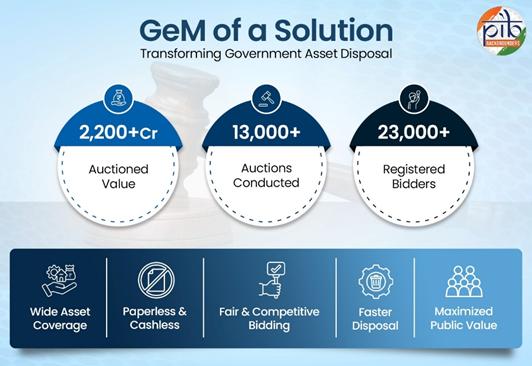
The platform has implemented technology-driven procurement processes for faster and more cost-effective transactions, expanded into new service verticals such as insurance, manpower and Mine Development & Operations (MDOs).
ONDC (Open Network for Digital Commerce)
ONDC is an initiative aiming at promoting open networks for all aspects of exchange of goods and services over digital or electronic networks. It envisions creating a level playing field for sellers, buyers, and service providers across India, particularly small and medium enterprises (MSMEs). By fostering open protocols and reducing dependency on monopolistic platforms, ONDC aims to catalyze innovation and inclusivity in the digital commerce landscape and thereby promotes ease of doing business. The sellers and service providers are spread across 616+ cities expanding the geographical coverage of the ONDC network.
Digital Public Infrastructure
The Digital Public Infrastructure (DPI) in India enables secure and co-ordinated interactions between people, businesses and governments.This integrated ecosystem dramatically reduces operational friction and enhances the Ease of Doing Business through instant, secure, and transparent digital interactions.
UPI (Unified Payments Interface)
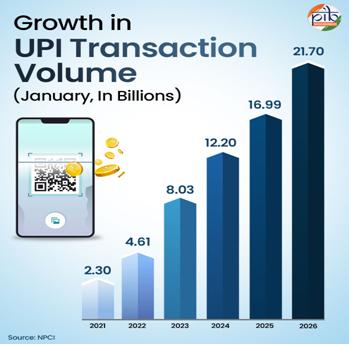
UPI is a real-time payment system that enables instant money transfers between bank accounts through a mobile application. UPI brings multiple bank accounts into a single app and supports various features such as fund transfers, merchant payments, and peer-peer payment requests, making digital transactions quick and convenient. It promotes ease of doing business with safe and quick payments, ensuring privacy and provides QR code convenience. The system connects 691 banks on a single platform allowing people to make payments easily without worrying about which bank they use. In January 2026 alone it handled 21.70 billion transaction amounting to ₹ 28.33 lakh crore. UPI with other public digital infrastructure has reduced transaction and compliance costs.
International Recognition of UPI
cKYC (Central Know Your Customer) Registry
cKYC Registry is a centralized repository of KYC records of customers in the financial sector with uniform KYC norms and inter-usability of the KYC records across the sector. The objective is to reduce the burden of producing KYC documents and getting those verified every time when the customer creates a new relationship with a financial entity.
Entity Locker
EntityLocker is a flagship initiative designed to empower organizations by providing a secure, cloud-based platform for storing, sharing, and verifying digital documents and certificates. Aligned with the goals of digital transformation, EntityLocker offers a ‘Digital Empowerment’ solution that grants organizations access to authentic digital documents through their digital document wallet. This platform ensures safe, efficient, and streamlined document management for businesses and institutions.
API Setu
The API Setu is a unified digital platform that enables government departments, private organizations, startups, and developers to discover, access, and integrate APIs with ease. It empowers developers with everything they need to build, share, and integrate APIs. It enables swift, transparent, safe and reliable information sharing across applications and promote innovation. It facilitates business friendly environment by promoting innovation through the availability of data from e-Governance applications and systems to the industry and public.
Conclusion
India’s digital reforms have fundamentally transformed the business environment, making approvals, registration, and trade processes seamless and efficient. Enhanced transparency, faster compliance, and real-time data flow have strengthened organisations’ confidence and operational ease. Robust digital infrastructure is fostering innovation, reducing costs, and enabling smooth interactions between businesses, citizens, and government. These initiatives collectively position India as a secure, efficient, and highly attractive destination for enterprise setup and growth.
References
Ministry of Corporate Affairs
https://www.mca.gov.in/content/mca/global/en/ease-of-doing-business/features.html
https://www.pib.gov.in/Pressreleaseshare.aspx?PRID=1604176®=3&lang=2
https://www.pib.gov.in/PressReleasePage.aspx?PRID=1695473®=3&lang=2
https://www.pib.gov.in/PressReleasePage.aspx?PRID=2099226®=3&lang=2
https://www.pib.gov.in/PressReleseDetailm.aspx?PRID=2226017®=3&lang=2
Ministry of Micro, Small & Medium Enterprises
https://www.pib.gov.in/PressReleasePage.aspx?PRID=1847452®=3&lang=2
https://dashboard.msme.gov.in/
https://udyamregistration.gov.in/Government-India/Ministry-MSME-registration.htm
Ministry of Commerce & Industry
https://www.pib.gov.in/PressReleasePage.aspx?PRID=2204665®=1&lang=1
https://www.pib.gov.in/PressReleasePage.aspx?PRID=2096786®=3&lang=2
https://www.trade.gov.in/pages/about-trade-connect-eplatform
https://www.pib.gov.in/PressReleasePage.aspx?PRID=2168993®=3&lang=2
https://www.pib.gov.in/PressReleasePage.aspx?PRID=2154136®=3&lang=2
https://www.pib.gov.in/PressReleaseIframePage.aspx?PRID=2090097®=3&lang=2
https://sansad.in/getFile/loksabhaquestions/annex/185/AU2676_JjlKis.pdf?source=pqals&utm_
https://www.pib.gov.in/PressReleasePage.aspx?PRID=2225805&lang=2®=3
https://www.pib.gov.in/PressReleasePage.aspx?PRID=2152521®=3&lang=2
Ministry of Finance
https://www.indiabudget.gov.in/economicsurvey/doc/echapter.pdf
https://www.icegate.gov.in/about-us/icegate
https://www.npci.org.in/product/upi/product-statistics
https://www.pib.gov.in/PressReleasePage.aspx?PRID=2200569®=3&lang=1
https://www.ckycindia.in/ckyc/index.php
Ministry of Electronics & IT
https://entity.digilocker.gov.in/
https://www.pib.gov.in/PressReleasePage.aspx?PRID=2224505®=3&lang=2
https://apisetu.gov.in/aboutus
Ministry of Ports, Shipping and Waterways
https://nlpmarine.gov.in/landings/about-new
Sansad.in
https://sansad.in/getFile/loksabhaquestions/annex/185/AU2676_JjlKis.pdf?source=pqals&utm_
Government of UP
https://invest.up.gov.in/uttar-pradesh-braps-top-achiever-in-2024/?utm_
Government of MP
https://sws.invest.mp.gov.in/advantages-of-mp/ease-of-doing-business
GST Network
Reserve Bank of India
https://www.rbi.org.in/commonman/English/scripts/FAQs.aspx?Id=3138
https://www.pib.gov.in/PressReleasePage.aspx?PRID=2221434®=3&lang=2
UNDP
https://www.undp.org/digital/digital-public-infrastructure
ISO.ORG
https://www.iso.org/standard/27001
PIB Headquarters
https://www.pib.gov.in/PressNoteDetails.aspx?NoteId=154772&ModuleId=3®=3&lang=2
https://www.pib.gov.in/PressNoteDetails.aspx?NoteId=156611&ModuleId=3®=3&lang=1
https://www.pib.gov.in/PressNoteDetails.aspx?NoteId=154912&ModuleId=3®=3&lang=2