Bridging Digital Divide
Bridging Digital Divide
Introduction
India’s digital transformation represents one of the largest population-scale expansions of connectivity and technology-enabled public service delivery globally. Anchored in the Digital India programme, launched in 2015, the country’s strategy has focused on building digital infrastructure as a core utility for every citizen, bridging the digital divide, delivering governance and services on demand, and empowering people through digital access.
A decade ago, the digital divide in India was visible and stark. High-speed internet was largely urban, rural connectivity was limited, and access to online services depended on location, income, and digital literacy. Over the years, sustained public investment has expanded broadband networks and transitioned toward extensive optical fibre infrastructure, improving both the reach and quality of connectivity across villages and remote regions.
Today, the divide is rapidly narrowing. Affordable data, assisted digital access points, and interoperable public platforms are enabling citizens to access welfare schemes, make digital payments, pursue online education, and participate in governance. What began as a connectivity mission has evolved into a broader empowerment journey—bringing more Indians into the digital mainstream with each passing year.
Building India’s Digital Infrastructure
India’s digital backbone is the foundation of its effort to bridge the digital divide at population scale. It operates through three interlinked pillars: Universal connectivity infrastructure, Digital Public Infrastructure (DPI), and Computing capacity. Together, these pillars ensure that access, services, and technological capability evolve in tandem. This integrated approach enables connectivity to translate into meaningful participation in the digital economy.
Universal Digital Connectivity & Affordable Access
Universal Digital Connectivity & Affordability is the cornerstone of India’s digital revolution, powering inclusive growth, better governance, economic opportunities, and social empowerment for every citizen.
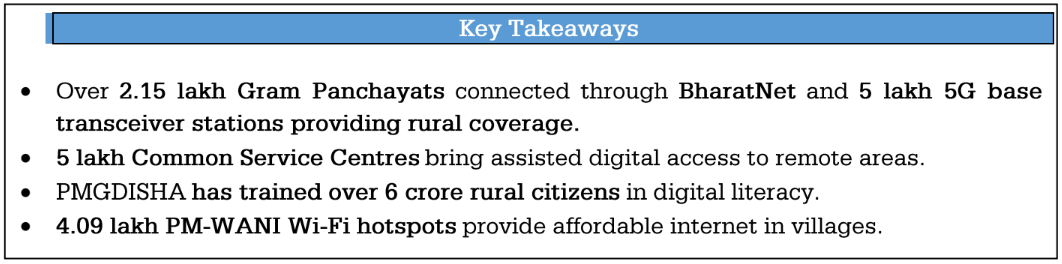
At its heart lies massive optical fibre expansion under BharatNet (launched 2011), which extends high-speed internet to rural India. As of early 2026, over 2.15 lakh Gram Panchayats are connected, with optical fibre cable deployment extended from 19.35 lakh route km in 2019 to 42.36 lakh route km in 2025 nationwide, building a strong backbone that bridges the urban-rural gap and brings reliable connectivity to remote areas.
Complementing fibre, India’s lightning-fast 5G rollout now covers 99.9% of districts with over 5.18 lakh Base Transceiver Stations (as of December 2025), delivering ultra-fast mobile broadband everywhere. Backed by the Telecommunications Act 2023 for faster infrastructure approvals, indigenous 4G/5G tech, and the National Broadband Mission, these efforts turn connectivity from a luxury into an essential right.
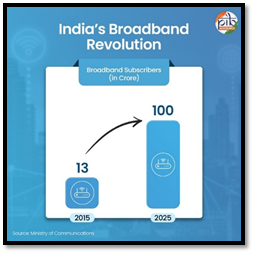
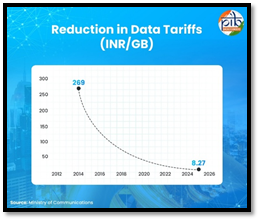
Affordability has been a game-changer: data costs have plummeted from ₹269 per GB in 2014 to roughly ₹8-10 per GB (about $0.10) in 2025-2026, making India one of the world’s cheapest data markets. This drastic reduction has fuelled explosive growth, broadband subscriptions crossed 1 billion (over 100 crore) in November 2025, a more than sixfold jump from 13.15 crore a decade earlier.
Altogether such reforms are empowering rural communities, farmers, students, entrepreneurs, and marginalized groups to fully join India’s thriving digital economy and systematically narrowing access gaps and integrating rural and marginalized communities into India’s digital economy.
Digital Public Infrastructure (DPI): Enabling Inclusive Services
 As digital connectivity reaches population scale, Digital Public Infrastructure (DPI) ensures that internet access translates into reliable, interoperable, and citizen-centric services—turning basic connectivity into real empowerment for governance, finance, and daily life. India’s fundamental DPI ecosystem provides foundational layers like universal digital identity, seamless payments, and secure document access, directly bridging the digital divide by making services inclusive for rural, low-income, and marginalized communities.
Aadhaar has issued over 143 crore unique digital IDs (as of February 2026), enabling targeted welfare delivery, direct benefit transfers, and easy access to government and financial services—even for those previously excluded due to lack of formal ID.
 Unified Payments Interface (UPI) handles nearly ₹28.33 lakh crore in monthly transactions (January 2026 data, with 21.7 billion transactions), delivering affordable, real-time digital payments nationwide, fuelling financial inclusion across urban-rural and income divides through zero-cost transfers via mobile phones.
 DigiLocker boasts over 62 crore registered users (as of February 2026), offering secure, paperless storage and sharing of official documents in sectors like health, education, agriculture, and welfare—eliminating paperwork barriers and empowering citizens with instant, trusted access anywhere.
Together, these DPI pillars transform mere internet access into tangible social and economic outcomes ensuring seamless service delivery, deeper financial inclusion, and trusted digital interactions that systematically narrow access gaps and integrate every Indian into the digital economy.
High-Performance Computing (HPC) and Cloud Infrastructure
 High-Performance Computing (HPC) and data centres are key enablers of India’s digital transformation, moving the country from basic connectivity to innovation-led inclusion. Under the National Supercomputing Mission (NSM)—jointly led by MeitY and the Department of Science & Technology—38 supercomputers with a combined capacity of 44 Petaflops have been deployed across institutions nationwide. By extending advanced computing infrastructure beyond metropolitan hubs, HPC ensures equitable access to world-class resources for universities, startups, researchers, and industry, supporting AI, climate modelling, biotechnology, and advanced manufacturing.
 Complementing HPC, India’s cloud and data centre ecosystem is also expanding rapidly to support digital governance and AI-ready infrastructure. Through MeghRaj (GI Cloud), over 2,170 Ministries and Departments are hosting applications on secure, scalable government cloud platforms. With a total data centre capacity of ~1,280 MW, it is projected to grow 4–5 times by 2030. India is aligning its digital infrastructure with global benchmarks, ensuring that high-end computing resources contribute directly to bridging the digital divide and enabling inclusive access to advanced technologies.
India’s investments in digital infrastructure, interoperable platforms, and high-performance computing are creating tangible impact—enhancing service delivery, financial inclusion, research capabilities, and innovation opportunities. By focusing on measurable outcomes and equitable access, the country is turning connectivity into capability, ensuring that digital growth benefits all citizens, including those in rural and marginalized communities.
Creating an Inclusive Digital Ecosystem for Bharat
India’s digital transformation is not only about expanding connectivity, but about ensuring that every citizen can participate meaningfully in the digital economy. Building an inclusive digital ecosystem requires more than infrastructure. It calls for local service access points, widespread digital literacy, affordable internet, advanced skilling, and opportunities for innovation and entrepreneurship.
By combining last-mile delivery with capability building and market linkages, these initiatives are turning digital access into real social and economic empowerment across rural and urban India.
Digital Literacy: Building Skills and Opportunities
India has positioned itself as a global leader in leveraging digital technologies for inclusive governance and citizen empowerment. Recognizing digital literacy as essential for equitable growth, the Government has focused on rural populations. Early efforts through the National Digital Literacy Mission (NDLM) or Digital Saksharta Abhiyan (DISHA) (2014–2016) trained 53.67 lakh beneficiaries against a 52.50 lakh target, with nearly 42% from rural areas. Building on this success, the Pradhan Mantri Gramin Digital  Saksharta Abhiyan (PMGDISHA), approved in 2017 aimed to digitally empower 6 crore rural households (one person per household). As of March 2024, it achieved a remarkable 6.39 crore trained individuals, creating one of the world’s largest rural digital literacy programmes and expanding access to online services and financial inclusion.
This foundation has been strengthened at the institutional level through, the National Mission on Education through ICT (NMEICT) launched 2009 has bridged gaps in higher education by expanding broadband connectivity, virtual labs, and digital resources ensuring even remote campuses match premier institutions in quality and access. The National Education Policy (NEP) 2020 is further accelerating this progress by mainstreaming digital literacy across school and higher education, integrating blended learning, digital libraries, AI-enabled tools, and teacher training to create a truly equitable and future-ready education system.
Under the NEP, national platforms like DIKSHA (Digital Infrastructure for Knowledge Sharing) and SWAYAM (Study Webs of Active-Learning for Young Aspiring Minds) are democratising access to quality education across school and higher education through large-scale digital courses and certifications. Extending this inclusion from access to opportunity, the Innovation in Science Pursuit for Inspired Research (INSPIRE) Awards – Million Minds Augmenting National Aspirations and Knowledge (MANAK) programme nurtures grassroots STEM innovation among Classes 6–10, with strong participation from girls and students belonging to SC, ST and OBC communities. Together, these initiatives move beyond connectivity to capability—ensuring that digital learning translates into equitable representation, innovation, and future-ready skills.
Inclusive Digital Learning: Schools to Higher Education
Additionally, India’s digital transformation is also rights-based and accessible. The Rights of Persons with Disabilities Act, 2016 mandates ICT accessibility, while the Unique Disability ID (UDID) scheme has generated 1,34,73,833 digital disability cards (8,906,328 male; 4,565,166 females; 2,338 others), streamlining access to welfare benefits nationwide. Complementing this, the Indian Sign Language Research and Training Centre has developed the world’s largest Indian Sign Language digital repository with 3,189 e-content videos, including 100 STEM terms and 18 National Book Trust titles in ISL format expanding accessible education and ensuring digital inclusion remains rights-based and data-driven.
India’s comprehensive digital literacy ecosystem, spanning from PMGDISHA, DIKSHA and SWAYAM to INSPIRE-MANAK’s grassroots STEM empowerment and rights-based accessibility for persons with disabilities, has transformed connectivity into real capability, opportunity and inclusion. By prioritizing rural areas, girls, marginalized communities, and underserved groups, these initiatives are effectively bridging the digital divide and equipping every Indian with the skills, access, and confidence to thrive in a digital-first economy. This people-centric approach positions Bharat as a global model of equitable, inclusive digital transformation where no one is left behind.
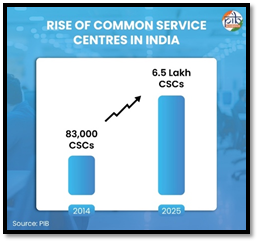
Under the Digital India programme, CSCs function as assisted digital access points that bridge the digital divide in rural and remote areas by delivering public services at the last mile. Operated by over 6.5 lakh Village Level Entrepreneurs (VLEs), CSCs serve as a vital physical–digital interface for citizens who lack devices, reliable connectivity, or adequate digital literacy, enabling inclusive access to essential online services. By embedding digital platforms within village-level institutions—including cooperative societies—CSCs systematically reduce access barriers, deepen financial inclusion, and generate digitally enabled livelihoods, thereby converting connectivity into tangible socio-economic empowerment at the grassroots level.
Digital Inclusion Enabling Rural Economic Integration
PM-WANI: Affordable Wi-Fi for India
 PM-WANI (Prime Minister Wi-Fi Access Network Interface) was launched in December 2020 to provide affordable, high-speed public internet connectivity, particularly in rural and remote areas. The scheme promotes a decentralised, licence-free public Wi-Fi model through Public Data Offices (PDOs), encouraging local entrepreneurship while widening broadband reach. As of February 2026, 4,09,111 Wi-Fi hotspots have been deployed nationwide, supported by 207 PDO Aggregators and 113 App Providers. By enabling low-cost internet access through locally operated Wi-Fi Access Points, PM-WANI plays a vital role in bridging the digital divide and ensuring inclusive participation in India’s digital economy. Integrating last-mile access, literacy programs, and affordable internet with platforms connecting markets and social schemes strengthens rural livelihoods, ensures timely benefit delivery, and fosters inclusive participation in India’s digital economy.
Digital Skilling for Future-Ready Bharat
The Government of India is transforming digital inclusion from mere access to advanced capability building, ensuring equitable opportunities for all citizens. Through integrated skilling, innovation, and  entrepreneurship initiatives, India is empowering its youth to innovate, create jobs, and drive economic growth across urban and rural India.
The Atal Innovation Mission (AIM) has established over 10,000 Atal Tinkering Labs (ATLs) across 722 districts, engaging 1.1 crore students, with an additional 50,000 ATLs planned as of December 2025. Students have developed 16 lakh+ innovation projects, gaining hands-on experience in robotics, AI, and IoT, laying the foundation for a tech-savvy generation.
FutureSkills Prime, led by MeitY and NASSCOM, has registered 29 lakh candidates, with 17.9 lakh enrolments and over 7 lakh unique badge holders, including 41% women. Ranked 3rd globally in the European Commission’s Pact for Skills Report 2024, the programme equips learners with industry-relevant skills in AI, cloud computing, cybersecurity, and data analytics.
 The IndiaAI Mission, with an outlay of ₹10,300 crore, has operationalised 38,000 GPUs (with 20,000 more planned) and offers subsidised compute at ₹65 per hour. The IndiaAI Kosh hosts 9,500+ datasets and 273 AI models across 20 sectors, supporting startups, researchers, and innovators nationwide.
 Under Startup India, recognised startups have grown from 400 in 2016 to over 2 lakh in 2025, generating 21 lakh jobs. 50% of startups now operate in Tier-II and Tier-III cities, decentralising innovation and enabling local economic growth. The NIDHI programme and Atal Incubation Centres (AICs) further support early-stage ventures and inclusive entrepreneurship. Recent expansions include 8 new Inclusive TBIs (iTBIs) and 10 Entrepreneur-in-Residence Centres, while 72 AICs have nurtured 3,500+ startups, created 32,000+ jobs, and supported 1,000+ women-led ventures, backed by 6,200+ Mentors of Change.
Collectively, these powerhouse initiatives prove that India’s digital inclusion extends far beyond devices and data—it’s about forging capabilities, sparking opportunities, and delivering growth to every village and town. By weaving connectivity with skilling, platforms, and startup support, India is crafting an unbreakable, inclusive digital ecosystem that propels broad-based progress and positions the nation as a global beacon of equitable innovation.
Conclusion
India’s decade-long digital transformation has fundamentally reshaped access to technology, governance, education, and economic opportunities. Through a combination of universal connectivity, robust digital public infrastructure, and advanced computing capacity, citizens across urban, rural, and remote areas are now better positioned to participate in the country’s digital economy. Programs such as CSCs, PMGDISHA, PM-WANI, and targeted interventions for SC/ST communities and women in STEM have translated connectivity into tangible socio-economic outcomes, empowering individuals and strengthening local innovation ecosystems.
Equally significant is the focus on youth, startups, and deep-tech sectors, which ensures that digital inclusion goes beyond access to create pathways for skills, entrepreneurship, and high-value employment. By integrating education, skilling, innovation, and entrepreneurship across diverse geographies, India is not only bridging the digital divide but also fostering inclusive growth, equitable opportunities, and a resilient knowledge economy. This multi-layered approach sets the foundation for sustained empowerment in the digital age, leaving no citizen behind.
References
Press Information Bureau
Others