Key Interventions for Women’s Economic Advancement
Key Interventions for Women’s Economic Advancement
India’s Journey Towards Women’s Financial Empowerment
Empowering women builds resilient families, thriving communities, and a prosperous nation. Recognising this, India’s landscape for women’s economic independence has undergone a remarkable transformation in the last 10 years. Guided by a women-centric vision, the government has prioritised expanding access to skills, credit, markets, and livelihoods, with special focus on rural and underserved women. The goal is a fully developed—Viksit Bharat—by 2047, where every woman stands as an equal architect of progress.
Driving this vision forward, the Government of India is working through a comprehensive portfolio of schemes—from self-help groups (SHGs) and targeted credit to drone technology and entrepreneurship platforms. It has also invested in digital tools for financial inclusion and cooperative networks. These advancements are positioning India as a global model for women’s economic leadership.
“Nari Shakti” – women’s power – is the guiding force, ensuring inclusive growth where no woman is left behind.
Ensuring Financial Security for Girls
Ensuring financial security for girls implies right investment in their education, health, and access to economic opportunities so they can build independent and dignified lives. It strengthens not only individual futures but also families, communities, and the nation as a whole.
Sukanya Samriddhi Yojana delivers exactly that promise: high returns, tax advantages, and unwavering support for every family investing in their daughter’s bright future.
Sukanya Samriddhi Yojana
Launched on 22ndJanuary 2015 under the Beti Bachao, Beti Padhao campaign, the Sukanya Samriddhi Yojana (SSY) provides financial security to a girl child. It is a government savings scheme that helps parents and guardians save money for their girls’ future needs, mainly education and marriage. The scheme gives high interest rates, tax benefits, and security, encouraging families to invest early and support girls’ growth and independence.
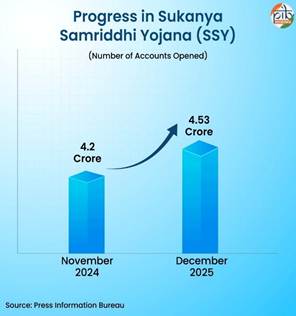
Key features and benefits include:
Since its inception, total deposits have exceeded ₹3.33 lakh crore (as on December 2025).
Revolutionising Rural Livelihoods, Leveraging Technology
Rural India is witnessing a remarkable transformation, where community strength, skill-building, and access to resources are unlocking new opportunities for millions of families. Through visionary, tech-based, people-centric initiatives, the Government of India is enabling rural households—especially women—to become confident entrepreneurs, skilled producers, and active contributors to a thriving economy.
DeenDayal Antyodaya Yojana – National Rural Livelihoods Mission (DAY-NRLM)
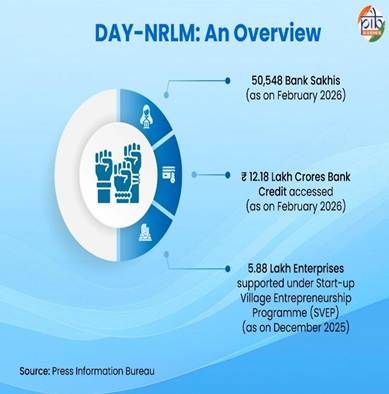
Deendayal Antyodaya Yojana – National Rural Livelihoods Mission (DAY-NRLM) is a Ministry of Rural Development flagship program. The programme brings rural women together into Self-Help Groups (SHGs), creating a strong sense of community and mutual trust. Through these Self-Help Groups, women and their families gain access to skill training, affordable credit, and hands-on support to launch small enterprises, shift to higher-income opportunities, or scale up their existing livelihoods.
Over time, this steady support helps them earn more, save for the future, send children to school, and build stronger, more secure lives for their families.
For women, in particular, it helps build sustainable livelihoods through financial inclusion and skill training to help them stride confidently toward economic self-reliance.
Some of its key features are:
Major achievements include:
NaMo Drone Didi Yojana
The NaMo Drone Didi scheme is a transformative Central Sector initiative. It empowers rural women by equipping selected Women Self-Help Groups (SHGs) with drones to provide rental services for precision agriculture—primarily spraying liquid fertilisers and pesticides—while introducing advanced technology to farming and creating sustainable income opportunities.
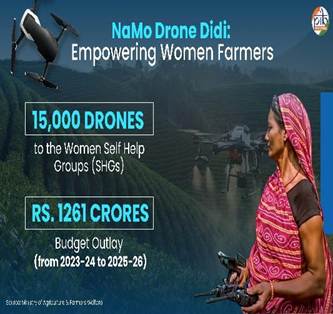
Key benefits include:
Selected SHGs receive 80% Central Financial Assistance (up to ₹8 lakh) toward the drone package. The package also includes training: 15 days for one member to become a certified drone pilot (covering operations and agriculture-specific applications) and 5 days for another as a drone assistant (focusing on repairs, maintenance, and support).
By putting drones in the hands of rural women, the scheme not only accelerates technology adoption in agriculture but also opens new economic pathways. This makes work faster and more productive while creating brighter opportunities for women and their communities.
Transforming Women into Successful Entrepreneurs
When women rise as entrepreneurs, entire family finds stability and opportunity. Keeping this in mind, the Government of India has launched many initiatives to push entrepreneurship among women.
Lakhpati Didi Scheme
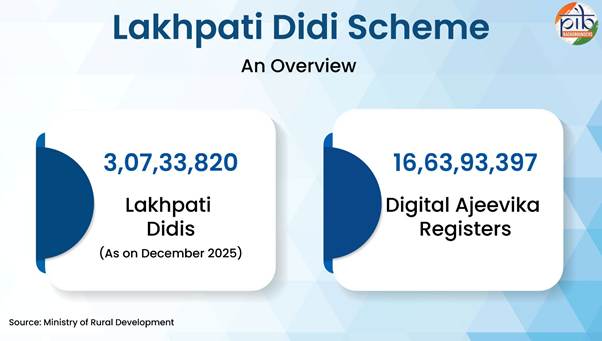
Lakhpati Didi is a flagship outcome of the Deendayal Antyodaya Yojana – National Rural Livelihoods Mission (DAY-NRLM), which strives towards rural poverty alleviation and women’s economic empowerment.
Rooted in the vision of rural prosperity led by women, a Lakhpati Didi is a Self-Help Group (SHG) member whose household earns over ₹1 lakh annually, through sustainable livelihood activities, strengthened skills, and improved access to credit and markets—signifying financial stability, confidence, and community leadership.
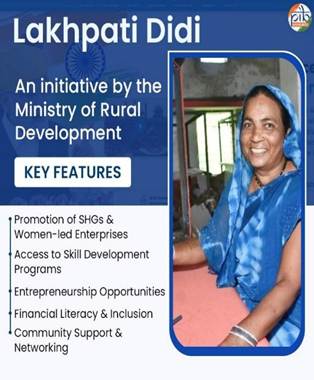
The objective extends beyond mere income generation to fostering entrepreneurship, financial literacy, and positioning women as catalysts for rural economic transformation.
The government has a target to create 6 crore Lakhpati Didis. To fast-track this goal, the Ministry of Rural Development launched a National Campaign on Entrepreneurship in January 2026, aiming to train 50 lakh SHG members through 50,000 Community Resource Persons.
Technologically, the LokOS app and Digital Aajeevika Register, managed by Digital India Corporation, digitise records and track real-time income data of potential Lakhpati Didis.
SHE-Mart
The Union Budget 2026-2027 has introduced provisions for Self-Help Entrepreneurs via SHE-Mart. This new program will establish community-owned retail outlets in every district, serving as dedicated platforms for marketing products created by women from Self-Help Groups (SHGs) and rural areas, thereby opening up fresh market opportunities.
With this initiative, women involved in animal husbandry, agriculture, and related vocations will transition beyond mere subsistence-level activities to become full-fledged entrepreneurs—a central goal of the scheme.
Womaniya Initiative
The Womaniya Initiative, a flagship programme of the Government e-Marketplace (GeM) under the Ministry of Commerce and Industry, was launched on 14 January 2019 to boost the participation of women-led Micro and Small Enterprises (MSEs) and Self-Help Groups (SHGs) in public procurement.

To support this, GeM has forged key partnerships through MoUs:
Most recently, on 14–15 January 2026, GeM signed an MoU with the Women’s Collective Forum (WCF) to raise awareness of business-to-government opportunities, assist with onboarding, compliance, product listing, and deliver structured training and workshops to enhance participation.
These collaborations have helped Womaniya grow into a robust ecosystem, with over two lakh women-led MSEs registered and securing procurement orders worth more than ₹80,000 crore (4.7% of GeM’s total order value) as on January 2026—surpassing the 3% mandated target.
By providing a direct, transparent, and fully digital interface with government buyers, Womaniya eliminates intermediaries and reduces entry barriers that historically constrained participation. It seeks to address the triple challenge of “access to markets,” “access to finance,” and “access to value-addition” faced by women entrepreneurs, aligning them with opportunities to supply products and services to Central and State Government Ministries, Departments, Public Sector Units, and autonomous bodies.
Other Key Interventions for Financial Independence
Women have long played a vital role in families and communities. And now, government schemes are helping them turn their skills and efforts into stronger economic opportunities.
Through better access to training, finance, and markets, these initiatives are enabling millions to build self-reliance, grow their incomes, and achieve greater independence with confidence.
Pradhan Mantri Mudra Yojana (PMMY)
The Pradhan Mantri Mudra Yojana (PMMY), launched on April 8, 2015, provides collateral-free institutional credit to micro-unit enterprises. It intends to support entrepreneurs in starting or expanding ventures without the burden of collateral with a loan offering of up to ₹10 lakh, now enhanced to ₹20 lakh, for a new “Tarun Plus” category for repeat borrowers who have successfully repaid previous loans.
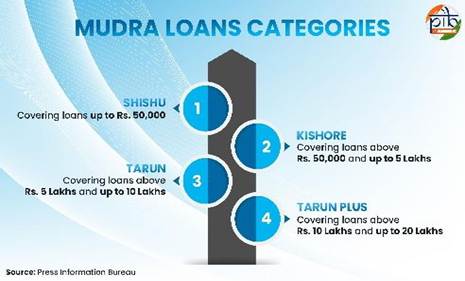
MUDRA (Micro Units Development & Refinance Agency Ltd), established under Pradhan Mantri Mudra Yojana (PMMY) and announced in the 2015-16 Union Budget, is a Government of India financial institution. It provides funding to non-corporate small/micro enterprises by refinancing last-mile institutions like banks, non-banking financial institutions (NBFC) and micro finance institutions (MFI).
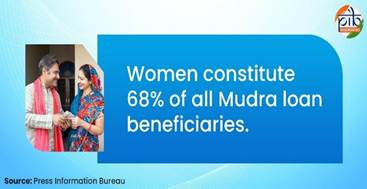
PMMY places a strong emphasis on women’s empowerment, with a majority of the loan accounts held by women entrepreneurs. This focus has enabled millions of women to start or grow their businesses, promoting financial inclusion and self-reliance.
Pradhan Mantri Jan Dhan Yojana
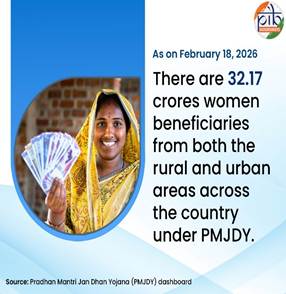
The Pradhan Mantri Jan-Dhan Yojana (PMJDY), launched on August 28, 2014, as a National Mission for Financial Inclusion by the Government of India, aims to financially support the unbanked population of the country. It provides universal access to affordable financial services, such as basic savings bank accounts, remittances, credit, insurance, and pensions.
PMJDY has been particularly beneficial for women. Previously, women had limited personal access to formal banking, often relying on family members for financial matters. But now, through PMJDY, millions of women have their own bank accounts, enabling direct receipt of government benefits, greater financial control, and easier access to other schemes for self-reliance and independence.
Some of the key features of PMJDY include:
Accounts can be opened at any bank branch or through Business Correspondents, making it accessible to all without requiring prior banking relationships.
Pradhan Mantri SVANidhi Scheme
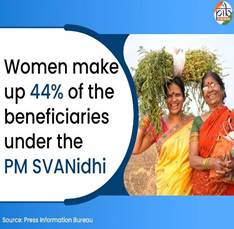
The Prime Minister Street Vendor’s AtmaNirbhar Nidhi (PM SVANidhi) scheme, launched in June 2020 by the Ministry of Housing and Urban Affairs, provides collateral-free working capital loans to street vendors, especially women, impacted by the COVID-19 pandemic.
Stand-Up India Scheme
The Stand-Up India Scheme has ignited a wave of entrepreneurship across India, empowering women and individuals from Scheduled Caste (SC) and Scheduled Tribe (ST) communities to turn their bold ideas into thriving businesses. Launched by the Government of India, this initiative makes it easy to access bank loans for launching enterprises in manufacturing, services, trading, or agri-allied activities. By providing dedicated financial support and opening doors to credit, Stand-Up India is not just funding startups—it’s fuelling dreams, creating jobs, building economic independence, and driving inclusive growth from the ground up. Some of its key features include:
Conclusion: A Path Forward for All
India’s women-led development story has moved from savings to enterprise, from fields to markets, and from beneficiaries to leaders. Schemes like Sukanya Samriddhi Yojana, NaMo Drone Didi, DAY-NRLM, Pradhan Mantri Jan Dhan Yojana, Pradhan Mantri Mudra Yojana, and the Womaniya Initiative have collectively transformed the economic landscape for women enabling them to access credit, technology, skills, and markets with dignity and ease.
Millions of women today are not just earners but owners of farms, enterprises, and their own futures. They are piloting drones, supplying to government ministries, leading community institutions, and building household prosperity from a position of strength.
Viksit Bharat rests on this very foundation- where every woman is the architect of her own prosperity, and where her success is neither an exception nor an aspiration but expectation.
Fostering financial independence for women is fostering India’s future.
References:
Press Information Bureau:
https://www.pib.gov.in/PressReleasePage.aspx?PRID=2149728https://www.pib.gov.in/PressReleasePage.aspx?PRID=2227542®=1&lang=1
https://www.pib.gov.in/PressReleasePage.aspx?PRID=2214504®=3&lang=2
https://www.pib.gov.in/PressReleaseIframePage.aspx?PRID=2070029®=3&lang=2
https://www.pib.gov.in/PressReleseDetailm.aspx?PRID=2100642®=3&lang=2
https://www.pib.gov.in/PressReleaseIframePage.aspx?PRID=2040878®=3&lang=2
https://www.pib.gov.in/Pressreleaseshare.aspx?PRID=1703147®=3&lang=2
https://www.pib.gov.in/PressReleaseIframePage.aspx?PRID=2215001®=3&lang=2
https://www.pib.gov.in/Pressreleaseshare.aspx?PRID=1891303®=3&lang=2
https://www.pib.gov.in/PressReleasePage.aspx?PRID=2186643®=3&lang=2
https://www.pib.gov.in/PressReleasePage.aspx?PRID=2201284®=3&lang=2
https://www.pib.gov.in/PressReleasePage.aspx?PRID=2160547®=3&lang=2
https://www.pib.gov.in/PressReleasePage.aspx?PRID=2119781®=3&lang=2
https://www.pib.gov.in/PressReleaseIframePage.aspx?PRID=2069170®=3&lang=2
https://www.pib.gov.in/PressReleasePage.aspx?PRID=2206995®=3&lang=1
Ministry of Rural Development:
https://lakhpatididi.gov.in/bn/how-do-i-become-a-lakhpati-didi/
https://lakhpatididi.gov.in/about-lakhpati-didi/
Ministry of Finance:
https://www.myscheme.gov.in/schemes/sui
https://www.standupmitra.in/Home/SUISchemes
https://www.pmjdy.gov.in/account
****