Government Strengthens Convergence-Driven Livelihood Frameworks for Tribal Communities; Ministry of Tribal Affairs Concludes Consultative Workshop with Key Line Ministries Under DAJGUA
Government Strengthens Convergence-Driven Livelihood Frameworks for Tribal Communities; Ministry of Tribal Affairs Concludes Consultative Workshop with Key Line Ministries Under DAJGUA
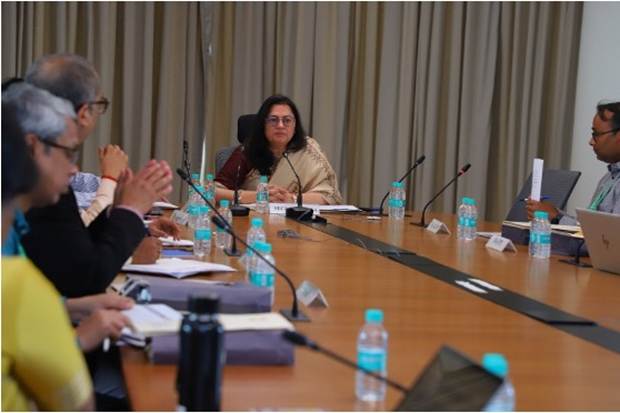
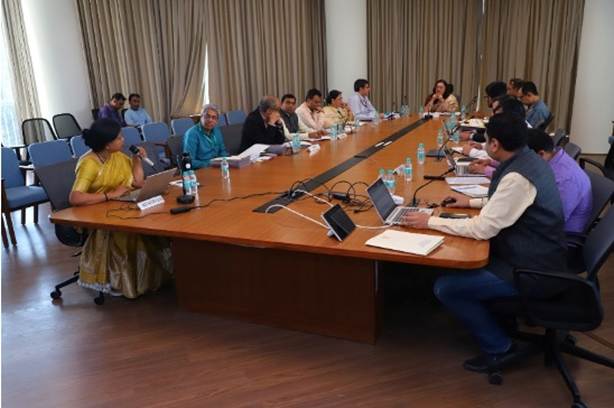
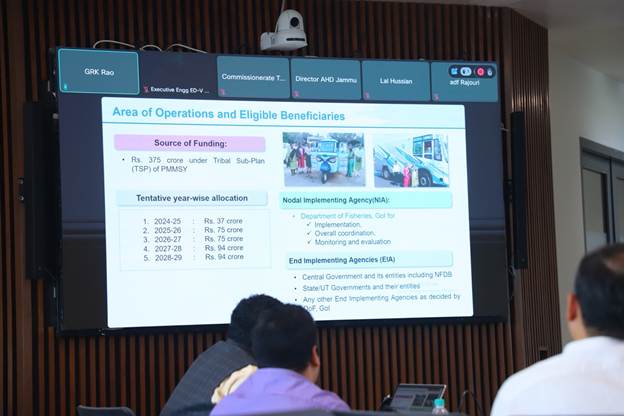
Guided by the vision of Hon’ble Prime Minister Shri Narendra Modi for holistic and saturation-based development of tribal communities, the Ministry of Tribal Affairs today organised a Consultative Workshop with senior government officials and experts from the Ministry of Agriculture & Farmers Welfare, Department of Animal Husbandry & Dairying, Ministry of Food Processing Industries, Ministry of New & Renewable Energy and the Department of Fisheries to strengthen the implementation architecture of livelihood interventions under the Dharti Aaba Janjatiya Gram Utkarsh Abhiyan (DAJGUA), the flagship mission of the Ministry of Tribal Affairs. The initiative is being taken forward under the guidance of Hon’ble Union Minister of Tribal Affairs, Shri, Jual Oram, reflecting the Government’s strong commitment to creating sustainable livelihood opportunities and accelerating inclusive development in tribal regions.
India’s tribal development landscape is undergoing an unprecedented transformation under the leadership of the Ministry of Tribal Affairs, which today anchors some of the most ambitious and outcome‑driven programmes for tribal communities.
DAJGUA marks a significant paradigm shift in tribal development, moving from fragmented delivery mechanisms to a saturation-based, community-led and empowerment-driven model of governance. Launched through a clarion call by the Hon’ble Prime Minister Shri Narendra Modi on 2nd October 2024 from Hazaribagh, Jharkhand, this pioneering initiative converges the efforts of 17-line ministries and 25 interventions across 63,843 tribal-majority villages, empowering approximately 5.5 crore tribal citizens.
The Consultative Workshop focused on resolving operational challenges and transitioning toward a structured, replicable and outcome-driven model of livelihood planning for tribal households. Discussions centered on developing standardized, financially viable Packages of Practices that clearly define eligibility norms, unit costs, implementation phasing, convergence pathways and projected income enhancement. The Ministries deliberated on integrated agriculture models, small livestock‑based livelihoods, fisheries development and renewable‑energy‑supported micro‑enterprises, emphasizing the shift from isolated asset distribution to holistic livelihood ecosystems backed by institutional support.
The Ministry underscored the importance of aligning scheme resources across sectors to enable States to undertake coherent and well‑phased planning and avoid duplication. Input from the workshop will support the development of a unified monitoring and assessment framework for DAJGUA.
In the course of the discussions, it was highlighted that intervention models must be not only financially sound but also tailored to the ecological and socio‑economic contexts of tribal regions. Officials noted that livelihood activities in these areas often face challenges such as low productivity, limited extension support and inadequate market integration. The workshop therefore emphasised integrated livelihood architectures across agriculture, animal husbandry, fisheries and value addition, aimed at enhancing income stability and ensuring long‑term sustainability for tribal households.
Speaking at the workshop, the Smt. Ranjana Chopra, Secretary, Tribal Affairs said, “Today’s deliberations mark an important step in institutionalising convergence across sectors for sustainable tribal livelihoods. By bringing multiple Ministries together, we are working to ensure that tribal households receive coherent, well‑structured and scalable support rather than fragmented interventions.”
She further added, “We believe that stronger convergence between Tribal Affairs and agriculture-allied Ministries must be institutionalised through joint advisories, so that States receive clear operational guidance on implementing livelihood interventions under DAJGUA. At the same time, States must proactively identify at least 20 innovative and locally contextualised proposals tailored to Scheduled Tribe communities, linking FRA lands, fisheries resources, livestock systems and traditional agro-ecologies to sustainable income generation.”
The Ministry noted that the convergence‑driven approach will further enable measurable improvements in income generation and livelihood security, especially in remote tribal areas where vulnerabilities remain persistent. The outcomes of the workshop will guide States in adopting uniform yet locally adaptable models under the DAJGUA framework.
A strong focus was also placed on enhancing coordination with key line departments, particularly the Agriculture and Fisheries Departments, to ensure sustained support for tribal livelihoods. Officials underscored the importance of developing an integrated approach to building sustainable livelihood clusters with long‑term resilience and steady, reliable income streams for tribal communities.
Following the discussions, the participating Ministries agreed to work closely with the Ministry of Tribal Affairs to refine intervention templates and strengthen cross‑sector coordination mechanisms. States will be provided with detailed guidance based on the workshop outcomes, enabling them to prepare annual action plans that integrate sectoral schemes more efficiently. The Ministry also noted that the structured approach adopted under DAJGUA will support stronger field‑level convergence, improved fund‑flow predictability and more robust monitoring of income‑related outcomes among tribal households.
The Ministry further emphasised that these convergence-driven livelihood frameworks are aligned with the Hon’ble Prime Minister Shri Narendra Modi’s vision of Viksit Bharat @ 2047, which places inclusive growth, economic self-reliance and social empowerment at the centre of India’s development journey.