Policy Reforms That Transformed Business Environment
Policy Reforms That Transformed Business Environment
Key Takeaways
· Business registrations in India grew by ~27% from 1.55 lakh in 2020–21 to 1.98 lakh in 2025–26 (as on 3 February 2026).
· The Union Budget 2026–27 further enhances India’s ease of doing business ecosystem with various measures proposed such as digital trade facilitation, tax certainty, reduced compliance and litigation, trust-based customs systems, and an investment-friendly tax regime.
· Institutional reforms such as Start-up India, Credit Guarantee Scheme, digital credit assessment models etc. are creating a transparent, tech-enabled, investor-friendly ecosystem.
· Parallel regulatory reforms such Jan Vishwas Act, IBC, MAT etc. are prioritizing capacity-building, regulatory coherence, and a governance model rooted in trust and accountability.
India: An Emerging Global Business Powerhouse
Over the past few years, India has emerged as one of the most attractive destinations not only for investments but also for doing business. Over a decade ago, the Government launched an ambitious program of regulatory reforms aimed at making it easier to do business in India.
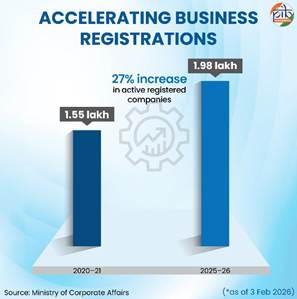
With the launch of Ease of Doing Business (EoDB) initiatives and a wave of business-friendly reforms, India has now ushered in a new era of efficiency and opportunity. The country- and its vibrant community of young entrepreneurs- now stand empowered and ready to seize the advantages of this reformed, growth-oriented ecosystem. The Indian business ecosystem has strengthened and the same is witnessed by an approximate 27% increase in the number of active registered companies in just five years. It grew from 1.55 lakh in 2020–21 to 1.98 lakh in 2025–26 (as on 3 February 2026).
The RBI’s Business Expectations Index, which has consistently stayed above the neutral benchmark of 100 through FY 2024-25 and into July to September (Q2) of the FY 2025-26, indicates positive sentiment regarding future output, employment, and investment. Together, these indicators reinforce the continued resilience of industry sentiment and reflect a business environment where firms remain confident about demand and growth prospects.
Government’s Strategic Focus on Ease of Doing Business
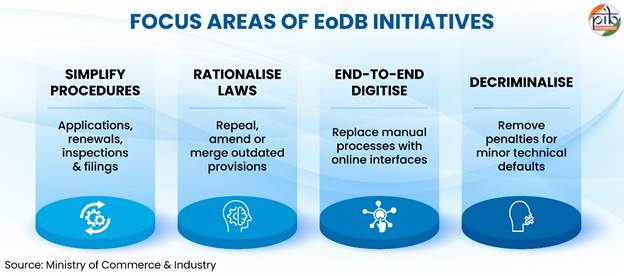
EoDB is fundamental to fostering entrepreneurship, innovation, and wealth creation. Recognising this, the Government has made “improving the business environment” a strategic priority to attract investment, stimulate enterprise, and accelerate economic growth. By reforming regulatory and legislative frameworks, streamlining procedures, and removing redundant compliances, the Government aims to create a more transparent, efficient, and predictable ecosystem for businesses.
Today, EoDB stands as a central pillar of India’s reform agenda. The Union Budget 2026–27 further advances this vision through measures promoting digital trade facilitation, tax certainty, reduced compliance and litigation, trust-based customs systems, and an investment-friendly tax regime. These sustained reforms strengthen investor confidence and reinforce India’s position as an increasingly competitive and business-ready economy.
Institutional Reforms Strengthening India’s Business Ecosystem
India’s reform-driven growth strategy is anchored in strengthening entrepreneurship, expanding access to finance, modernising regulatory frameworks, and enhancing trade facilitation. Through initiatives such as Startup India, credit guarantee schemes, digital credit assessment models, comprehensive insurance sector reforms, and integrated customs systems, the Government is creating a more transparent, technology-enabled, and investor-friendly ecosystem. Together, these measures not only improve EoDB but also deepen financial inclusion, boost innovation, accelerate MSME growth, and position India as a competitive global trade and investment hub.
Start-Up India
Under the Startup India initiative, eligible companies can obtain recognition as startups from the Department for Promotion of Industry and Internal Trade (DPIIT), enabling them to access a range of benefits including tax incentives, simplified compliance procedures, fast-tracked intellectual property rights (IPR) processing, and other regulatory support. The initiative seeks to build a robust and inclusive startup ecosystem that fosters innovation, drives sustainable economic growth, and generates large-scale employment opportunities across the country.
With over 2.16 lakh DPIIT-recognised startups as of February 2026, India stands firmly as one of the world’s largest startup ecosystems. Regulatory reforms for start-ups initiated since 2016 aim to enhance EoDB, ease of raising capital and reduce compliance burden for the startup ecosystem-
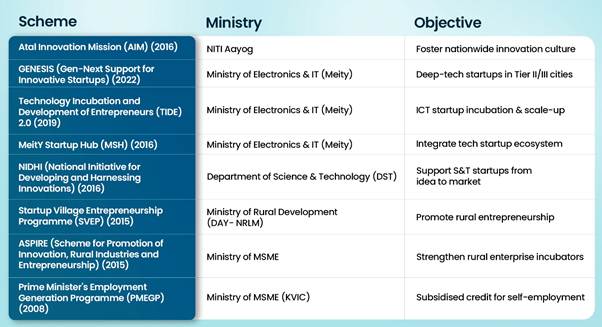
Beyond Startup India, several initiatives have further strengthened India’s startup ecosystem by promoting technological innovation, rural entrepreneurship, academic research, and regional inclusion. These initiatives ensure that startup support remains broad-based, decentralized, and closely aligned with national development priorities.
Credit Guarantee Scheme
Credit guarantee schemes enhance EoDB by providing collateral-free, or third-party guarantee-free, loans for MSMEs and startups. These schemes reduce risk for lenders, enabling easier access to finance for entrepreneurs, fostering innovation, and simplifying the overall business environment.
Targeted Schemes:
By facilitating, or speeding up, the loan approval process, these schemes also help reduce time and cost associated with accessing capital.
Credit Assessment Model (CAM)
The public sector banks (PSBs) have launched the credit assessment model (CAM) based on the digital footprints for MSMEs in 2025. This model aims at leveraging digitally fetched and verifiable data to enable automated loan appraisal for MSMEs, utilising objective decisioning for all loan applications and model-based limit assessment for both existing-to-bank and new-to-bank MSME borrowers.
Along with improving the EoDB for the MSMEs, this model also integrates the credit guarantee schemes, such as the Credit Guarantee Fund Trust for Micro and Small Enterprises (CGTMSE). During the period 1st April to 30th November 2025, over ₹3.2 lakh crore MSME loan applications, amounting to more than ₹41.5 thousand crore, have been sanctioned by PSBs under the credit programmes of CAM.
Sabka Bima, Sabki Raksha (Amendment of Insurance Laws) Act, 2025
The Sabka Bima, Sabki Raksha (Amendment of Insurance Laws) Act, 2025 introduces comprehensive reforms by amending the Insurance Act, 1938, the Life Insurance Corporation Act, 1956, and Insurance Regulatory and Development Authority Act, 1999. The objective is to strengthen policyholder protection, deepen insurance penetration, accelerate sectoral growth, and significantly improve EoDB.
A key reform is the increase in the FDI limit to 100%, which is expected to attract new players, expand capital availability, and bridge the protection gap for individuals and businesses. The Act promotes EoDB through:
Trade and Investment Facilitation
To strengthen India’s position as a competitive global trade and investment destination, the Government has provided measures aimed at streamlining cargo clearances, modernising customs processes, and enhancing investor access. These initiatives focus on digital integration, faster approvals, technology-driven risk management, and expanded investment avenues, creating a more efficient, transparent, and investor-friendly trade ecosystem.
Regulatory Reforms Enhancing Ease of Doing Business
Parallel regulatory reforms have prioritised capacity-building, regulatory coherence, and a governance model rooted in trust and accountability to enhance Ease of Doing Business. Recent measures span financial markets, taxation, labour regulation, insolvency resolution, customs administration, quality standards, and compliance rationalisation. By consolidating laws, decriminalising minor offences, digitising processes, and strengthening transparency, these reforms reduce regulatory friction while preserving accountability. These coordinated measures reinforce regulatory certainty, encourage competition, and foster a more efficient and resilient business environment.
RBI’s Master Directions
Reserve Bank of India (RBI) has simplified and streamlined its regulatory framework by consolidating over 9,000 circulars and guidelines into 238 function-specific Master Directions for different categories of regulated entities. In coordination with National Bank for Agriculture and Rural Development (NABARD), instructions issued to Regional Rural Banks and cooperative banks have also been consolidated and simplified to ensure greater transparency.
With an aim to enhances accessibility and reduces compliance burden, a total of 9,446 circulars are being repealed, 3,809 have been consolidated into Master Circulars, and 5,673 identified as obsolete. This exercise improves clarity and enhances EoDB.
SEBI’s move to simplify regulations and improve transparency
To enhance EoDB and deepen capital markets, Securities and Exchange Board of India (SEBI) has introduced measures to simplify regulatory requirements and strengthen transparency. It has aligned the guidelines for issuance and listing of securitised debt instruments (SDIs) with the Reserve Bank of India’s norms on securitisation of standard assets, thereby ensuring greater regulatory consistency, smoother compliance, and clearer processes for issuers.
Rationalizing Penalty and Prosecution
To reduce compliance stress, the Government has introduced a series of measures aimed at rationalising penalties, decriminalising minor defaults, and simplifying assessment and prosecution frameworks—making the tax system more transparent, predictable, and business-friendly.
Trust-based systems
Deferred duty payment is a mechanism for delinking duty payment and Customs clearance. It is based on the principle ‘Clear first-Pay later’. The aim is to have a seamless wharf to warehouse transit in order to facilitate just-in-time manufacturing.
An Authorised Economic Operator (AEO) is a business entity involved in international movement of goods requiring compliance with provisions of the national Customs law and is approved by or on behalf of national administration in compliance with World Customs Organization (WCO) or equivalent supply chain security standards.
The Government is focused on offering trust-based custom systems to enhance EoDB. In this regard, the Union Budget 2026-27 proposed to enhance the duty deferral period for Tier 2 and Tier 3 Authorised Economic Operators (AEO), from 15 days to 30 days, to have better wharf to warehouse transit and facilitate just-in-time manufacturing. The enhancement in the duty deferral period means extending the time allowed to pay customs or import duties after goods are imported, instead of paying them immediately.
Other proposals include-
Jan Vishwas Act
In order to further strengthen a trust-based regulatory framework, the Government has undertaken significant decriminalization reforms. The Jan Vishwas (Amendment of Provisions) Act, 2023 decriminalized 183 provisions across 42 Acts, thereby reducing criminal liability for minor and technical offences.
Continuing these efforts, the Jan Vishwas (Amendment of Provisions) Bill, 2025, which comprises of 355 provisions, proposes amendments to 288 provisions for decriminalisation to promote EoDB and 67 provisions aims at enhancing Ease of Living. It reflects the Government’s commitment to “Minimum Government, Maximum Governance” and is poised to boost sustainable economic growth and improved ease of doing business.
Insolvency and Bankruptcy Code (IBC), 2016
The Insolvency and Bankruptcy Code (IBC) has significantly transformed India’s insolvency framework by enabling timely resolution of financially distressed companies and improving recoveries for creditors. By establishing a clear, structured, and time-bound process for corporate revival or liquidation, it has enhanced transparency, strengthened creditor confidence, and fostered a more predictable business
The primary objective of the IBC is rescuing corporate debtors (CDs) in distress. Since inception till September 2025, a total of 3,865 CDs have been rescued, 1,300 through resolution plans, 1,342 through appeal, review or settlement, and 1,223 through withdrawal. As of 30 September 2025, creditors have realised ₹3.99 lakh crore under resolution plans. This is about 170% of the liquidation value and nearly 94% of the fair value (based on 1,177 cases). Overall, creditors have recovered more than 32% of their admitted claims.
By maximising the value of assets, promoting entrepreneurship, enhancing the availability of credit, and balancing the interests of all stakeholders, the Code has strengthened the overall credit ecosystem and improved business confidence in the country.
The Securities Markets Code, 2025 (SMC)
The SMC Code, 2025 replaces the Securities Contracts (Regulation) Act, 1956, the SEBI Act, 1992, and the Depositories Act, 1996, thereby consolidating the uneven laws governing India’s securities markets. It spans subjects such as board composition, independence, conflict management, transparency, regulatory sandboxing, investor protection, governance of market infrastructure institutions, and EoDB.
Quality Control Orders
Quality Control Orders (QCOs), issued by various Ministries and Departments, play a crucial role in strengthening India’s quality ecosystem. Their implementation supports India’s ambition to expand its share in global manufacturing by enforcing robust quality standards that enhance consumer safety, curb the circulation of sub-standard products, attract investment, and reduce the risk of accidents and loss of life. QCOs also enable early detection of product defects and malfunctions, benefiting both manufacturers and consumers through improved reliability and more rationalised costs.
To minimise compliance burdens and support EoDB-particularly for MSMEs-extensive consultations are held with industry bodies, sectoral associations, and other stakeholders during both the formulation and implementation stages.
India has significantly expanded its mandatory quality assurance framework in recent years. As of 31 December 2025, 143 QCOs covering 723 products have been notified—more than tripling the coverage from 214 products in 2019. This calibrated approach strengthens quality standards while balancing regulatory efficiency and business facilitation.
Regulatory Compliance Burden (RCB) Initiative
Launched in 2020, the RCB initiative seeks to ease regulatory pressures on businesses and citizens through a comprehensive self-review by Central Ministries, Departments, and States/UTs. Over the past five years, more than 47,000 compliances have been reduced.
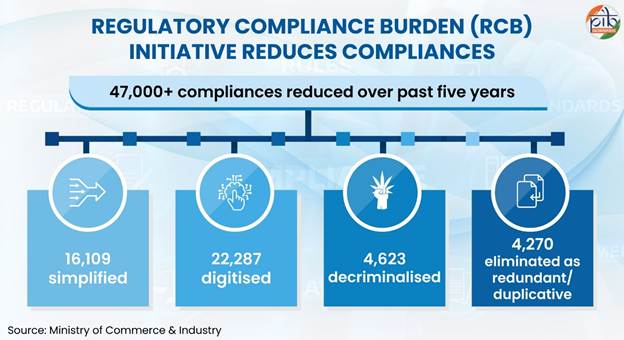
Additionally, under the expanded RCB+ initiative, 4,846 compliances have already been reduced out of 6,262 identified across 23 State-implemented Acts, further advancing regulatory simplification.
Minimum Alternate Tax (MAT)
Minimum Alternate Tax (MAT) enhances the EoDB in India by creating a fair, transparent tax structure that ensures profitable companies pay a minimum tax. Recently, Significant rationalization measures have been proposed under the MAT framework in the Union Budget 2026-27.
Non-residents opting for presumptive taxation are proposed to be exempted from the applicability of MAT, thereby reducing compliance burden and enhancing tax certainty. Buyback taxation is to be streamlined by taxing buybacks in the hands of all shareholders as capital gains. Further, in the new tax regime, set-off of available MAT credit is proposed to be permitted up to one-fourth of the tax liability. Additionally, MAT is proposed to be treated as a final tax, with the rate reduced from 15% to 14%, aiming to simplify the structure while maintaining revenue stability.
Labour Reforms
The consolidation of 29 Central labour laws into four Labour Codes has significantly enhanced EoDB by simplifying compliance, reducing approval timelines, and providing greater operational flexibility, particularly for MSMEs.
GST 2.0
GST reforms introduced in September 2025 strengthen EoDB by simplifying tax slabs, reducing rates across key sectors, thus lowering tax incidence and improving price competitiveness. The move towards a simplified two-rate structure lowers compliance and transaction costs, while rate rationalisation improves affordability and supports entrepreneurship.
The impact is reflected in the expansion of the tax base, with registered taxpayers increasing from about 60 lakhs in 2017 to over 1.6 crore in January 2026, indicating deeper formalisation. Further, correction of inverted duty structures in labour-intensive and agri-input sectors such as textiles and fertilisers has reduced costs and working capital pressures, easing business operations.
Conclusion
India’s emergence as a global business powerhouse is anchored in sustained, structural reforms across taxation, regulation, finance, labour, trade, and investment. From compliance rationalisation and trust-based governance to digital trade systems and startup support, the reform momentum reflects a transparent, predictable, and growth-oriented ecosystem.
Rising enterprise registrations, strong business sentiment, expanding formalization, and improved credit access underscore the confidence of industry and investors alike. As India deepens its integration with global value chains and strengthens its policy framework, it is not merely enhancing EoDB- it is shaping a resilient, competitive, and future-ready economic landscape.
References
Ministry of Finance
https://www.indiabudget.gov.in/economicsurvey/doc/echapter.pdf
https://www.indiabudget.gov.in/doc/budget_speech.pdf
https://www.pib.gov.in/PressReleasePage.aspx?PRID=2210599®=3&lang=1
https://incometaxindia.gov.in/Pages/faqs.aspx?k=FAQs+on+Computation+of+tax&c=4
Ministry of Corporate Affairs
https://sansad.in/getFile/annex/270/AU381_Ff7hlQ.pdf?source=pqars
https://www.pib.gov.in/PressReleasePage.aspx?PRID=2157539®=3&lang=2
Ministry of Commerce & Industry
https://www.dpiit.gov.in/ministry/about-us/details/Title=Ease-of-Doing-Business-(EODB)-ITMwETMtQWa
https://www.investindia.gov.in/blogs/business-friendly-reforms-indias-path-prosperity
https://www.pib.gov.in/PressReleasePage.aspx?PRID=2201280®=3&lang=2
https://www.pib.gov.in/PressReleasePage.aspx?PRID=2157460®=3&lang=2
https://sansad.in/getFile/annex/268/AU1488_UIHVq7.pdf?source=pqars
https://www.startupindia.gov.in/content/sih/en/startupgov/regulatory_updates.html
https://www.startupindia.gov.in/content/sih/en/credit-guarantee-scheme-for-startups.html
https://www.startupindia.gov.in/content/sih/en/credit-guarantee-scheme-for-startups.html
https://www.startupindia.gov.in/
Ministry of Micro, Small & Medium Enterprises
https://dcmsme.gov.in/CLCS_TUS_Scheme/Credit_Guarantee_Scheme/Scheme_Guidelines.aspx
Reserve Bank of India
Embassy of India, The Hague, The Netherlands
Indian Customs
https://www.jawaharcustoms.gov.in/pdf/Authorised%20Economic%20Operator%20(AEO)_FAQ_English.pdf
Investor.gov
https://www.linkedin.com/company/startup-india/?originalSubdomain=in
Goods and Services Tax Network
Insolvency and Bankruptcy Board of India
https://ibbi.gov.in/uploads/publication/e42fddce80e99d28b683a7e21c81110e.pdf
PIB Archives
https://www.pib.gov.in/PressNoteDetails.aspx?id=157227&NoteId=157227&ModuleId=3®=3&lang=2
https://www.pib.gov.in/PressReleasePage.aspx?PRID=2214872®=3&lang=2