Advancing Self-Reliance and Export Resilience: India’s Growing Global Footprint
Advancing Self-Reliance and Export Resilience: India’s Growing Global Footprint
Key Takeaways
Introduction
In the post-pandemic period, India has emerged as a fast-growing major economy, leveraging domestic strengths to navigate global uncertainties. The Economic Survey 2025-26 notes that India’s growth rates are “the envy of the world,” backed by healthy banking system, credit intermediation, ample foreign reserves and a comfortable current account balance.
The global trade landscape has been undergoing adjustments as reflected in UNCTAD Trade Policy Uncertainty (TPU) Index and the Global Economic Policy Uncertainty (GEPU) Index in April 2025. At the same time, these developments have accelerated India’s efforts to strengthen resilient supply chains, expand diversified trade and investment partnerships worldwide.
Against this backdrop, India has been able to pursue targeted import substitution in critical sectors, pairing it with an export-oriented approach to stay competitive over the long run.
Manufacturing Renaissance: Building Domestic Capabilities
India’s quest for import substitution is powered by themes of swadeshi and aatmanirbharta and has translated into targeted policies across industries. The government has focused on sector-specific incentives, investments, and reforms in scaling domestic manufacturing capabilities. Over the past decade, bold reforms and visionary policies like Make in India initiative and Production-Linked Initiatives have transformed the country into a global manufacturing hub.
Highlights of Union Budget 2026-27
The Union Budget 2026-27 places a sharp focus on scaling domestic manufacturing in strategic and labour-intensive sectors, thereby strengthening export competitiveness and reducing critical import dependence. The Government announced a wide range of measures spanning the services sector, manufacturing, Special Economic Zones (SEZs), infrastructure, ease of doing business, and sector-specific reforms.
Flagship initiatives include Biopharma SHAKTI, the launch of India Semiconductor Mission 2.0, expansion of the Electronics Components Manufacturing Scheme, development of Rare Earth Corridors, establishment of Chemical Parks, and targeted support for capital goods and container manufacturing.
It proposes facilitation measures to enable customs duty reductions on aviation parts, lithium‑ion cell manufacturing, and parts for defence and civil aviation that will help to lower manufacturing costs for engineering sub‑segments such as aerospace components, electronics engineering, and energy storage hardware.
Electronics Success Story
A direct outcome of the import substitution efforts is clearly visible in the striking performance of India’s electronics manufacturing. With a target of building a $500 billion domestic electronics ecosystem by 2030-31, India is now firmly on track to become a global leader in electronic design, manufacturing, and exports.
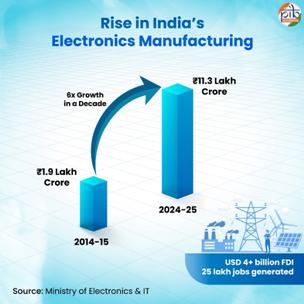
Today, India is one of the world’s fastest-growing electronics manufacturers, particularly in mobile phones. India has now achieved near self-reliance in mobile production, moving from importing most of its requirements a decade ago to manufacturing almost all devices domestically.
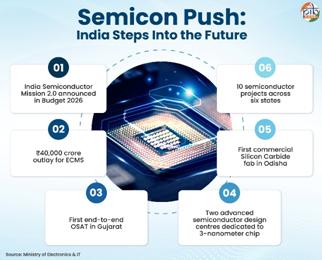
A similar thrust is visible in other high-value sectors. Semiconductors and electronics components are critical areas where import substitution is strategically important, as seen during global chip shortages. Acknowledging this, Budget 2026-27 announced the launch of India Semiconductor Mission 2.0 to produce equipment and materials, design full stack Indian IP, and fortify supply chains, alongside expanding the Electronics Components Manufacturing Scheme with an increased outlay of ₹40,000 crore.
In August 2025, India inaugurated one of its first end-to-end OSAT (Outsourced Semiconductor Assembly and Test) facilities in Sanand, Gujarat, strengthening the Atmanirbhar Bharat push in semiconductors. Earlier, in May 2025, two state-of-the-art semiconductor design facilities were inaugurated to focus on advanced 3-nanometer chip design, marking a significant milestone in the nation’s semiconductor innovation journey.
India has also approved 10 semiconductor projects across six states, including its first commercial Silicon Carbide fab in Odisha on the anvil and an advanced packaging unit, with total investments of about ₹1.6 lakh crore, further strengthening the country’s position in the global semiconductor value chain.
Key initiatives to strengthen electronics manufacturing
Recognising that electronics manufacturing requires large capital investments, economies of scale, long gestation periods, access to advanced technologies, and a highly skilled workforce, the Government has undertaken a series of strategic interventions to strengthen domestic capabilities and enable domestic firms to integrate more effectively into Global Value Chains (GVCs). To support this objective, several targeted schemes have been launched to strengthen domestic manufacturing and attract investments.
Electronics Component Manufacturing Scheme (ECMS): Notified in 2025 with an outlay of ₹22,919 crore, the scheme aims to strengthen component manufacturing and integrate India’s electronics industry with global value chains through turnover-linked, capex, and hybrid incentives. With investment commitments already nearly double the initial target, the Union Budget 2026-27 increased the outlay to ₹40,000 crore to capitalise on this momentum.
India Semiconductor Mission: Approved in 2021 with an outlay of ₹76,000 crore, the India Semiconductor Mission (ISM) 1.0 provides up to 50% fiscal support for semiconductor fabrication, assembly, testing, and chip design. Building on this, the Union Budget FY 2026-27 provides ₹1,000 crore for ISM 2.0, focusing on industry-led research, technology development, and skilled workforce creation.
Other key initiatives include the Production Linked Incentive (PLI) Scheme for Large Scale Electronics Manufacturing, PLI Scheme 2.0 for IT Hardware, Electronics Manufacturing Clusters (EMC and EMC 2.0) Scheme, Scheme for Promotion of Manufacturing of Electronic Components and Semiconductors (SPECS), and the Modified Programme for Development of Semiconductors and Display Manufacturing Ecosystem.
Automotive Industry on a Growth Drive
The automotive industry, including both vehicles and auto components, continues to be a key pillar of the economy owing to its significant contribution to economic growth, employment generation, and strong linkages with multiple sectors.
India has emerged as the world’s largest market for two-wheelers and three-wheelers, and the third-largest globally for passenger and commercial vehicles. Supported by a vast manufacturing and auto component ecosystem, the sector provides direct and indirect employment to over 30 million people.
Performance trends also reflect sustained growth: total production increased from 22,652 thousand units in FY21 to 31,028 thousand units in FY25, while domestic sales rose from 18,620 thousand units to 25,607 thousand units during the same period, reflecting strong growth and rising domestic demand. Overall, the industry has recorded nearly 33% growth in production over the last decade (FY15-FY25), accompanied by greater innovation and technology adoption, along with increased localisation and value addition.
Key initiatives to strengthen automobile industry
Over the past decade, policy reforms, targeted fiscal incentives, and infrastructure development have strengthened India’s position as a global automotive hub.
PLI Scheme for Automobile & Auto Components Industry: Approved in September 2021 with an outlay of ₹25,938 crore, the PLI-Auto Scheme promotes high-value Advanced Automotive Technology (AAT) vehicles and products and has attracted cumulative investments of ₹35,657 crore as of September 2025.
PM E-DRIVE Scheme: Launched in September 2024 with an outlay of ₹10,900 crore, the scheme offers demand incentives for e-2W and e-3W while extending support to new categories such as e-trucks and e-ambulances, along with funding for charging infrastructure and upgrades to testing facilities.
Other key policy initiatives supporting this transformation include the PLI Scheme for Advanced Chemistry Cell (ACC) Battery Storage, the PM e-Bus Sewa-Payment Security Mechanism (PSM) Scheme, and the Scheme to Promote Manufacturing of Electric Passenger Cars in India (SMEC).
Leveraging “Pharmacy of the World”
India’s pharmaceutical industry is widely recognised for large-scale manufacturing of affordable medicines. Often referred to as the “Pharmacy of the World ,” India plays a crucial role in ensuring access to cost-effective generic drugs while building strong domestic manufacturing capabilities. Today, India ranks as the world’s third-largest pharmaceutical producer by volume and the eleventh largest by value, with the sector recording an annual turnover of ₹4.72 lakh crore in FY25.
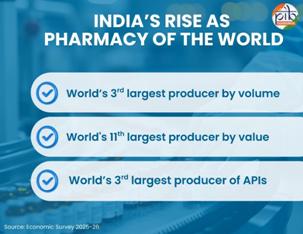
In this context, given their critical vulnerability and high strategic importance , strengthening domestic manufacturing of Active Pharmaceutical Ingredients (APIs) has become a priority. India is already the world’s third-largest producer of APIs, and domestic production has increasingly begun substituting imports.
Key initiatives to strengthen pharmaceuticals industry
This momentum is now being reinforced through initiatives aimed at strengthening supply chain resilience and domestic production.
PLI for Bulk Drugs: To mitigate reliance on imported Active Pharmaceutical Ingredients (APIs), Key Starting Materials (KSMs), and Drug Intermediates, the PLI scheme for Bulk Drugs has mobilised investments of ₹4,763 crore as of September 2025 and created an annual manufacturing capacity of 55,000 MT for 26 critical products, with focus on fermentation-based synthesis for KSMs like Penicillin G Potassium.
PLI for Medical Devices: The Government launched the PLI Scheme for Promoting Domestic Manufacturing of Medical Devices in 2020, to promote indigenous manufacturing of medical devices. As of September 2025, the scheme has attracted ₹1,093.69 crore in actual investment, and manufacturing of 57 high-end medical devices has started in the country.
Global Integration of AYUSH: Efforts are underway to integrate India’s AYUSH systems into the global health intervention framework. The WHO Global Traditional Medicine Centre established in Jamnagar serves as an international hub for research, innovation, and policy dialogue on traditional medicine. In May 2025, an MoU was also signed with WHO to develop the International Classification of Health Interventions module, aimed at improving global acceptance and facilitating gradual integration of traditional medicine into public health systems.
Other key initiatives include the Strengthening of Pharmaceutical Industry (SPI) Scheme, the Scheme for Promotion of Bulk Drug Parks, the Scheme for Promotion of Medical Devices Parks, and the Strengthening of Medical Device Industry (SMDI) Scheme. As these schemes progress and production units become operational, India is expected to achieve greater self-reliance and improved resilience in the supply of bulk drugs.
Defence and Strategic Manufacturing: Atmanirbharta in Action
India’s defence sector has witnessed a major shift towards self-reliance, ensuring that every procurement strengthens national industry, reduces import dependency, and enhances operational preparedness. At least 65% of India’s defence equipment is now manufactured domestically, marking a significant shift from the earlier import dependence of nearly 65-70%.
Indigenous defence production rose from ₹46,429 crore in FY 2014-15 to ₹1,27,434 crore in FY 2023-24, and further reached a record ₹1.54 lakh crore in FY 2024-25.
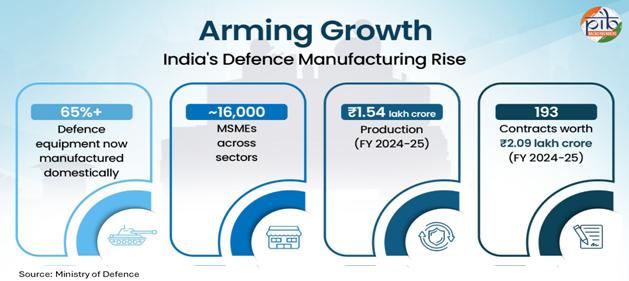
Reforms under Defence Acquisition Procedure (DAP) 2020 and Defence Procurement Manual (DPM) 2025 have ensured speed, transparency, innovation, and self-reliance across both capital and revenue procurements. The government now targets defence manufacturing worth ₹3 lakh crore and defence exports of ₹50,000 crore by 2029, positioning India as a growing global defence manufacturing hub. To realise this vision, the Government has undertaken several measures, including :
Together, these developments signal India’s steady transition from a major defence importer to an emerging global hub for defence manufacturing and innovation.
Export Resilience and Diversification
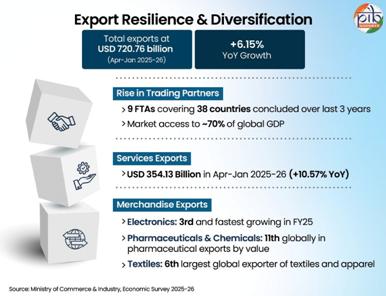
While strengthening domestic production, India has simultaneously worked to ensure that its exports remain robust and diversified. Recent data highlights this resilience: cumulative exports (merchandise & services) during April-January 2025-26 is estimated at USD 720.76 billion, up from USD 679.02 billion in April-January 2024-25, implying an estimated 6.15% growth. In a period marked by global uncertainties, this growth reflects India’s resilience, with high-value commodities, widening global partnerships, and policy reforms supporting a more balanced and globally integrated trade trajectory.
A key aspect of resilience is export diversification. It helps navigate uncertain global trade environments, demand volatility, and supply chain disruptions. By expanding across products and markets, countries reduce overdependence on limited partners and build resilience against external shocks. Under UNCTAD’s trade diversity indices for the Global South, India ranks among the top five economies for the diversity of its traded products and among the top three for the diversity of its trade partnerships , reflecting a broad export basket and an increasingly wide range of trading relationships.
Merchandise Exports
On the product side, India’s export basket is widening. In January 2026 (YoY), positive growth was recorded across multiple key categories:
Highest growth
Other Cereals*(+88.49%), Coffee (+36.03%), Iron Ore (+31.54%), Meat, Dairy & Poultry (+17.92%), Marine Products (+13.29%), Engineering Goods (+10.37%)
Strong growth
Petroleum Products (+8.55%), Mica, Coal, Other Ores & Minerals Including Processed Minerals (+6.35%)
Steady growth
Man-Made Yarn/Fabrics/Made-Ups Etc. (+1.01%), Drugs & Pharmaceuticals (+0.96%), Electronic Goods (+0.32%), Cereal Preparations & Miscellaneous Processed Items (+1.12%), Fruits & Vegetables (+1.77%)
*Other cereals include rye, barley, oats, fonio, quinoa, etc, and excludes wheat, rice, maize, and millet
Such broad-based growth signifies that multiple industries are pulling their weight. Some sectors have also shown remarkable growth over the years:
Rise in Trading Partners
India’s continued efforts to negotiate trade agreements have helped diversify trade partnerships and bolster the economy amid external challenges. Over the last three years, India concluded nine FTAs covering 38 countries, expanding market access to an estimated ~70% of global GDP, at mostly zero duty.
These agreements are widening opportunities for Indian goods and services, with more deals currently under negotiation. The objective is to spread trade ties across regions and reduce overdependence on any single market.
Strengthening India’s Export Ecosystem through Institutional Support
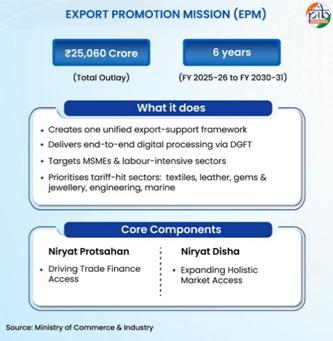
Export Promotion Mission
To further strengthen export competitiveness, especially for MSMEs, first-time exporters and labour-intensive sectors, the Government approved the Export Promotion Mission (EPM). With a total outlay of ₹25,060 crore for FY 2025-26 to FY 2030-31, EPM aims to strengthen India’s export ecosystem, improve access to affordable trade finance and enhance global market readiness and competitiveness across sectors and regions. It operates via two integrated sub-schemes- Niryat Protsahan and Niryat Disha.
New interventions under the EPM
Services Exports
Services exports, India’s core strength, have remained a steady growth engine even amid global uncertainty. In FY25, services exports reached an all-time high of USD 387.5 billion, registering 13.6% (YoY) growth, and reinforcing India’s position as a global hub for technology, business, and professional services. During this period, the services trade surplus also widened to an all-time high of USD 188.8 billion. This strength has carried into FY26. During April-January 2025-26, services exports are estimated at USD 354.13 billion , up from USD 320.28 billion a year earlier (+10.57%) . Market diversification is also improving: while the US remains the largest export destination for India, Europe’s share rose from 30.8% to 32.8% between FY24 and FY25.
Drivers of India’s Services Exports
India’s services export growth is being powered by the rapid expansion of Global Capability Centres (GCCs), which grew at around a 7% CAGR from FY20 to FY25, alongside sustained global demand for software, BPM, consulting, and fintech services.
Another key enabler is India’s deep and diverse talent base. Stanford’s AI Index Report 2025 places India second globally in AI skill penetration. This advantage is reinforced by strong physical and digital infrastructure, combined with labour arbitrage, SEZ-based GCCs benefiting from tax holidays, and a vibrant startup ecosystem, bolstering India’s cost competitiveness and efficiency.
Conclusion
India’s experience demonstrates that import substitution and export strength can move together when approached strategically. Across sectors, from mobile phones and medicines to automobiles and defence, the push is to build in India not only for domestic needs, but for global markets. As local capacity expands and imports reliance falls, many industries also gain the scale to export more, strengthening the external sector.
Looking ahead to Viksit Bharat 2047, India’s self-reliance will go hand in hand with deeper global integration. This will help expand Made in India products, create jobs, boost growth, and strengthen India’s position as a global manufacturing and export hub.
References
Ministry of Finance
https://www.indiabudget.gov.in/economicsurvey/doc/echapter.pdf
https://www.indiabudget.gov.in/doc/Budget_Speech.pdf
Ministry of Commerce & Industry
https://static.pib.gov.in/WriteReadData/specificdocs/documents/2025/aug/doc2025818614701.pdf
https://www.pib.gov.in/PressReleasePage.aspx?PRID=2221840®=3&lang=2
https://www.pib.gov.in/PressReleasePage.aspx?PRID=2206194®=3&lang=2
https://www.commerce.gov.in/wp-content/uploads/2026/01/PIB-Release-15.1.2026.pdf
https://www.pib.gov.in/PressReleasePage.aspx?PRID=2226987®=3&lang=1
https://www.pib.gov.in/PressReleasePage.aspx?PRID=2175702®=3&lang=2
Ministry of Electronics and Information Technology
https://static.pib.gov.in/WriteReadData/specificdocs/documents/2026/feb/doc202623777901.pdf
https://www.pib.gov.in/PressNoteDetails.aspx?NoteId=155130&ModuleId=3®=3&lang=2
https://d2p5j06zete1i7.cloudfront.net/Cms/admin/PressRelease/1770478760.pdf
Ministry of Defence
https://www.pib.gov.in/PressReleasePage.aspx?PRID=2191937®=3&lang=2
Ministry of Chemicals and Fertilizers
https://www.pib.gov.in/PressReleaseIframePage.aspx?PRID=2085344®=3&lang=2
NITI Aayog
https://www.niti.gov.in/sites/default/files/2026-01/Trade_Watch_Quarterly_April_June_Q1_FY26.pdf
Parliamentary Responses
https://sansad.in/getFile/loksabhaquestions/annex/185/AU939_dYGgDX.pdf?source=pqals
https://sansad.in/getFile/annex/268/AU2897_xM8Uo8.pdf?source=pqars
Other Sources
https://unctad.org/system/files/official-document/tdr2025_en.pdf
- Support for Alternative Trade Instruments (Export Factoring): This measure promotes export factoring as a cost-effective working capital solution for MSMEs. It provides 2.75% interest subvention on factoring costs through RBI/IFSCA-recognised entities, capped at ₹50 lakh per MSME annually, with digital claim processing for timely disbursal.
- Credit Assistance for E-Commerce Exporters: The intervention introduces structured credit with interest subvention and partial guarantees. The Direct E-Commerce Credit Facility offers up to ₹50 lakh with 90% guarantee coverage, while the Overseas Inventory Credit Facility provides up to ₹5 crore with 75% guarantee coverage. A 2.75% interest subvention is available, capped at ₹15 lakh annually per applicant.
- Support for Emerging Export Opportunities: This facilitates entry into new, high-risk markets via shared-risk and credit instruments, improving exporter confidence and liquidity.
- Trade Regulations, Accreditation & Compliance Enablement (TRACE): The measure aims to support exporters in meeting international testing, inspection, certification requirements. It reimburses 60% of eligible costs under the Positive List and 75% under the Priority Positive List, capped at ₹25 lakh per IEC annually.
- Facilitating Logistics, Overseas Warehousing & Fulfilment (FLOW): Enables access to overseas warehousing and fulfilment infrastructure, including e-commerce export hubs. Provides up to 30% of approved project cost for a maximum of three years, subject to prescribed ceilings and MSME norms.
- Logistics Interventions for Freight & Transport (LIFT): Offsets freight disadvantages in low export-intensity districts by reimbursing up to 30% of eligible freight costs, capped at ₹20 lakh per IEC per financial year.
- Integrated Support for Trade Intelligence & Facilitation (INSIGHT): This measure strengthens exporter capacity-building, district-level facilitation under Districts as Export Hubs, and trade intelligence systems. It offers up to 50% of project cost, and up to 100% for Central/State Government institutions and Indian Missions abroad, subject to notified ceilings.