CSIR-NIScPR organised a workshop on Strengthening India’s Semiconductor Ecosystem
CSIR-NIScPR organised a workshop on Strengthening India’s Semiconductor Ecosystem
CSIR–National Institute of Science Communication and Policy Research (CSIR-NIScPR) organized a day-long workshop on “Strengthening India’s Semiconductor Ecosystem: Policies, Challenges, and Opportunities” at Vivekananda Hall, Pusa Campus, New Delhi, on 27 February 2026. The workshop brought together experts from R&D institutions, government, academia, and industry to deliberate on policies, challenges, and strategic opportunities for straightening India’s semiconductor ecosystem. The workshop was organized to strengthen the recent study undertaken by CSIR-NIScPR on ‘Comparative Analysis of Global Semiconductor Policies and Strategies vis-à-vis India’s Semiconductor Ecosystem’. This workshop was organized to achieve the objectives of assessing India’s current landscape of semiconductor ecosystem, identifying challenges, exploring opportunities for collaboration, identify global best practices and policy insights, facilitate dialogue on policy interventions, and develop actionable recommendations for supporting strengthening India’s semiconductor capabilities.
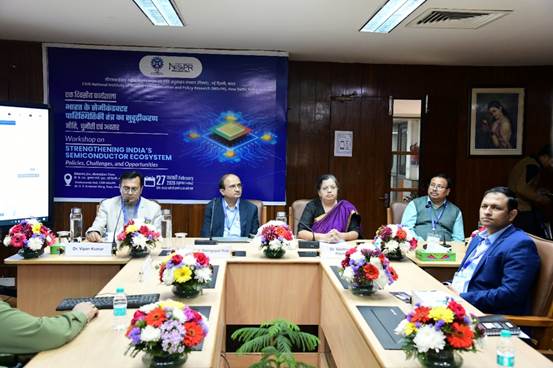
In the workshop, India Semiconductor Mission MeitY, BITS Pilani; NITI Aayog; CSIR-CEERI Pilani; Solid State Physics Laboratory (SSPL) DRDO, NIELIT New Delhi; CSIR-CSIO, Chandigarh; CSIR-NPL, New Delhi; IIT Jodhpur; IIT Delhi; Research and Information System for Developing Countries (RIS); Delhi Technical University; CSIR-NAL, Bengaluru; Amrita University; Intel India; Lam Research, Applied Materials, Semiverse Solutions Pvt. Ltd; Sahasra Semiconductor Private Limited, New Delhi; and VerSemi Microelectronics (P) Ltd, Noida were participated and shares their opinion for strengthening India’s semiconductor ecosystem. The proceedings were also streamed live on YouTube to enable wider participation by stakeholders across the country.
In the inaugural session, Dr. Geetha Vani Rayasam, Director, CSIR-NIScPR, highlighted the institute’s role in science communication and policy research and emphasized the importance of dialogue to strengthen India’s semiconductor ecosystem. Dr. Vipan Kumar, Chief Scientist, CSIR-NIScPR, highlighted India’s semiconductor paradox, strong global design leadership yet 95% import dependence and emphasized evidence-based policy reforms, ISM 2.0 innovation push, and strategic self-reliance to position India as a credible global semiconductor hub by 2030.
Prof. V. Ramgopal Rao, Group Vice Chancellor, BITS Pilani and Ex-Officio Member, ES Manufacturing Committee, delivered the Chief Guest address, highlighting the strategic importance of semiconductors for national competitiveness and technological self-reliance. He argued for a strategy centered on indigenous technology, mission-mode programs, and deep-tech startups rather than merely hosting advanced foundries. Prof. Rao recommended expanding centers of excellence, R&D hubs, and prototyping facilities to help innovations progress from low to high TRLs and overcome the “valley of death.”
The technical discussion was structured into three thematic sessions. First session was focused on “R&D and Innovation, Design, and Manufacturing Ecosystem”. The speakers of the session urged ISM 2.0 to bridge academia–industry gaps via pilot fabs, niche defense semiconductors, indigenous materials/equipment, design-led R&D, photonics/AI focus, sustainable electronics, diversified manufacturing, stronger IP, skills, infrastructure, global partnerships, resilience strategies. Session II on “Ecosystem for Skill Workforce & Talent Development” was chaired by Dr. Manish K Hooda, Director (Technology), India Semiconductor Mission. Speakers of this session emphasized balanced design-manufacturing growth, CMOS-focused academic programs, structured skilling initiatives, industry collaboration, and workforce development to scale India’s semiconductor ecosystem.
“Policy, Governance, and Institutional Framework” was the key topic of Session III and this session examined the policy and institutional architecture needed to support a resilient semiconductor ecosystem. The session was chaired by Prof. Sujit Bhattacharya, Adjunct Professor, Amrita University and Former Chief Scientist, CSIR-NIScPR. Speakers compared global policy models, urged unified governance and a national research centre, highlighted AI-chip startup opportunities, and emphasized semiconductor diplomacy, rare-earth access, supply-chain resilience and strategic autonomy. Session III: Policy, Governance, and Institutional Framework examined the policy and institutional architecture needed to support a resilient semiconductor ecosystem. The session was chaired by Prof. Sujit Bhattacharya Adjunct Professor, Amrita University and Former Chief Scientist, CSIR-NIScPR.
The workshop concluded with a Panel Discussion and Concluding Session on “Strategic Pathways: A Roadmap for India’s Semiconductor Future.” The session was chaired by Prof. Navakanta Bhat, Dean, Division of Interdisciplinary Sciences and Professor, Centre for Nanoscience and Engineering, Indian Institute of Science (IISc), Bengaluru. The experts highlighted the Indian government’s sustained momentum through the India Semiconductor Mission (ISM 1.0 and 2.0), stressing that the next phase requires focused execution, innovation, and scaling. Industry perspectives emphasized advanced manufacturing capabilities and structured workforce development through academia–industry collaboration, including partnerships with Indian Institute of Science.
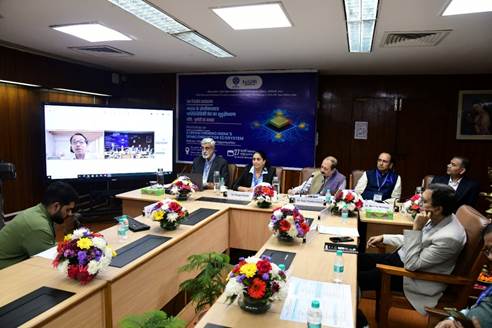
Speakers underscored India’s strengths in indigenous analog, sensor, and application-specific products, alongside the urgent need for highly specialized scientific talent in niche semiconductor domains. Emerging areas such as chip-to-chip-less architectures and quantum-integrated semiconductor systems were identified as leapfrogging opportunities. The concluding remarks of the workshop were given by Dr. Vipan Kumar, Chief Scientist, CSIR-NIScPR, and Dr. Charu Verma, Chief Scientist, CSIR-NIScPR. The deliberations across sessions collectively underscored the need for coordinated efforts in R&D, design, manufacturing, skills, and policy support to strengthen India’s position in the global semiconductor value chain. The discussions also reinforced CSIR-NIScPR’s role in providing evidence-based policy inputs and facilitating multi-stakeholder dialogue on strategic S&T domains.